
Conformal Coating Application Methods Hub
Spray, dip, selective coating and controlled application routes for reliable PCB protection
This hub focuses on how conformal coatings are physically applied to PCB assemblies.
The method used to apply a conformal coating has a major effect on coverage, repeatability, masking burden, production cost and long-term reliability. Spray coating, dip coating, selective coating, brushing and automated application methods all create different process risks and different control requirements.
This hub focuses on application method selection rather than equipment selection. It helps engineers compare how coatings are applied, where each route works best, and which process risks must be controlled before moving into production.
Once the preferred application method is understood, equipment selection can then be considered separately through spray booths, dip systems, selective coating platforms, valves, drying systems and inspection tools.
Where are you in the application method decision?
- Comparing spray, dip, selective and brush coating → Application Method Comparison
- Choosing a process for a complex PCB → Complex PCB Application Risks
- Reviewing selective coating accuracy → Selective Conformal Coating Accuracy
- Separating process method from equipment choice → Application Methods vs Equipment Selection
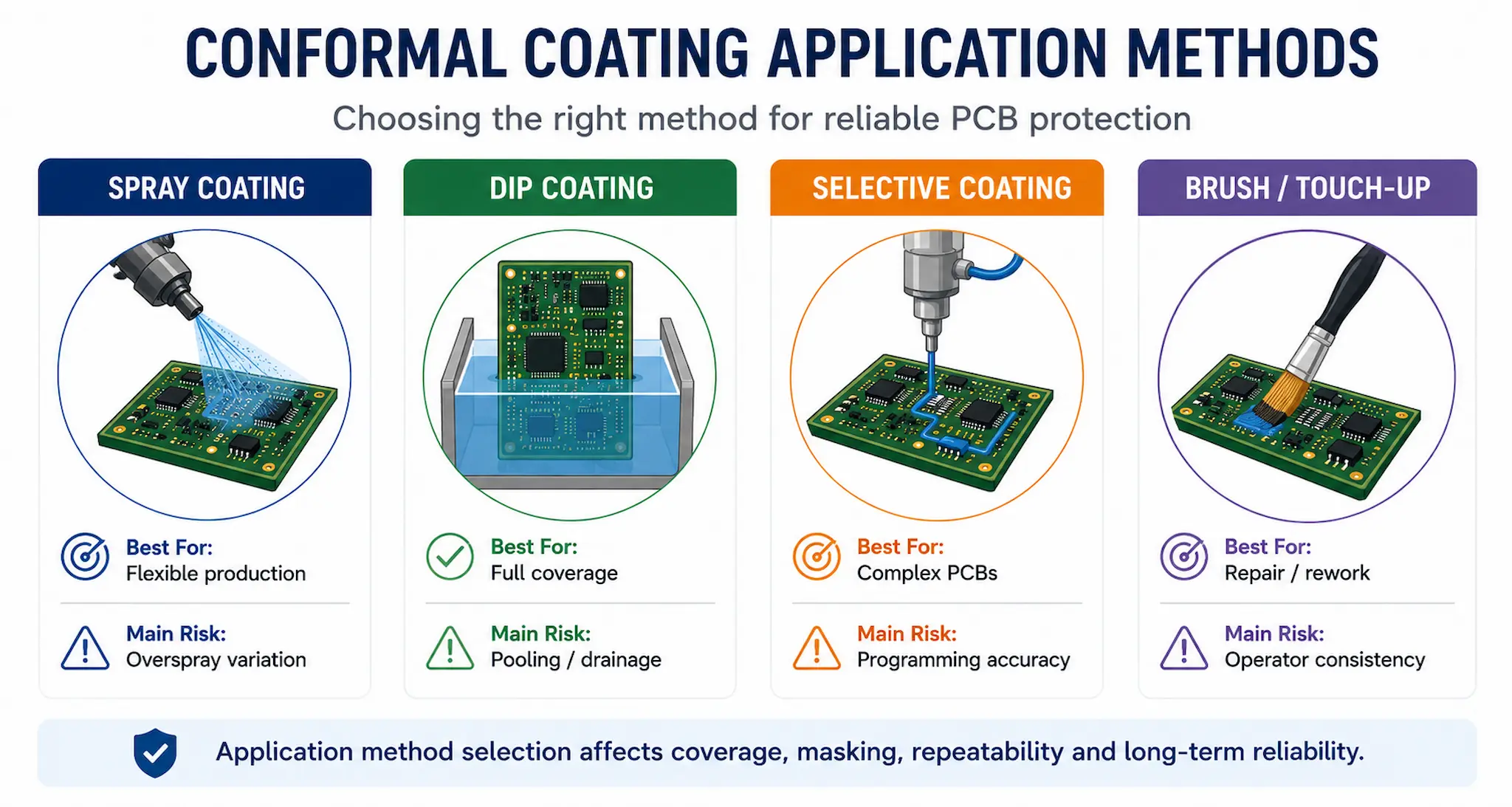
Comparison of the main conformal coating application methods used for PCB protection and production coating processes.
Application Methods Index
| Topic | More | Article |
|---|---|---|
| Application Method Comparison – spray, dip, selective and brush coating routes | 🔗 | — |
| Batch Spray Conformal Coating – production spray workflows, throughput advantages and process limitations | 🔗 | ↗ |
| Conformal Coating Spraying with a Spray Gun – spray-gun setup, atomisation, airflow and operator process control | 🔗 | ↗ |
| Selective Conformal Coating Accuracy – boundary control, programming and real-world process tolerance | 🔗 | ↗ |
| Complex PCB Application Risks – geometry, coating flow and method selection problems | 🔗 | ↗ |
| Hybrid Conformal and Nano Coating Strategy – combining process routes where one method is not enough | 🔗 | ↗ |
| Conformal Coating Process Control – how application control links into production stability | 🔗 | ↗ |
| Application Methods vs Equipment Selection – separating process route from machinery choice | 🔗 | ↗ |
Core Application Routes
The main application routes each have different strengths, limitations and process control requirements. No single method is automatically best; the correct choice depends on the PCB design, production environment and reliability requirement.
- Spray coating: flexible for batch production, repair work and medium-volume coating, but sensitive to operator technique, spray setup and viscosity.
- Dip coating: efficient for repeatable full-board coverage where keep-out areas can be controlled, but sensitive to drainage, withdrawal speed and component entrapment.
- Selective coating: useful for complex assemblies with defined coating zones, but dependent on programming, datum control, coating flow and edge accuracy.
- Brush and touch-up: useful for repair, rework and low-volume work, but difficult to control in high-repeatability production.
Batch Spray Conformal Coating
Batch spray conformal coating is commonly used where higher throughput is required but full robotic selective coating is unnecessary or commercially impractical. Assemblies are typically coated using manual or semi-automated spray systems in controlled batches.
The process offers good flexibility and production efficiency, particularly for medium-volume PCB assemblies with manageable masking requirements. However, coating consistency still depends heavily on operator control, spray technique, viscosity stability, airflow management and drying conditions.
Compared with selective robotic coating, batch spray systems generally require more masking and provide lower edge-definition accuracy. Compared with dip coating, they offer better localised control and reduced connector flooding risk.
Understanding where batch spray fits between manual spraying, dip coating and selective robotic coating is important when choosing a scalable and repeatable coating process.
Conformal Coating Spraying with a Spray Gun
Spray-gun application provides a flexible coating route for prototype, repair, batch and medium-volume PCB production. However, repeatable results depend on controlling the spray gun, coating material, airflow and operator technique as one connected process.
- Atomisation and pressure: control droplet formation, transfer efficiency and coating finish.
- Spray pattern and distance: influence overlap, edge coverage, film build and overspray.
- Material condition: viscosity, temperature and solvent balance affect flow and levelling.
- Operator control: gun angle, travel speed, pass sequence and flash-off must be standardised for repeatable production.
Spray-gun coating should be carried out within a suitable controlled spray environment with appropriate airflow, filtration and overspray management. The spray equipment and booth configuration must support the coating chemistry, assembly geometry and required production throughput.
Selective Conformal Coating Accuracy
Selective coating is often treated as a precise digital process, but real-world accuracy is limited by fluid behaviour, board tolerance, nozzle dynamics, material viscosity, fixture repeatability and keep-out geometry.
- Boundary control: the programmed path is not the same as the final wet coating edge.
- Process tolerance: component height, board position and coating spread all affect real outcomes.
- Design impact: narrow keep-outs and connector-adjacent areas need realistic tolerance planning.
Complex PCB Application Risks
Complex PCB assemblies can fail even when the coating material itself is suitable. The issue is often the interaction between geometry, coating flow, masking boundaries, component density and inspection limits.
- Geometry-driven failure: tall components, sharp transitions and hidden areas change coating flow and drainage.
- Boundary control: connectors, switches and keep-out areas increase masking complexity and defect risk.
- Method selection: spray, dip, selective and hybrid routes create different risks on complex assemblies.
Hybrid Conformal and Nano Coating Strategy
Hybrid coating strategies combine different coating technologies where one route alone creates unacceptable trade-offs. This may include conformal coating for protected areas and nano coating or hydrophobic surface treatment near functional interfaces.
- Conformal coating: used where barrier protection, corrosion resistance and dielectric margin are required.
- Nano or hydrophobic coating: used where low-build surface behaviour or reduced wetting is the key requirement.
- Process order: compatibility, boundaries and inspection must be validated as a system.
Conformal Coating Process Control
The application method should be linked directly to inspection criteria, training, work instructions and production validation. It is not enough to choose a coating process because it appears faster or cheaper.
- Define application parameters and acceptable process limits.
- Connect method choice to masking, surface preparation, curing and inspection.
- Control operator variation, equipment setup and coating material condition.
- Use production feedback to refine process windows and defect prevention.
Application Methods vs Equipment Selection
This hub focuses on the process route: how the coating is applied and what risks the method introduces. Equipment selection is a separate but related decision.
Once the preferred method is understood, the next step is to choose suitable spray booths, dip systems, selective coating platforms, valves, drying systems, inspection tools and process monitoring equipment.
For hardware-focused guidance, use the Conformal Coating Equipment Hub. That hub should be used for machinery, tools, system configuration and production equipment rather than application method selection.
Relevant equipment pathways:
- CB100 Conformal Coating Spray Booth – controlled manual and batch spray coating.
- Dip Coating Systems – controlled immersion and withdrawal for repeatable dip processes.
How Application Methods Link to the Wider Process
Application method selection sits between coating strategy and production control. The method affects masking burden, equipment choice, inspection requirements, surface preparation sensitivity and defect risk.
- Conformal Coating Processes Hub — master process navigation and overview.
- Surface Preparation Hub — cleaning, contamination control and adhesion preparation.
- Conformal Coating Equipment Hub — machinery, hardware, booths, valves and production systems.
- Masking Hub — masking strategies and keep-out control.
- Inspection & Quality Hub — verification, thickness and coverage control.
Related Application, Process & Production Hubs
Use these related hubs to continue through the wider conformal coating process:
- Conformal Coating Processes Hub
- Conformal Coating Surface Preparation Hub
- Conformal Coating Equipment Hub
- Conformal Coating Masking Hub
- Conformal Coating Design Hub
- Conformal Coating Defects Hub
- Inspection & Quality Hub
- Removal & Rework Hub
- Conformal Coating Standards Hub
- Parylene Basics Hub
- Parylene Process & Reliability Hub
Need help choosing the right application method?
SCH Services supports customers with conformal coating process selection, application trials, production setup, training and troubleshooting. We can help assess whether spray, dip, selective coating or a hybrid route is most suitable for the PCB assembly and production requirements.
Explore Conformal Coating Services
Contact SCH Services to discuss application method selection, process trials or production support.
Why Choose SCH Services?
- Practical application experience: SCH works with manual spray, batch spray, dip coating, selective coating and specialist coating processes.
- Process-led support: We help connect application method selection with masking, surface preparation, curing, inspection and process control.
- Equipment and production knowledge: SCH can help move from application-method selection into suitable spray, dip and production equipment.
- Scalable implementation: Support can include coating services, trials, consultancy, training, equipment and production process development.
Useful starting points include conformal coating services, conformal coating systems, training and consultancy.
These articles provide general technical guidance for conformal coating application methods, process selection and production planning. They do not replace product-specific standards, OEM requirements or qualification testing. Always validate coating method selection, process controls and coating performance against the relevant assembly design, coating material, customer specification and production environment.
