Batch Spray Conformal Coating: Process, Equipment & Control
How batch spraying works, where it fits, and what controls coating quality
Batch spray coating is one of the most widely used methods for applying conformal coating in low to medium volume production, prototype work, and high-mix manufacturing. It can produce a consistent protective film with good edge coverage when the coating material, spray set-up, masking approach, and operator technique are properly controlled.
Unlike selective coating systems, batch spraying applies coating broadly across the board surface. That makes it flexible and relatively low cost, but it also means masking, viscosity control, spray pattern control, and drying discipline become critical to process stability.
This guide explains the basic equipment required, how batch spraying is normally carried out, where the method works well, and which variables most strongly influence coating quality.
If you are looking for a more basic practical guide to manual application, see How to Spray Coat a PCB.
The infographic below summarises the full batch spray conformal coating process and the key variables that influence coating quality.
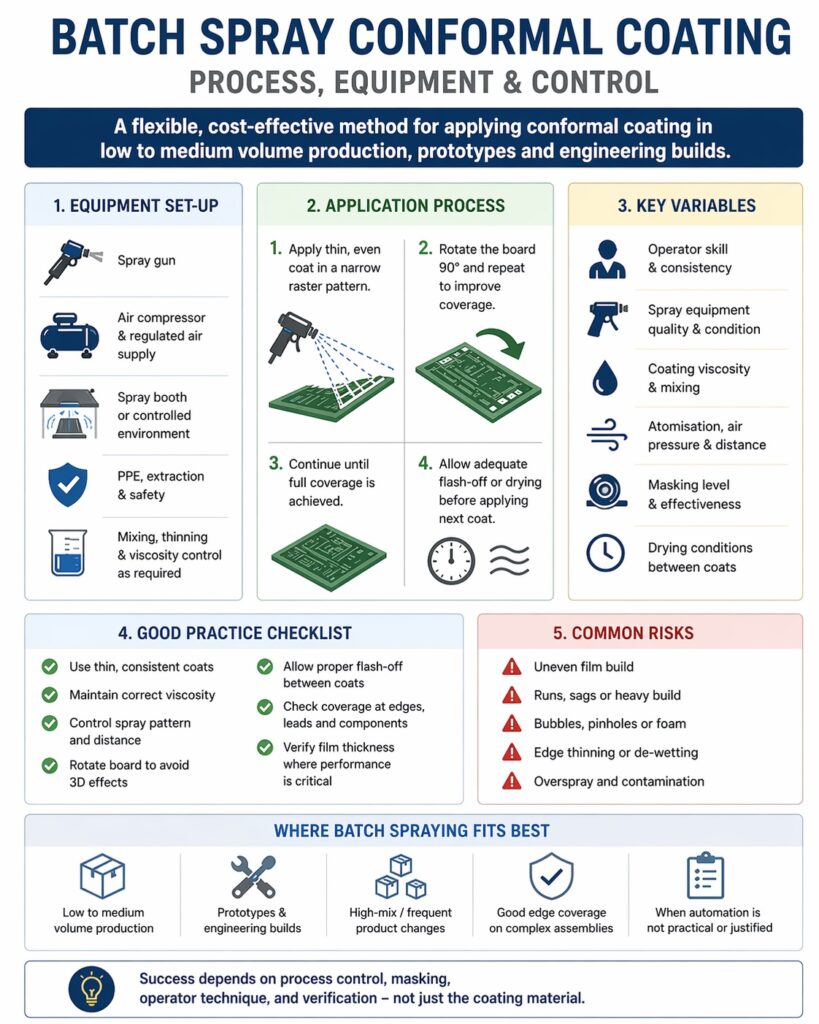
Overview of batch spray conformal coating including equipment setup, application method, process control variables, and common defects.
Where batch spray coating fits
Batch spraying is often a practical choice when production volumes do not justify a fully automated selective coating process, or where product mix changes frequently. It is also commonly used for prototypes, engineering builds, repair work, and lower-volume production where application flexibility matters more than full automation.
Unlike selective coating systems, batch spraying applies coating broadly across the board surface. When well controlled, batch spraying can deliver very good functional protection. However, because it is not inherently selective, the process burden shifts toward masking, operator consistency, and verification of film quality after coating. Where batch spraying is being formalised into a repeatable workflow, see Setting Up a Conformal Coating Production Line.
- Suitable for low to medium volume production
- Useful for prototypes and mixed product families
- Can deliver good edge coverage on complex assemblies
- Usually requires more masking than selective coating methods
- Depends more heavily on operator technique and process discipline
Batch spraying is often presented as a simple process, but most quality problems come from poor control of viscosity, spray pattern, drying, or masking rather than from the coating material alone.
What equipment is normally required
For aerosol application, the equipment requirement is minimal. For more controlled spraying, a typical batch spray set-up includes a manual spray gun, compressed air supply, and a suitable spray enclosure or booth. The quality of the final coating finish depends heavily on how well this equipment is matched to the coating material and maintained in service.
- Spray gun
- Air compressor and regulated air supply
- Spray booth or controlled spraying area
- Appropriate extraction and operator protection
- Mixing, thinning, and viscosity control arrangements where required
A low-cost set-up can handle a surprisingly useful throughput, but low entry cost does not remove the need for process control. Poor atomisation, unstable air supply, inconsistent gun set-up, or contamination in the spray environment can all lead to coating defects and rework.
For more controlled manual spraying, see our conformal coating spray booth.
How conformal coating is typically applied by batch spraying
The exact spray method depends on the coating chemistry, solids content, and supplier guidance, but the basic objective is the same: apply thin, even coats that build coverage without creating excessive film build, runs, bubbles, or uneven surface appearance.
A common approach is to spray in a narrow raster pattern across the board, then rotate the assembly and repeat so that the coating builds more evenly across three-dimensional features and shadowed areas. Where multiple coats are required, the previous coat must be allowed to flash off or dry sufficiently before the next is applied. For more on this stage, see conformal coating curing & drying.
- Apply thin, consistent coats rather than one heavy coat
- Use a controlled raster pattern across the assembly
- Rotate the board and repeat to improve coverage uniformity
- Allow adequate flash-off or drying between coats
- Check coverage at edges, leads, connectors, and component bases
During manual spray coating, visual inspection (often under UV lighting) is used to confirm coverage and identify missed areas or inconsistencies.
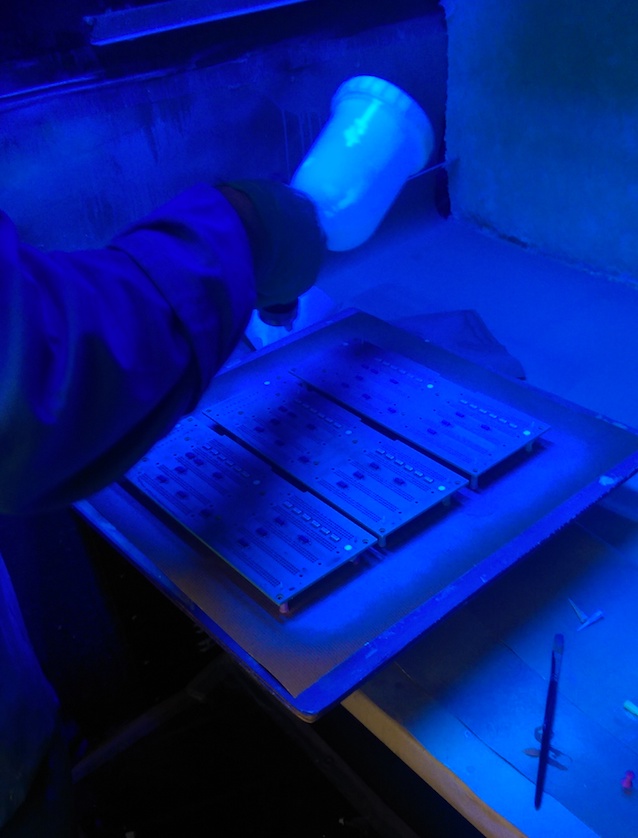
Manual spray application of conformal coating under UV lighting to verify coverage and consistency across PCB assemblies.
What controls coating quality in batch spraying
Batch spray performance is controlled by a combination of material condition, equipment set-up, and operator practice. Even with a good coating material, poor viscosity control or inconsistent application technique can quickly create large variation in surface finish and film thickness.
Key variables
- Operator skill and repeatability
- Quality and condition of spray equipment
- Coating viscosity and solvent balance
- Atomisation and air pressure stability
- Spray distance and pass overlap
- Board orientation and handling during coating
- Level and complexity of masking required
- Drying conditions between coats
Viscosity control is especially important. If the material is too thick, atomisation and flow may be poor. If it is too thin, edge coverage, build control, and surface appearance may suffer. Blending or thinning should always be controlled against the coating supplier’s process window rather than done informally on the bench.
Once coated, verification should not rely only on appearance. Where coating performance matters, inspection and thickness verification should form part of the process. See our guide to conformal coating thickness verification.
Limitations and common process risks
Batch spraying can be highly effective, but it has practical limitations. It is not selective, so components and zones that must remain free of coating will usually need masking. As assembly complexity increases, the masking burden and risk of process variation also increase.
- Higher masking requirement than selective coating methods
- Greater dependence on operator consistency
- Risk of uneven film build on complex geometries
- Overspray and contamination risks if the spray environment is poorly controlled
- Potential for bubbles, de-wetting, edge thinning, and poor finish if process settings drift
If coating defects are appearing regularly, the issue is often broader than application alone. Surface cleanliness, material preparation, drying control, and inspection method may all need review. Related reading: surface preparation & cleanliness, pinholes, bubbles & foam, orange peel, and de-wetting.
Related process guidance
Batch spraying should be viewed as part of a wider coating process, not as an isolated application step. The most useful supporting guidance is usually found in process preparation, masking, inspection, and defect diagnosis.
Why Choose SCH Services?
SCH Services supports conformal coating users with practical process knowledge, application equipment, masking solutions, training, and technical guidance. Whether you are refining a manual spray process, improving consistency, or assessing the right coating route for your assemblies, we can help you make more informed process decisions.
If you would like help reviewing your current spray process, equipment set-up, or masking approach, please contact SCH Services.
This article is provided as general technical guidance only. Batch spray conformal coating performance depends on coating chemistry, assembly design, masking strategy, operator technique, and process control. Final process settings, inspection criteria, and acceptance limits should be validated against your own product requirements, supplier data, and applicable standards.