Conformal Coating Thickness, Curing & Verification Hub
Thickness measurement, curing behaviour, coating verification and process validation for conformal coating reliability
This hub focuses on verifying that conformal coating processes are stable, measurable and producing reliable protective films.
Thickness, curing behaviour and coating verification are closely linked. A coating may appear visually acceptable while still containing insufficient film build, excessive coating, trapped solvent, incomplete cure, local coverage variation or process drift.
Use this hub to understand coating-thickness measurement, cure-state control, witness coupons, UV inspection and production verification—and then follow the supporting Bulletins and Insights where apparently acceptable inspection results can hide process problems.
The objective is not simply to collect measurements. It is to build evidence that the coating process remains stable, repeatable and capable of protecting the assembly where protection is actually required.
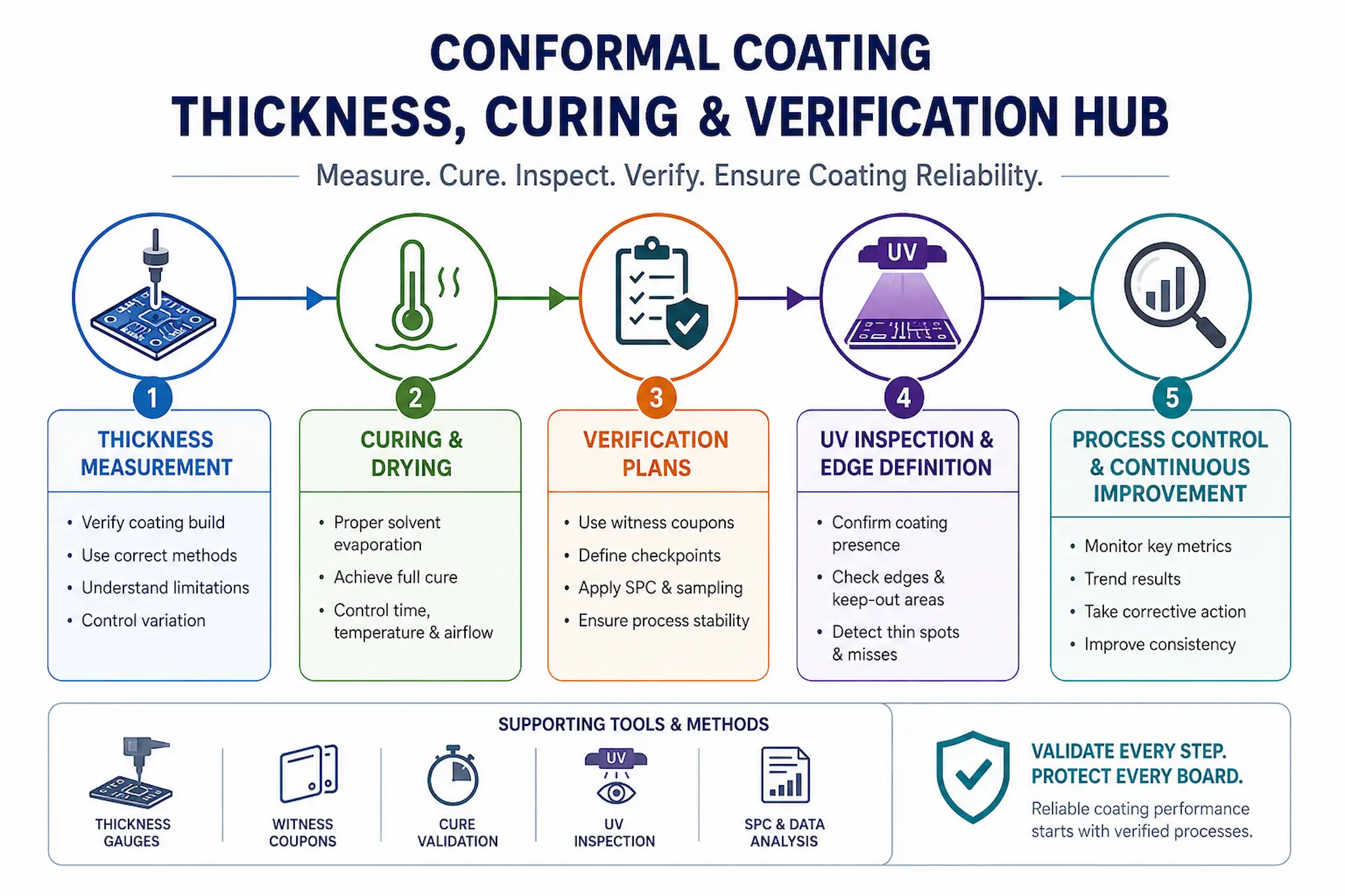
Thickness measurement, curing control, UV inspection and process verification should operate together rather than as isolated acceptance checks.
Where Are You in the Verification Process?
- I need to understand how coating thickness should be measured → Thickness Measurement
- My thickness readings vary or do not seem representative → Why Measuring Thickness Is Difficult
- I am investigating drying, tackiness, solvent retention or cure problems → Curing & Drying
- I rely heavily on UV inspection → UV Inspection & Edge Definition
- I need a production sampling, witness-coupon or thickness-verification plan → Verification & Process Control
- The process passes inspection but production results still drift or fail → Production Warnings & Supporting Guidance
Thickness, Curing & Verification Index
| Topic | Summary | Article |
|---|---|---|
| Conformal Coating Thickness Measurement – wet, dry and practical production measurement methods | ↓ | Read ↗ |
| Why Measuring Thickness Is Difficult – geometry, substrate and measurement-system limitations | ↓ | Read ↗ |
| Curing & Drying – cure mechanisms, flash-off, cure-state and process stability | ↓ | Read ↗ |
| Thickness Verification Plans – measurement locations, witness coupons, sampling and production evidence | ↓ | Read ↗ |
| UV Inspection & Edge Definition – fluorescence, coverage, boundaries and inspection limitations | ↓ | Read ↗ |
Production Warnings & Supporting Guidance
The core articles explain how thickness, curing and verification should work. These supporting Bulletins and Insights show where apparently sensible production controls can still create false confidence.
Thickness Drift During Production
A process can begin inside its required thickness window and drift during the shift as viscosity, solvent loss, temperature, replenishment practice, equipment condition or operator adjustment change. Thickness variation should therefore be investigated as a process-control issue, not only as a final inspection failure.
Bulletin: Why Conformal Coating Thickness Changes During Production Runs ↗ · Insight: Inconsistent Coating Thickness – Why Process Control Fails ↗
A Passing Thickness Reading Can Still Be Misleading
Thickness varies across real PCB assemblies. Geometry, drainage, edges, component height and measurement location mean that one compliant reading may say little about critical areas elsewhere on the same assembly.
Bulletin: Why One Conformal Coating Thickness Reading Can Be Misleading ↗ · Insight: Measurement Reliability on PCBs – Why Eddy Current Often Fails ↗
UV Fluorescence Can Create a False Pass
UV fluorescence is valuable for confirming coating presence and boundaries, but fluorescence alone does not prove required thickness, adhesion, cure-state, continuity or long-term protective performance.
Cure-State Failures Can Appear After the Coating Looks Acceptable
Dry-to-touch, tack-free and fully cured are not equivalent conditions. Solvent entrapment, inadequate cure energy, excessive cure, moisture, thick film build and recoat timing can create tackiness, brittleness, wrinkling, bubbles or other defects during or after cure.
Guide: Conformal Coating Curing & Drying ↗ · Cure-State & Film Formation Defects ↗ · Bubbles After Cure ↗
Conformal Coating Thickness Measurement
Thickness measurement is one of the most misunderstood areas of conformal coating. PCB geometry, transparent films, substrate construction and uneven surfaces make verification difficult unless the measurement method is matched to the process and assembly.
- Understand the difference between wet-film, dry-film and functional coating thickness.
- Choose measurement methods appropriate to the coating chemistry and substrate.
- Use witness coupons or controlled reference surfaces where they provide representative information.
- Define measurement locations rather than allowing operators to select convenient points.
- Build realistic tolerances around both process capability and measurement uncertainty.
Why Measuring Thickness Is Difficult
A conformal coating on a populated PCB is not a uniform flat film. Component geometry, edges, drainage, pooling, substrate construction and application method create a distribution of coating thickness across the assembly.
- Separate genuine coating variation from measurement-system variation.
- Understand the limitations of eddy-current and other spot-measurement methods on PCB structures.
- Avoid assuming that an accessible flat measurement location represents the critical protection area.
- Use several relevant locations where product risk justifies them.
- Interpret measurement data alongside coating coverage and process conditions.
Curing & Drying
Drying and curing are not the same process. A coating may be sufficiently dry to handle while still developing the mechanical, electrical or chemical properties associated with its fully cured state.
- Define flash-off separately from final cure.
- Control time, temperature, airflow, humidity or UV energy according to the coating chemistry.
- Do not treat dry-to-touch or tack-free condition as proof of complete cure.
- Control film build because thick or pooled areas can cure differently from thin regions.
- Review shadowed zones and secondary-cure requirements for UV or dual-cure systems.
- Validate the cure condition required before calibration, testing, packing or service.
UV Inspection & Edge Definition
UV inspection is a fast and useful way to identify fluorescent conformal coating, coating boundaries and some masking or coverage errors. Its limitation is that fluorescence confirms presence—not complete coating performance.
- Use controlled UV lighting and inspection conditions.
- Inspect boundaries, shadowed regions and areas around tall components deliberately.
- Do not infer coating thickness solely from fluorescence brightness.
- Use white-light or magnified inspection where appropriate alongside UV.
- Combine UV inspection with thickness, process and cure verification where those factors are critical.
Verification & Process Control
A verification plan should provide evidence that the coating process remains inside an acceptable operating window rather than simply demonstrating that occasional inspected units passed.
- Define representative measurement locations around actual assembly risk.
- Use witness coupons where their relationship to the product has been understood.
- Record thickness against batch position, time or process conditions where drift is possible.
- Use sampling or SPC methods appropriate to product risk and process capability.
- Define escalation rules for trends, outliers and repeated failures.
- Link inspection data back to viscosity, equipment condition, environment and application parameters rather than treating it in isolation.
Connect Verification to the Wider Coating Process
Thickness, cure and inspection results are outputs of a wider manufacturing process. When verification is unstable, the root cause may sit upstream of the inspection station.
- Conformal Coating Processes Hub – complete coating workflow and process fundamentals.
- Process Control Hub – viscosity, material condition, environment and production stability.
- Application Methods Hub – spray, dip and selective-coating behaviour.
- Inspection & Quality Hub – inspection techniques, acceptance and verification strategy.
- Conformal Coating Defects Hub – route recurring thickness, cure or film-formation symptoms to the likely defect mechanism.
Need Help Validating Thickness, Cure or Inspection?
SCH Services can review a coating verification problem as a complete production system rather than treating individual measurements or defects in isolation.
Useful information to send us includes: the coating material, target thickness, application method, cure profile, PCB or assembly, current measurement method and locations, inspection criteria, production data and examples of any recurring variation or failures.
- Thickness-measurement and verification strategy.
- Witness-coupon and sampling-plan review.
- Viscosity and thickness-drift investigation.
- Cure and drying-process review.
- UV inspection and false-pass assessment.
- Production troubleshooting and process validation.
- Operator, engineering and inspection training.
Process ConsultancyConformal Coating TrainingDiscuss Your Process
Why Choose SCH Services?
SCH Services works with coating application, inspection, process engineering and production troubleshooting, allowing verification problems to be reviewed against the process conditions that created them.
- Practical coating experience – measurement and inspection reviewed against real production behaviour.
- Process-led diagnosis – thickness, viscosity, application, cure and inspection considered together.
- Verification support – measurement strategy, coupons, sampling and inspection workflow development.
- Training and consultancy – support for operators, engineers, inspectors and quality teams.
- Production support – from prototype validation through repeat conformal coating production.
📞 Call: +44 (0)1226 249019 | ✉ Email: sales@schservices.com | 💬 Contact Us ›
Disclaimer: This content provides general technical guidance on conformal coating thickness measurement, curing behaviour, inspection and process verification. Measurement methods, sampling strategy, cure requirements, acceptance criteria and production controls must be validated against the specific coating chemistry, assembly geometry, application process, operating environment, customer specification and applicable standards.