Parylene Coating Applications
Where Parylene Is Used and How to Evaluate Whether It Is Suitable for Your Application
Parylene is used where thin, highly conformal polymer protection must be combined with electrical, environmental, chemical or dimensional requirements that can be difficult to achieve with conventional liquid coatings.
Applications include electronic assemblies, medical devices, sensors and MEMS, aerospace and defence systems, automotive electronics and products operating in demanding industrial or outdoor environments.
The important engineering question is not simply whether Parylene has been used in a particular industry. Suitability depends on the required function of the coating, Parylene grade, substrate, geometry, operating temperature, chemical and moisture exposure, coating thickness, masking requirements and the qualification evidence required for the finished product.
Use this hub to identify the application route closest to your requirement, then move into the detailed sector, design, material and process guidance needed to evaluate it properly.
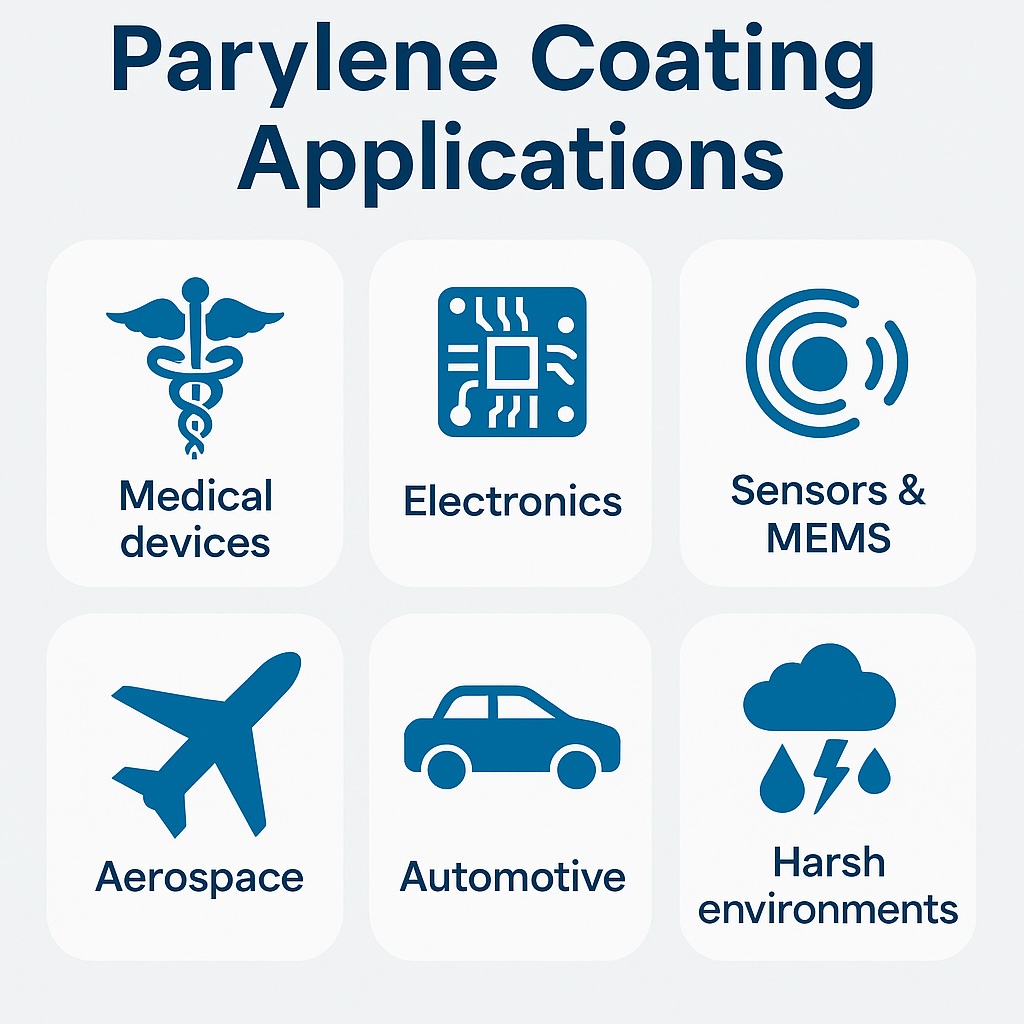
Parylene applications span electronics, medical devices, aerospace, automotive, sensors, MEMS and products requiring controlled protection in demanding environments.
Where Are You in the Parylene Application Decision?
Start with the product or engineering requirement you are trying to protect.
- I have an electronic assembly or PCB exposed to moisture, contamination or electrical stress → Electronics & PCB Assemblies
- I am developing a medical, wearable or life-science device → Medical Devices & Life Sciences
- I need to protect a sensor, MEMS device or very small component → Sensors, MEMS & Miniaturised Components
- I have aerospace, defence or other high-reliability electronics → Aerospace & Defence Electronics
- I am evaluating Parylene for automotive, EV or transportation electronics → Automotive & EV Systems
- My product faces moisture, salt, chemicals, dust or outdoor exposure → Harsh-Environment & Industrial Products
- I already know the application but need to select the Parylene grade → Parylene Dimers Hub
- I need to design the assembly for coating and masking → Parylene Design Hub
- I am scaling or troubleshooting the coating process → Parylene Process & Reliability Hub
Before Selecting Parylene: Check These Application Factors
Industry sector alone is not enough to determine coating suitability. The same Parylene grade may behave very differently depending on the assembly, operating environment and required lifetime.
| Decision Factor | Questions to Resolve |
|---|---|
| Required function | Moisture barrier, corrosion control, electrical insulation, chemical protection, surface modification or another defined function? |
| Temperature | What are the continuous temperature, short excursions, thermal cycles and required service life? |
| Environment & chemistry | Humidity, condensation, immersion, salt, fuels, oils, cleaning chemicals, process fluids or other contaminants? |
| Substrate & adhesion | Which metals, polymers, ceramics, solder masks or other materials must be coated, and what preparation is required? |
| Electrical requirement | What voltage, dielectric, frequency, insulation or surface-leakage performance must be achieved? |
| Thickness & geometry | What film thickness is required and will it affect tolerances, moving elements, cavities, interfaces or sensor response? |
| Masking | Which connectors, contacts, optical surfaces, mechanical interfaces, test points or functional areas must remain uncoated? |
| Medical / biological requirements | Is biological evaluation required, and does the selected Parylene grade and coating system have appropriate supporting evidence? |
| Sterilisation | Will the finished device experience EtO, radiation, steam, repeated sterilisation or another process requiring specific validation? |
| Qualification | What customer specification, standard, environmental test or application-specific evidence is needed before production approval? |
Parylene Application Guide Index
| Application | Summary | Guide |
|---|---|---|
| Medical Devices & Life Sciences – biological, barrier, dimensional and sterilisation considerations | ↓ | Read ↗ |
| Electronics & PCB Assemblies – environmental protection and electrical isolation | ↓ | Read ↗ |
| Sensors, MEMS & Miniaturised Components – thin-film protection where dimensions and device response matter | ↓ | Read ↗ |
| Aerospace & Defence – high-reliability environmental and electrical protection | ↓ | Read ↗ |
| Automotive & EV Systems – electronics operating around heat, moisture and chemical exposure | ↓ | Read ↗ |
| Harsh-Environment & Industrial Products – moisture, salt, chemical and outdoor-exposure requirements | ↓ | Read ↗ |
Medical Devices & Life Sciences
Parylene is used in medical and life-science products where a thin polymer coating can provide a combination of barrier protection, electrical insulation, chemical resistance or surface modification without adding significant bulk.
Applications may include medical electronics, sensors, diagnostic devices, surgical instruments, wearable systems and selected implantable components.
Biocompatibility must be treated as a specific qualification requirement.
Certain Parylene grades and proprietary coating systems have supporting biological-evaluation data, including ISO 10993 and USP Class VI testing. This should not be interpreted as automatic approval of every Parylene grade, coating process or finished medical device. The selected material, manufacturing process, nature and duration of patient contact and applicable regulatory pathway must all be considered.
Sterilisation also requires application-specific review. Parylene systems can be compatible with commonly used sterilisation methods, but grade, film thickness, substrate, number of cycles and the finished device construction can affect performance. Representative validation should therefore be part of the product qualification plan where sterilisation is required.
Electronics & PCB Assemblies
Parylene is used on electronic assemblies where thin, highly conformal coverage and strong electrical or environmental barrier properties are valuable. Applications may include high-reliability PCBs, power and control electronics, miniaturised assemblies and electronics exposed to moisture or contamination.
Because the polymer is deposited from the vapour phase, Parylene can form a highly uniform film over exposed three-dimensional surfaces and can reach some areas that are difficult to coat consistently with conventional liquid processes.
This should not be described as automatic “360° protection”. Actual coverage depends on component geometry, gaps and shadowed regions, chamber loading, masking and deposition conditions. Connectors, contacts, switches, test points and other functional interfaces may also require deliberate masking rather than coating.
Similarly, while correctly deposited Parylene films are commonly valued for continuous, low-defect barrier coverage, coating integrity on a production assembly still depends on preparation, adhesion, deposition control, film thickness and the geometry being coated.
↑ Back to Index · Read Parylene Coating for PCB Protection ↗
Sensors, MEMS & Miniaturised Components
Parylene can be particularly useful where a protective film must add very little thickness or mass. This makes it relevant to sensors, MEMS, miniature electronic assemblies and other devices where conventional coating thickness may be impractical.
Applications can include pressure and flow sensors, environmental sensors, medical sensing devices, accelerometers and other miniaturised structures requiring electrical or environmental protection.
Protection must not be confused with functional neutrality. Even a very thin polymer film can alter mass, stiffness, damping, dielectric behaviour, optical properties, surface chemistry, fluid interaction or response time. Sensor and MEMS applications should therefore be coated at representative thickness and functionally tested before the process is approved.
Masking can also be critical because sensing surfaces, diaphragms, ports, electrodes, optical paths or mechanical interfaces may need partial coating, precisely controlled thickness or complete exclusion from deposition.
Aerospace & Defence Electronics
Parylene is used in aerospace, defence and other high-reliability electronics where the coating must provide controlled protection while adding minimal mass and thickness.
Potential applications include avionics, flight-control electronics, sensors, communications hardware, monitoring systems and other assemblies exposed to combinations of humidity, altitude, contamination, vibration or temperature cycling.
Selection should be based on the actual mission profile rather than the industry label. Operating temperature and duration, thermal cycling, chemical exposure, altitude, outgassing requirements, electrical performance, substrate materials and service-life expectations can all affect the grade and qualification strategy.
Where reliability is critical, representative environmental testing and controlled preparation, masking, deposition, thickness verification and inspection should form part of the qualification route.
Automotive & EV Systems
Parylene can be considered for automotive and electric-vehicle electronics where compact assemblies require thin environmental or electrical protection.
Potential applications include sensors, battery-management electronics, control modules, power-related electronics and other assemblies exposed to moisture, contamination or demanding temperature cycles.
Automotive suitability cannot be assumed simply because Parylene has strong generic barrier properties. The coating grade must be reviewed against the actual continuous and peak temperature, fluid and chemical exposure, thermal cycling, mechanical environment, substrate system and required design life.
High-temperature locations are particularly grade-dependent. Where the operating profile approaches or exceeds the long-term capability of one Parylene chemistry, an alternative Parylene grade or an alternative protection strategy may be required.
↑ Back to Index · Read Parylene for Automotive Electronics ↗
Harsh-Environment & Industrial Products
Parylene is also used on industrial, outdoor and consumer products where environmental exposure threatens electronic or component reliability.
Potential applications include marine and outdoor instrumentation, robotics, agricultural electronics, monitoring systems, wearables, hearing devices, drones and other products exposed to moisture, condensation, salts, contamination or selected chemicals.
The phrase “harsh environment” is not itself a coating specification. Humidity, continuous immersion, salt atmosphere, fuel exposure, solvent contact, UV radiation, abrasion and elevated temperature create different failure mechanisms and may require different coating grades, thicknesses or complementary protection.
Representative environmental testing should therefore reproduce the conditions that matter to the real product rather than relying only on generic Parylene property data.
Connect the Application to the Wider Parylene System
Once Parylene appears technically relevant, the next step is to convert the application requirement into a material, design and manufacturing specification.
- Parylene Basics Hub – understand deposition, coating grades, thickness, masking and adhesion fundamentals.
- Parylene Design Hub – review geometry, materials, clearances, interfaces, masking and design for manufacture.
- Parylene Dimers Hub – compare Parylene N, C, D and AF-4 and understand grade-selection factors.
- Parylene Process & Reliability Hub – translate the requirement into controlled preparation, deposition, inspection and repeat production.
Is Parylene Suitable for Your Application?
SCH Services can review the application before a Parylene grade, thickness or coating specification is fixed.
Useful information to send us includes: the component or assembly, substrate materials, operating environment, continuous and peak temperatures, chemical or moisture exposure, electrical requirement, target lifetime, dimensional constraints, areas that must remain uncoated, production volume and any customer or regulatory specification.
For medical, sensor or other function-sensitive products, include the biological, sterilisation, sensing or performance requirements that the coating must not compromise.
We can then help determine whether Parylene is an appropriate starting route, which grades should be evaluated, what thickness and masking strategy should be considered and what representative trials or qualification work may be required.
Discuss Your ApplicationParylene Coating ServicesExplore Parylene Solutions
Why Choose SCH Services?
SCH Services supports Parylene applications from initial suitability review through coating trials, specification development, production coating and development of in-house processing capability.
- Application-led evaluation – start with the operating environment and required coating function rather than a preferred material name.
- Parylene grade support – comparison of Parylene N, C, D and fluorinated options against the application requirements.
- Design and masking review – identify coating boundaries, sensitive interfaces, geometry and manufacturability issues before production.
- Prototype and validation support – representative coating trials, thickness strategy and application-specific evaluation.
- Production and process capability – coating services, dimers, Parylene equipment, consumables and technical process support.
📞 Call: +44 (0)1226 249019 | ✉ Email: sales@schservices.com | 💬 Contact Us ›
Disclaimer: This content provides general technical guidance on possible Parylene coating applications and selection considerations. The presence of Parylene in a particular industry or similar product does not establish suitability for another application. Final Parylene grade, coating thickness, surface preparation, masking, deposition process and qualification requirements must be validated against the specific substrate, geometry, operating environment, device function, customer specification and applicable regulatory or industry requirements.