Why Perfect Masking Still Produces Conformal Coating Defects
Why masking can pass inspection while coating defects still appear in the protected assembly
Bulletin Category: Masking process control | Typical Environments: Manual masking, reusable masking boots, masking tapes, masking dots, liquid conformal coating, selective coating, batch spray, dip coating and Parylene masking
Perfect masking is not the same as a perfect conformal coating process.
In production, masking can be correct, fitted accurately and inspected before coating, yet conformal coating defects can still appear after application, cure or final inspection. This does not always mean the masking failed. It often means the masking controlled the boundary, but the coating process still produced defects in the coated area.
This bulletin explains why perfect masking still produces conformal coating defects when surface condition, wetting, contamination, viscosity, film build, cure behaviour or inspection control are not stable.
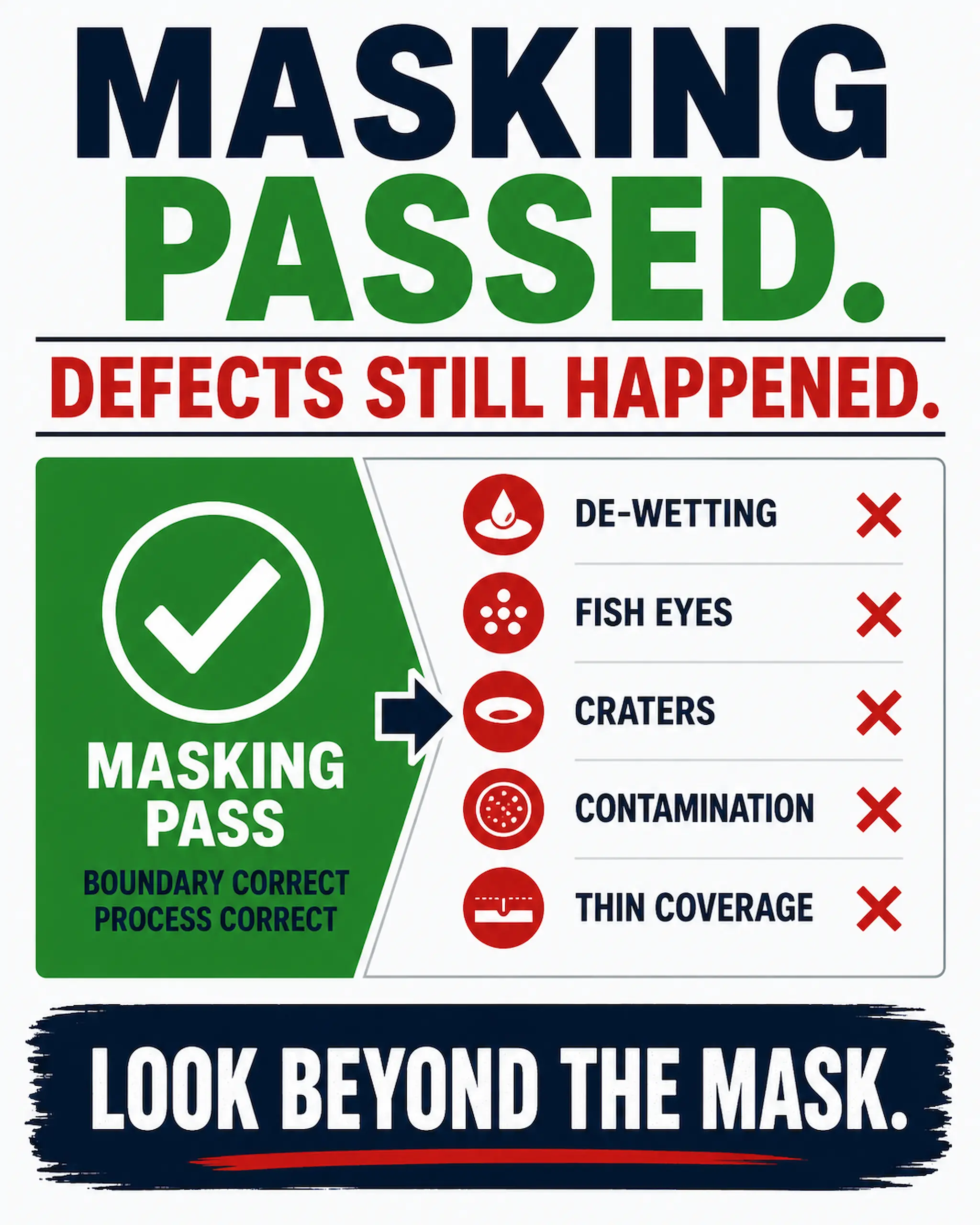
Perfect masking can still produce conformal coating defects because masking only controls the coating boundary. Defects such as de-wetting, contamination, fish eyes, craters and thin coverage can still occur within correctly masked areas.
Engineering observation
A common production mistake is to inspect the masking, see that the boundary is correct, and assume the coating risk has been controlled. That assumption is incomplete.
Masking controls where coating should not go. It does not control how the coating wets the board, whether the surface is clean, whether the coating film is continuous, whether viscosity has drifted, whether cure is correct or whether defects are hidden until inspection.
This means a PCB assembly can have perfect masking, correct keep-out protection and clean boundaries, but still fail because the coating itself has not formed a reliable protective film.
Simple production test: after de-masking, inspect two separate things: did the masking protect the boundary, and did the coating form a defect-free film where protection was required?
The Core Mistake
Perfect masking only controls where coating should not go. It does not control de-wetting, fish eyes, craters, contamination, thin coverage, viscosity variation, cure behaviour, adhesion or coating continuity. A board can therefore pass masking inspection and still fail conformal coating inspection.
Why Perfect Masking Still Produces Conformal Coating Defects
The phrase sounds contradictory, but the mechanism is simple. The masking can be successful while the coating process is not. The masked areas may remain clean, while the coated areas still contain defects.
De-wetting
The coating pulls away from contaminated or low-energy areas, leaving exposed regions even though the masking boundary is correct.
Fish eyes and craters
Local contamination, silicone transfer, particles or surface-energy variation can create circular defects within the coated area.
Thin coverage
A coating may be present but too thin, shadowed or discontinuous to provide the required protection.
Poor adhesion
The coating can release from the assembly because of residues, poor surface preparation, moisture or unsuitable cure conditions.
Visual process guide
①
Masking passes
Keep-out areas are protected
②
Coating applied
Film forms on required areas
③
Process varies
Surface, viscosity or cure affects film quality
④
Defect found
The coating fails despite correct masking
The key point is that masking success and coating success are separate checks. Good masking prevents coating from entering restricted areas. It does not prove that the coating is continuous, clean, well adhered or thick enough elsewhere.
Defects that can still occur after perfect masking
- De-wetting: coating pulls back from the PCB surface because of contamination, surface-energy variation or poor surface preparation.
- Fish eyes: local circular defects form where the coating rejects the surface, often due to contamination or silicone transfer.
- Craters: small voids or depressions appear in the coating film because of contamination, trapped material, air release or process instability.
- Thin coverage: coating is present but does not provide enough film build or continuity for the required protection.
- Poor adhesion: coating releases from the surface after cure, handling, testing or environmental exposure.
- Thickness variation: local film build changes because of drainage, geometry, viscosity drift, spray pattern, dip withdrawal or cure behaviour.
- False visual confidence: the assembly appears acceptable under basic inspection, but detailed inspection reveals missed coverage, poor film continuity or contamination defects.
Process note
Masking should not be treated as proof that the coating process is stable. A correct mask confirms boundary control. It does not confirm surface cleanliness, wetting behaviour, cure performance, coating thickness, adhesion or long-term reliability.
What to check when masking passed but coating failed
- Surface cleanliness: check for flux residues, fingerprints, oils, moisture, ionic contamination and handling marks. If the assembly looks clean but defects still appear, see Boards Look Clean but Still Fail Conformal Coating.
- Silicone contamination: review masking materials, release agents, elastomers, handling tools and nearby silicone sources.
- Coating viscosity: confirm whether solvent loss, temperature, ageing or replenishment has changed coating behaviour.
- Film thickness: check whether the coating is too thin, too thick or variable across the assembly.
- Coverage continuity: inspect for missed areas, shadowed locations, voids, bubbles, craters and thin films.
- Cure condition: confirm flash-off, oven profile, humidity exposure and cure timing are appropriate for the coating chemistry.
- Adhesion behaviour: investigate whether the coating is bonded to the substrate or merely present on the surface.
- Inspection method: avoid relying on UV response alone where film build, continuity or adhesion are critical.
Escalation point
If masking passes inspection but conformal coating defects still repeat, the issue should be escalated as a coating process-control problem. Re-masking the same way will not solve defects caused by contamination, viscosity drift, poor wetting, thin coverage, cure instability or poor adhesion.
Related masking and process bulletins
Related technical guidance
Need help when masking passes but coating still fails?
If masking looks correct before coating but conformal coating defects still occur after processing, the next step is to review the coating process, surface condition and inspection evidence together.
Why Choose SCH Services?
- Production experience: SCH works with masking and coating defects in real production environments, not just in theory.
- Practical defect understanding: We connect masking, surface preparation, coating flow, contamination, inspection and rework into one process-control view.
- Training and support: We help operators and engineers understand why masking can pass while conformal coating defects still occur.
- Solution-led approach: We can support coating services, process reviews, masking methods, inspection planning, operator training and defect investigation.
Disclaimer: This bulletin is general technical guidance only. Final masking method, coating process, de-masking timing, inspection criteria and repair decisions must be validated against the specific PCB design, coating material, customer requirements and applicable production standards.