Parylene Basics Hub
Parylene coating fundamentals, deposition process & application engineering
The Parylene Basics Hub brings together essential guides on Parylene dimer grades, deposition principles, masking methods, adhesion, thickness measurement, thickness specification and core application concepts.
It is designed as a structured starting point for engineers who need to understand how Parylene works, where it fits best, and how to specify it correctly for high-reliability electronics, medical devices, sensors and industrial products.
The diagram below summarises the core Parylene fundamentals, bringing together grades, deposition, masking, adhesion, thickness and application selection.
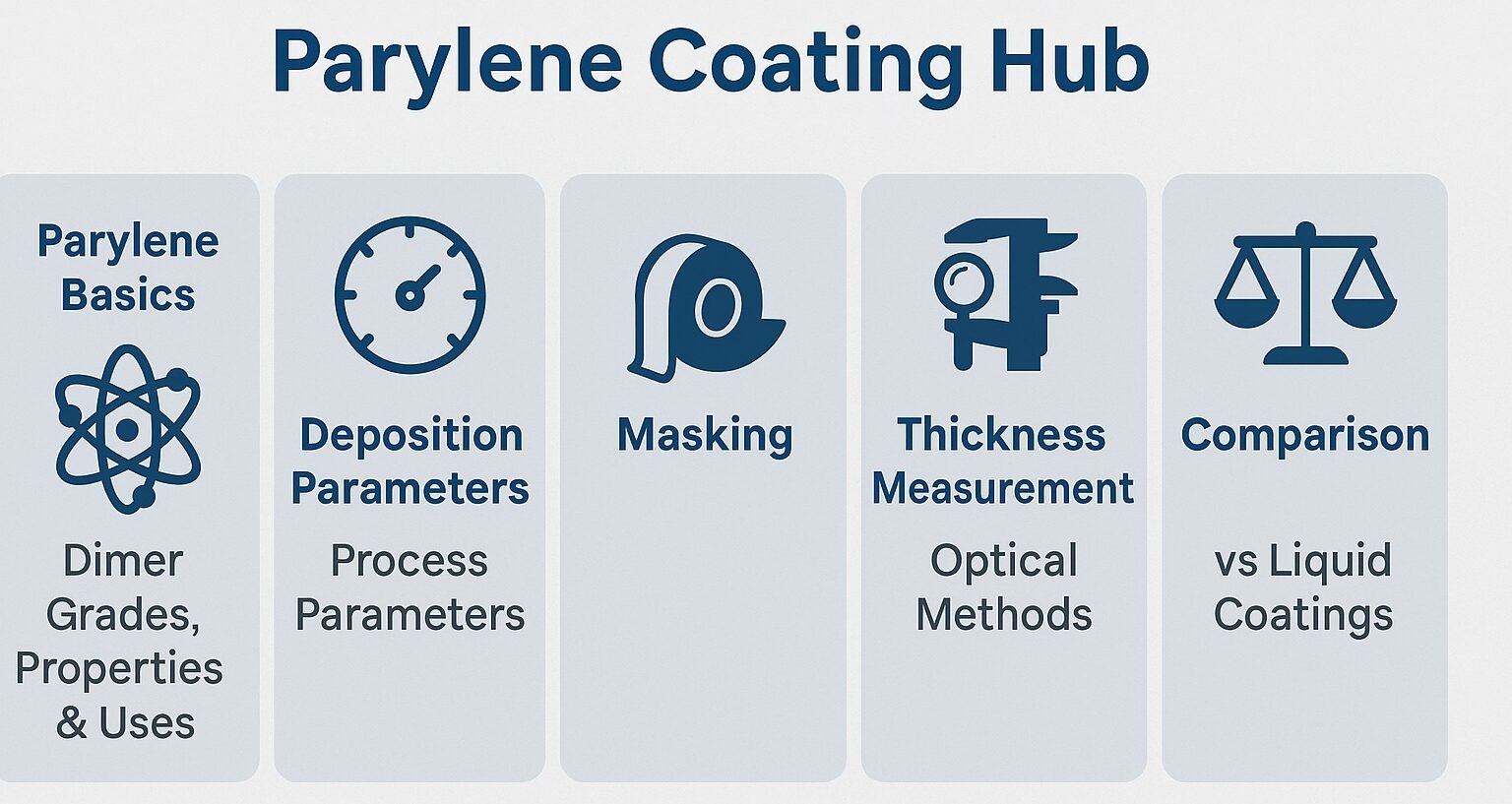
Parylene Basics framework covering grades, deposition, masking, adhesion, thickness, applications and coating selection.
Quick Links
Start here (recommended order)
If you are new to Parylene or building an initial coating requirement, the sequence below is the fastest route from basic material understanding to a practical specification.
- Parylene Basics: Dimer Grades, Properties & Uses
- Parylene Deposition: Process Parameters
- Masking for Parylene
- Parylene Adhesion: Causes of Failure & Solutions
- Parylene Thickness & Environmental Protection: How Much Is Enough?
- Parylene Thickness Specification Guide
- How to Specify Parylene Coating
- Parylene vs Conformal Coating: How to Choose the Right Protection for Electronics
Tip: Once the basic coating requirement is understood, use the Parylene Process & Reliability Hub for engineering runs, process control, chamber stability, troubleshooting and production scale-up.
Parylene Basics: Dimer Grades, Properties & Uses
Parylene is available in several grades, including N, C, D and fluorinated variants. Each grade has different electrical, barrier, thermal and process characteristics, so material selection should be matched to the operating environment, geometry and reliability requirement.
How to Specify Parylene Coating
A usable Parylene specification should define the grade, thickness, coated and uncoated areas, adhesion requirements and acceptance route clearly enough for coating, quality and supplier control. Ambiguous drawing notes can create avoidable problems during quotation, engineering trials and production release.
Parylene Deposition: Process Parameters
Parylene is deposited from the vapour phase under vacuum. Temperature, pressure, material input, chamber condition and loading all influence deposition behaviour, coating uniformity and repeatability between batches.
Masking for Parylene
Because Parylene deposits from the vapour phase, areas that must remain coating-free need deliberate masking. Boots, tapes, dots, plugs and custom shapes can protect connectors, mating faces, threads, sensors and other critical keep-out areas.
Parylene Adhesion: Causes of Failure & Solutions
Parylene adhesion depends on substrate condition, contamination control and appropriate surface preparation. Cleaning, drying, plasma treatment and adhesion promotion may all influence the long-term stability of the coating interface.
Optical Thickness Measurement for Parylene
Thickness measurement is an important part of Parylene process verification. Non-contact optical methods can provide accurate, repeatable measurements without damaging the deposited film and can support traceability against defined coating requirements.
Parylene Thickness & Environmental Protection: How Much Is Enough?
Parylene thickness should be selected against the actual protection requirement rather than by assuming that thicker is always better. Environmental severity, dielectric performance, geometry, deposition time and cost all influence the useful coating window.
Parylene Thickness Specification Guide
This engineering guide explains how to convert dielectric requirements, environmental exposure, geometry constraints and process economics into a practical thickness specification. The objective is to establish a sensible coating range without unnecessary over- or under-specification.
Parylene Applications: Where It Fits
Parylene is used where thin, conformal protection is required across complex assemblies and components. Applications include electronics and PCBs, sensors and microelectronics, medical devices, optical assemblies, aerospace systems and automotive or EV electronics.
- Electronics & PCBs: avionics, automotive modules and industrial controls.
- Medical: devices and components where thin-film protection is required.
- MEMS & sensors: pressure sensors, biosensors and microstructures.
- Optics & LEDs: lenses, LED assemblies and optical components.
- Aerospace & defence: navigation modules, satellites and rugged electronics.
- Automotive & EV: sensors, BMS assemblies and vehicle electronics.
Parylene vs Conformal Coating: How to Choose the Right Protection for Electronics
Parylene and liquid conformal coatings solve different manufacturing and protection problems. Parylene offers highly conformal vapour-deposited coverage at low thickness, while liquid coatings can offer easier selective application, rework and lower process complexity. Selection should be based on the actual reliability, geometry and production requirement.
Why Choose SCH Services?
SCH Services supports Parylene projects from initial coating selection and specification through masking, process development, inspection and production scale-up. Our technical guidance is based on practical coating, equipment and training experience rather than material selection alone.
- ✈️ 25+ Years of Expertise – Specialists in coating technologies trusted worldwide.
- 🛠️ End-to-End Support – Guidance on coating selection, Parylene grades, masking, inspection, and ProShieldESD integration.
- 📈 Scalable Solutions – From prototype batches to high-volume production, SCH grows with your needs.
- 🌍 Global Reach – Responsive support across Europe, North America, and Asia.
- ✅ Proven Reliability – Built on quality, consistency, and customer satisfaction.
📞 Call: +44 (0)1226 249019 ✉ Email: sales@schservices.com 💬 Contact Us ›