ProShieldESD Coating Platform
Permanent, visible and repairable ESD control across materials and environments
The ProShieldESD coating platform is not a single paint or coating. Built on intrinsically conductive polymer technology, it delivers static-dissipative or conductive performance across multiple chemistries, substrates and operating environments.
The core engineering value is simple: insulating materials can be converted into controlled ESD surfaces without redesigning the base part. This includes plastics, metals, composites, foams, cartons, floors, fixtures, work surfaces and industrial equipment.
Unlike conventional filled systems, the ProShieldESD coating platform does not rely on carbon or graphite particle networks to create conductivity. This supports more stable, uniform and maintainable static control where real-world performance matters.
This diagram shows how the ProShieldESD coating platform converts insulating materials into controlled ESD surfaces.
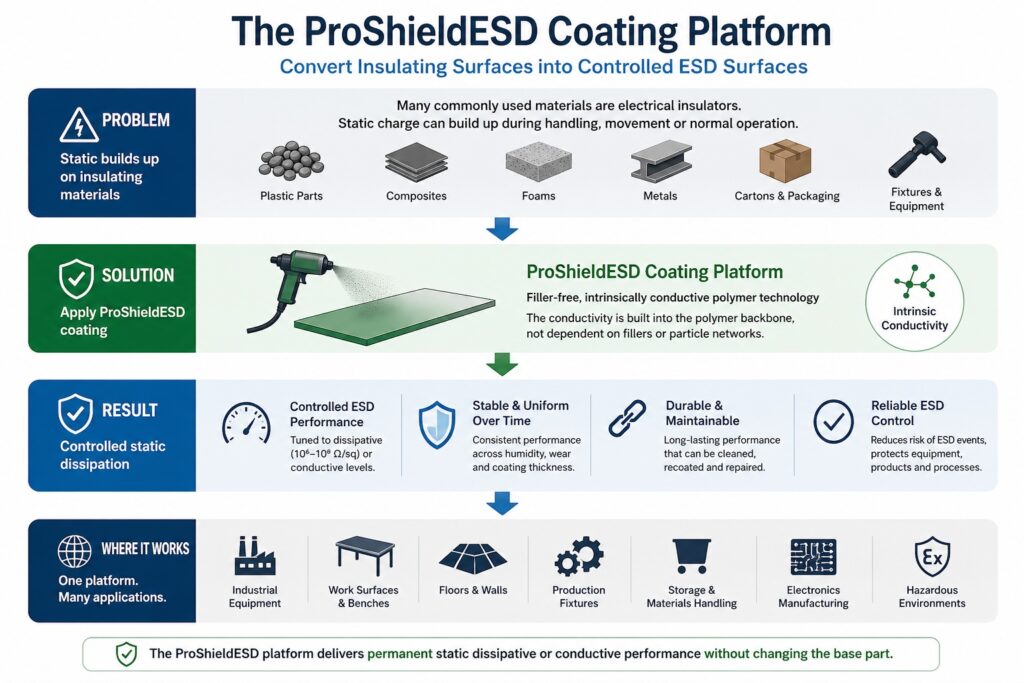
How the ProShieldESD coating platform converts insulating materials into stable, controlled ESD surfaces across multiple applications
Where Conventional ESD Systems Fail
Traditional ESD floors, paints, plastics and coatings rely on conductive fillers such as carbon, graphite or metal particles to create a conductive pathway. This pathway only exists when particles are correctly dispersed and remain in continuous contact across the surface.
In practice, this dependency creates instability:
- Conductivity can vary across the surface
- Ageing, wear and cleaning can break the conductive network over time
- Humidity can influence performance in some systems
- Localised failures can occur without being visible
- Audit testing may miss hidden degraded areas
The result is a system that may appear acceptable during testing, but behaves inconsistently during real operation.
Reality: Filler-based ESD coatings often degrade over time as particle networks break down, leading to hidden instability and performance drift.
This is why filler-free technology matters. For more on why uniform behaviour matters across real surfaces, see homogeneous ESD protection and consistency in static control.
These limitations are widely seen in real applications, where carbon-filled coatings and moulded anti-static plastics can show inconsistency, wear-related drift and contamination risk over time. See why carbon-filled ESD paints and moulded anti-static plastics can fail for a practical breakdown.
For a practical breakdown of common misunderstandings in this area, see ESD paint myths explained. For a deeper technical explanation, see The Technology Behind Filler-Free ESD Coating.
These limitations are not theoretical. See measured ProShieldESD testing results demonstrating stable behaviour across real substrates.
See how filler-based ESD coatings can lead to instability and performance drift in real applications
Key point: The most serious ESD risk is often not the visible surface condition, but hidden loss of electrical performance during operation.
What Makes ProShieldESD Different
ProShieldESD is not a conventional filled anti-static coating. It uses a conductive polymer platform that can be adapted across different materials, chemistries and application requirements.
- Filler-free conductive polymer technology: ProShieldESD uses intrinsically conductive polymer technology rather than carbon or graphite fillers. Conductivity is built into the polymer system rather than dependent on particle contact.
- Humidity-stable performance: Electrical performance remains stable across varying humidity conditions, unlike conventional anti-static coatings that rely on moisture to function effectively.
- Visible, continuous conductive layer: ProShieldESD forms a continuous surface coating. If the coating is present, the conductive pathway is present — allowing visual confirmation of coverage, unlike invisible anti-static additives or treatments.
- Engineered electrical performance: The platform can be engineered for static-dissipative or conductive performance depending on the requirement, with controlled and predictable results.
- Multiple chemistries, one platform: ProShieldESD is available in PU, epoxy, water-based and solvent-based systems. See ProShieldESD Chemistries.
- Upgrade existing materials: Existing materials can be converted into ESD-controlled surfaces without redesigning products or replacing installed assets.
Real-world performance is critical. See live ProShieldESD ESD coating testing results across multiple materials from Productronica, including measured resistance values on plastics, flooring, packaging and tools.
For more on the difference between an initial ESD reading and stable long-term dissipative behaviour, see what lifetime dissipation really means for permanent ESD protection.
Engineering Application Routes
The platform is applied through specific solution routes depending on the material, environment and risk.
- ProShieldESD Solutions Overview
- Anti-Static Coating for Plastic
- Static Control for Industrial Equipment
- Static Control for Work Surfaces & Facilities
- Static Control for Packaging & Logistics
- Static Control in Hazardous Environments
- Explosive & ATEX Environments
Each route focuses on how static control is applied in real systems rather than only at material level.
Critical Environment Applications
ProShieldESD is used where static control must remain stable during real operation. These are environments where uncontrolled static behaviour can create reliability, contamination or safety risk.
- Electronics and semiconductor environments
- Industrial equipment and automation systems
- Work surfaces, facilities and production areas
- Packaging and logistics systems
- Chemical, solvent and powder processes
- Explosive and ATEX environments
In explosive and ATEX environments, static risk is not limited to floors or operators. Frequently handled tooling and accessories can also act as charge-generation interfaces. See our Insight article: Non-Sparking Tools Are Not Electrostatic Safe.
See ProShieldESD applications for solution pathways, or a broader ESD coating applications overview across industries.
What Engineering Problem Does ProShieldESD Solve?
Many commonly used materials are electrical insulators. Plastics, composites, foams, painted metals and packaging materials allow static charge to accumulate during handling and operation.
Traditional solutions require conductive materials or redesign. ProShieldESD provides a route to apply controlled conductivity at the surface level.
The result is a practical method to upgrade parts, equipment, work areas and environments into controlled ESD systems without changing the base material.
This comparison highlights the difference between filler-based conductivity and intrinsically conductive polymer behaviour.
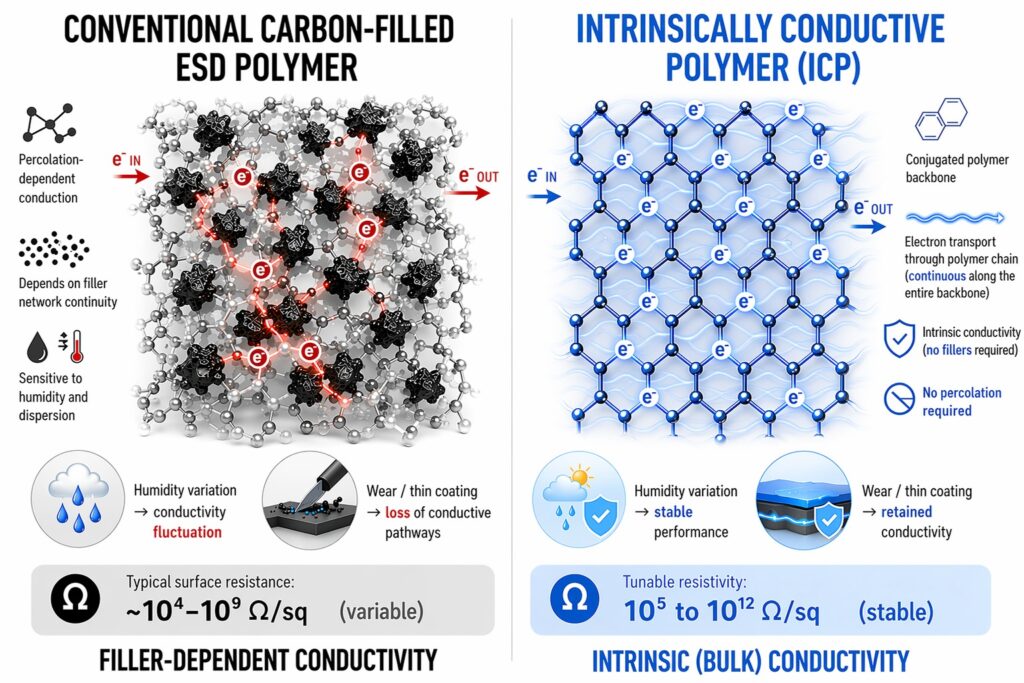
Comparison of filler-based conductivity vs intrinsically conductive polymer behaviour
How SCH Services Supports ProShieldESD Projects
SCH Services supports ProShieldESD projects in three ways: supplying coating materials for in-house application, helping customers implement their own coating process, or providing application through subcontract coating services.
- Supply the coating materials: ProShieldESD coating systems can be supplied for suitable in-house application projects.
- Help you apply them yourself: We can provide technical guidance, process support and training so customers can apply ProShieldESD materials within their own facility.
- Apply them for you: SCH can coat parts, samples or production items through subcontract coating services.
- Support the application decision: We help review the substrate, environment, ESD requirement, coating chemistry, application method, inspection approach and verification route.
Platform & Technical Reference
Why Choose SCH Services?
- Engineering-led support for coating selection, application and system integration
- Trial coating before implementation
- Support for retrofit and repair strategies
- Experience across industrial and safety-critical environments
- Practical inspection and maintenance guidance
Disclaimer: This page provides general technical guidance only. Final suitability must be validated through testing, risk assessment and qualification.