Sometimes the coating decision is not about maximum thickness, but minimum interference
Traditional conformal coating thinking often starts with film build, coverage and environmental protection. That approach is still valid, but it does not fit every electronic assembly.
Some products need protection without adding meaningful thickness, changing optical output, altering RF behaviour, filling connectors or creating major masking work. In those cases, an ultra-thin coating can change the whole process decision.
The important point is not that ultra-thin coatings replace conformal coatings or Parylene. The point is that they provide an alternative engineering route when conventional coating thickness, masking or dielectric behaviour becomes too intrusive for the product being protected.
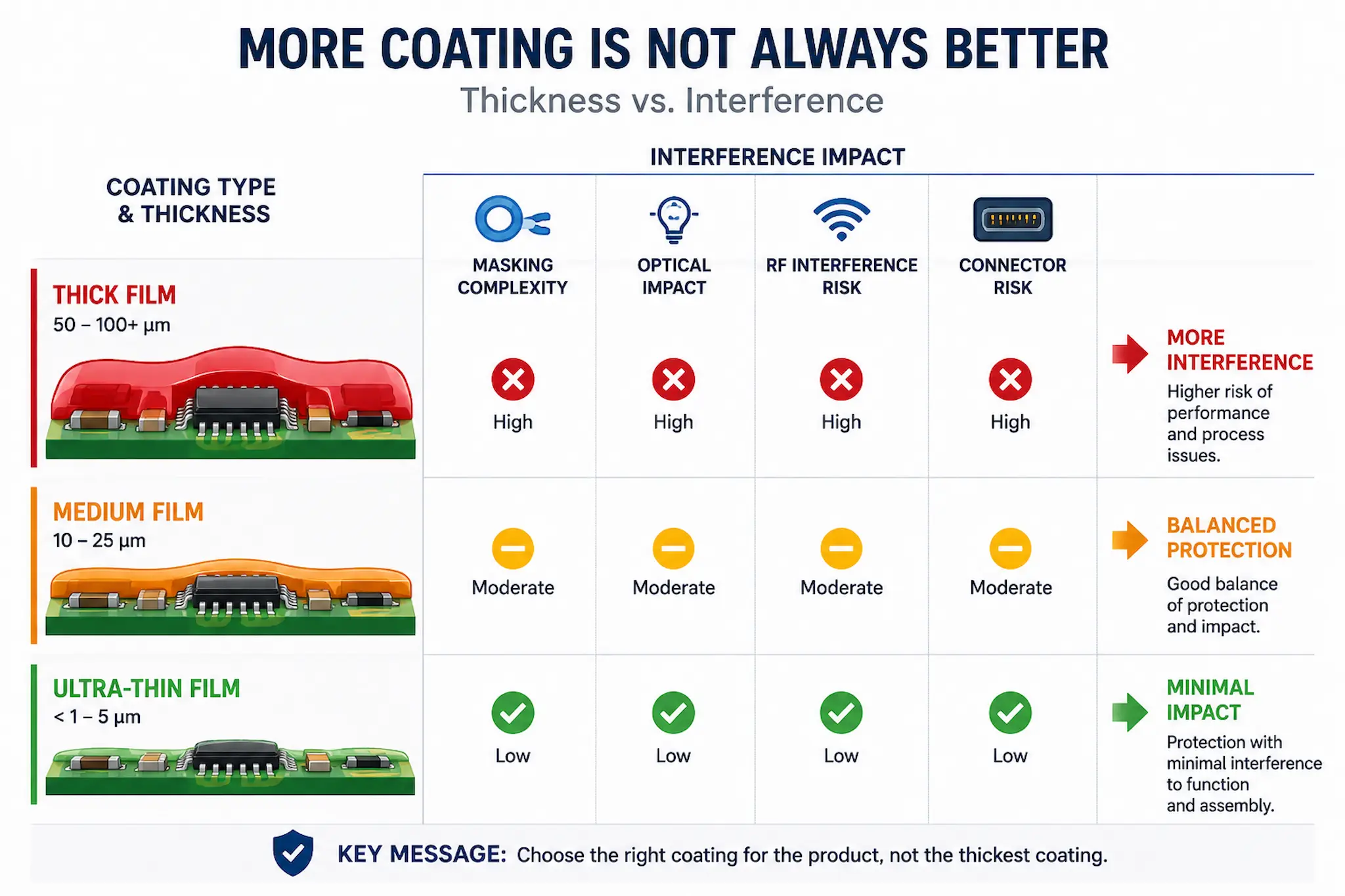
Ultra-thin coatings can reduce masking complexity and performance interference compared with thicker coating systems.
Why thickness can become the problem
Film thickness is often treated as a measure of protection, but thickness also brings consequences. It can affect fine-pitch areas, connector zones, LEDs, sensors, RF circuits and assemblies where coating clearance is limited.
In these cases, the coating may technically protect the board but introduce a new production or performance problem.
The coating is only successful if the assembly still performs correctly after protection has been added.
This is where ultra-thin coating systems become interesting. Many of these systems are used as surface-function coatings, where the goal is to reduce interference while still providing useful surface behaviour or environmental protection. For the wider distinction between surface-function coatings and true barrier coatings, see surface energy vs environmental barrier protection.
Where ultra-thin coatings can be useful
Ultra-thin coatings are most relevant where the assembly has sensitive functional areas that cannot easily tolerate a conventional coating thickness.
LED assemblies
Protection may be required without visibly changing light output, colour quality or optical behaviour. This is explored further in Ultra-Thin Coatings for LEDs and Optical Electronics.
RF and sensor areas
Very thin films may reduce the risk of unwanted electrical, RF or performance changes where coating build, dielectric loading or contamination behaviour could affect the product. See RF transparent coatings for electronics & antennas.
Dense electronics
Low film build can help around BGAs, fine-pitch components and restricted geometries.
Low-mask processes
Reduced coating thickness may simplify production where masking is the main cost or risk.
The engineering question changes
The traditional question is often: how much coating do we need?
With ultra-thin coatings, the better question is: what level of protection can we achieve without disturbing the product?
That shift matters.
In some assemblies, reducing coating interference improves overall system reliability more effectively than increasing coating thickness.
It moves the decision away from simply comparing coating thickness and towards understanding product risk, exposure conditions, required reliability and acceptable process complexity. This is discussed further in Why Thin Coatings Can Sometimes Protect Better Than Thick Ones.
For deeper coating route selection, see Advanced Functional Coatings, Ultra-Thin Coatings and Advanced Functional Coating Services.
What still needs validation
Ultra-thin does not mean automatically suitable. The coating still needs to be tested against the real operating environment, including moisture exposure, chemical exposure, handling, thermal cycling, cleaning processes and electrical performance requirements.
It is also important to avoid overselling water resistance based on simple demonstrations.
Hydrophobic behaviour, water beading and thin-film demonstrations can sometimes create misleading assumptions if the actual failure mechanism has not been validated. See Why Water Beading Is Not Proof of Electronics Protection for more context.
Submersion, condensation, humidity, ionic contamination, powered bias conditions and long-term field exposure are all different reliability problems. For the difference between short-term water behaviour and corrosion reliability, see why water resistance is not corrosion protection.
Ultra-thin coatings should be treated as an engineering option, not a shortcut around qualification.
The best use case is usually where the coating solves a specific process or design conflict that thicker conformal coatings cannot solve cleanly.
Why Choose SCH Services?
SCH Services supports coating selection, coating trials, process development and production coating for electronics where protection, reliability and manufacturability all need to be considered together.
- Practical coating experience: SCH works across conformal coating, Parylene and advanced functional coating processes.
- Process-led decision support: coating selection is based on application risk, production method and validation requirements.
- Trial and production capability: SCH can support early evaluation, sample coating, process definition and subcontract coating routes.
Disclaimer: This article is provided as general technical guidance only. Coating selection, process design and product suitability must be validated against the relevant application requirements, operating environment, customer specifications and qualification tests.