Top Conformal Coating Failure Mechanisms and How to Prevent Them
A practical troubleshooting guide for identifying coating defects, understanding root causes and preventing repeat failures
Conformal coating failures are often visible as defects such as bubbles, pinholes, cracking, de-wetting, corrosion, lifting or coating ingress into restricted areas.
However, the visible defect is usually only the symptom. The real cause is normally linked to surface preparation, coating selection, application control, masking, drying, thickness or the operating environment.
This guide summarises the most common conformal coating failure mechanisms, what they look like, why they happen and how to prevent them from recurring.
Key point: A visible coating defect should be treated as a process signal, not just a cosmetic issue.
How to Use This Guide
Start by identifying the visible defect, then work backwards to the likely process cause.
Do not assume the coating material is the problem. Many coating failures are caused by contamination, incorrect application method, poor masking, uncontrolled viscosity, uneven thickness or insufficient drying and curing.
For a broader explanation of why coating systems fail, see Why Conformal Coating Fails: Real Causes & Solutions.
For process-level causes such as contamination, thickness, cure control, masking and environment, start with Why Conformal Coating Fails. Where the failure is linked to dense layouts, connectors, keep-out areas or difficult geometry, see Why Conformal Coating Fails in Complex PCB Assemblies.
The diagram below summarises the most common conformal coating failure mechanisms and how they link to process control and application conditions.
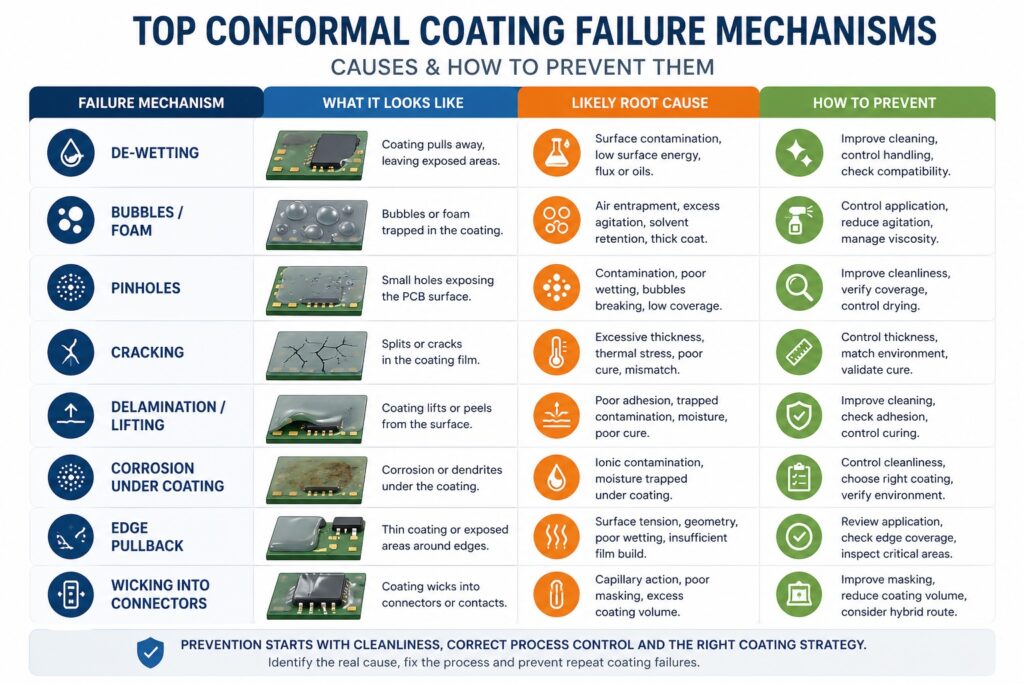
Summary of common conformal coating failure mechanisms with typical causes and practical prevention methods.
Conformal Coating Failure Mechanisms: Quick Reference Table
| Failure mechanism | What it looks like | Likely root cause | Prevention route |
|---|---|---|---|
| De-wetting | Coating pulls away from areas of the PCB, leaving exposed patches or poor coverage. | Surface contamination, poor surface energy, residues, oils, flux or incompatible surface finishes. | Improve cleaning, control handling, verify cleanliness and review coating compatibility. |
| Bubbles / foam | Visible air bubbles, foam, trapped voids or raised circular defects in the coating. | Air entrapment, excessive agitation, poor application technique, solvent retention or coating applied too thick. | Control application method, reduce agitation, manage viscosity and avoid excessive wet film build. |
| Pinholes | Small holes or exposed points through the coating film. | Contamination, poor wetting, bubbles breaking during cure or insufficient coating coverage. | Improve surface preparation, verify coating coverage and control drying conditions. |
| Cracking | Splits, crazing or fracture lines in the coating film. | Excessive thickness, thermal stress, poor cure, material mismatch or mechanical movement. | Control thickness, match coating to thermal environment and validate cure profile. |
| Delamination / lifting | Coating peels, lifts or separates from the PCB surface. | Poor adhesion, trapped contamination, moisture, incompatible surfaces or cure problems. | Improve cleaning, assess adhesion, review primer needs and control curing conditions. |
| Corrosion under coating | Corrosion, staining, dendritic growth or electrical leakage beneath the coating. | Ionic contamination, moisture trapped under coating or inadequate environmental protection. | Control cleanliness, verify ionic contamination risk and select coating for the real environment. |
| Edge pullback | Thin coating or exposed areas around sharp edges, component leads or solder joints. | Surface tension, geometry, poor wetting, insufficient film build or application limitations. | Review application method, validate coverage around edges and use inspection criteria. |
| Wicking into connectors | Coating travels into connectors, switches, press-fit zones or contact areas. | Capillary action, poor masking, excessive coating volume or uncontrolled boundary spread. | Improve masking, reduce coating volume, reassess application method or consider hybrid strategies. |
De-Wetting
De-wetting occurs when the coating fails to wet the PCB surface properly and pulls away, leaving exposed areas or uneven coverage.
The most common causes are contamination, poor surface energy, flux residues, oils, handling contamination or incompatible surface finishes.
De-wetting should be treated as a surface preparation and compatibility problem first, not simply as a coating application issue.
For more detail, see De-Wetting in Conformal Coating. If de-wetting is recurring, also review Surface Preparation & Cleanliness, as the cause is often upstream of the coating application step.
Bubbles, Foam and Pinholes
Bubbles, foam and pinholes indicate instability in the coating film during application, drying or cure.
They may be caused by air entrapment, excessive agitation, high wet film thickness, solvent retention, contamination or poor application technique.
If pinholes remain after drying, they can create weak points where moisture or contamination can reach the PCB surface.
For more detail, see Pinholes, Bubbles & Foam in Conformal Coating. Where bubbles or film instability vary between batches, check Conformal Coating Viscosity Control as part of the process review.
Cracking
Cracking occurs when the coating film cannot tolerate the mechanical, thermal or cure-related stresses placed on it.
Common causes include excessive coating thickness, poor cure, thermal cycling, material mismatch or movement in the assembly.
Cracking is especially important because it can create direct pathways for moisture and contamination.
For more detail, see Cracking in Conformal Coating. Where cracking is linked to heavy film build or local stress, also review Conformal Coating Thickness Verification.
Delamination and Lifting
Delamination occurs when the coating separates from the PCB surface, either locally or across wider areas.
The root cause is usually poor adhesion. This may be linked to contamination, moisture, surface incompatibility, insufficient cure or inappropriate handling before coating.
Lifting can also occur during rework or thermal exposure if the coating was applied too thick or did not bond properly to the surface.
Prevention starts with cleanliness control, adhesion assessment and process validation before production release.
Prevention starts with cleanliness control, adhesion assessment and process validation before production release. If lifting appears near masking edges or after de-mask, also review why masking causes many conformal coating defects.
Corrosion and Ionic Contamination
Corrosion under conformal coating is a serious reliability failure because the problem is often hidden until electrical leakage, dendritic growth or field failure occurs.
The coating may not be the root cause. It may have trapped ionic residues, moisture or contamination beneath the film.
In these cases, the coating can slow the movement of contaminants but cannot remove the underlying chemical risk.
For more detail, see Corrosion & Ionic Contamination.
Edge Pullback and Thin Coverage
Edge pullback occurs when coating becomes too thin around component edges, leads, solder joints or sharp geometry.
This is usually caused by surface tension, geometry, poor wetting or limitations in the selected application method.
Thin areas may pass a basic visual inspection but still become weak points during humidity, condensation or contamination exposure.
Coverage around critical edges should be validated using defined inspection criteria rather than assumed from general coating presence.
Wicking into Connectors and Keep-Out Areas
Coating wicking into connectors, switches, contacts, test points or press-fit zones is one of the most common functional risks in conformal coating.
This is normally caused by capillary action, excessive coating volume, poor masking control or unrealistic boundary expectations.
On complex assemblies, the issue may not be solvable by tighter dispensing alone. The whole coating strategy may need review.
For detailed defect guidance, see Capillary Wicking in Conformal Coating. For complex geometry and connector-heavy assemblies, see Why Conformal Coating Fails in Complex PCB Assemblies.
How to Prevent Repeat Coating Failures
Preventing coating failure requires control of the full coating process, not just selection of a different material.
- Define the real operating environment before selecting the coating.
- Control cleaning, handling and surface preparation before coating.
- Validate coating thickness and coverage in critical areas.
- Control masking and keep-out zones as process-critical features.
- Monitor viscosity, drying, curing and application conditions.
- Use test boards, witness coupons or trials before production release.
- Review whether conformal coating, Parylene, nano coating or a hybrid route is most appropriate.
If failures are recurring, the process should be reviewed from environment and design through to coating selection, application and inspection.
If failures are linked to complex layouts, connectors or masking limits, review why conformal coating fails in complex PCB assemblies before adjusting materials or process settings.
Related Technical Articles
Use these articles to move from visible defect symptoms to the wider process causes behind them.
Process-level causes
- Why Conformal Coating Fails: Real Causes & Solutions
- Why Conformal Coating Fails in Complex PCB Assemblies
- Conformal Coating Surface Preparation & Cleanliness
- Conformal Coating Viscosity Control
- Conformal Coating Thickness Verification
Defect-specific mechanisms
What this means for your process
If defects are recurring, the issue is rarely a single coating fault. It is usually a combination of surface condition, geometry, masking, application control and inspection limits.
- If the defect changes between batches → review process control
- If it appears in the same location → review geometry, masking and coverage
- If it appears after testing or service → review cleanliness, environment and coating selection
The most effective next step is to review the coating process as a system rather than continuing isolated adjustments to material, thickness or cure settings.
Why Choose SCH Services?
SCH Services supports customers with conformal coating failure investigation, coating selection, process development, masking strategy, inspection, training and production coating services.
We help customers identify whether the real issue is material choice, contamination, coating thickness, masking, application method, cure control or operating environment.
- Conformal Coating Solutions
- Coating Selection Guide
- Conformal Coating Services
- Conformal Coating Training
- Conformal Coating Consultancy
If you are seeing repeat coating defects or reliability concerns, SCH can help review the coating route, PCB design, process controls and operating environment together.
Disclaimer: This article provides general technical guidance only. Final coating selection, failure investigation, process definition and acceptance criteria should be validated against the relevant product requirements, customer specifications, operating environments, applicable standards and qualification testing.