
Why effective electrostatic control depends on controlled dissipation, not maximum conductivity
When electrostatic problems appear, the instinctive response is to increase conductivity. If a surface is causing static issues, the assumption is that making it conductive will solve the problem.
In reality, this approach often creates new risks. Many systems do not require full conductivity. They require controlled behaviour — specifically, the ability to dissipate charge in a stable and predictable way.
The difference between these two approaches is small in theory, but critical in practice. It defines whether a coating improves system stability or introduces new failure modes.
For a deeper explanation of why consistent surface behaviour is critical in real applications, see homogeneous ESD protection and consistency in static control.
Understanding the Static Dissipative Range
Effective electrostatic control typically sits within the static dissipative range, rather than at full conductivity. This range allows charge to move away from the surface in a controlled manner without creating rapid discharge paths.
Surfaces that are too insulating allow charge to accumulate. Surfaces that are too conductive can enable uncontrolled current flow, localised discharge events, or unwanted electrical interaction with nearby components.
The objective is balance — not extremes. The surface must dissipate charge gradually enough to remain stable, but quickly enough to prevent accumulation.
To see how conductive, dissipative and anti-static approaches work together as a complete system, see the ESD control pyramid explanation.
The goal is not maximum conductivity. The goal is controlled, predictable charge dissipation.
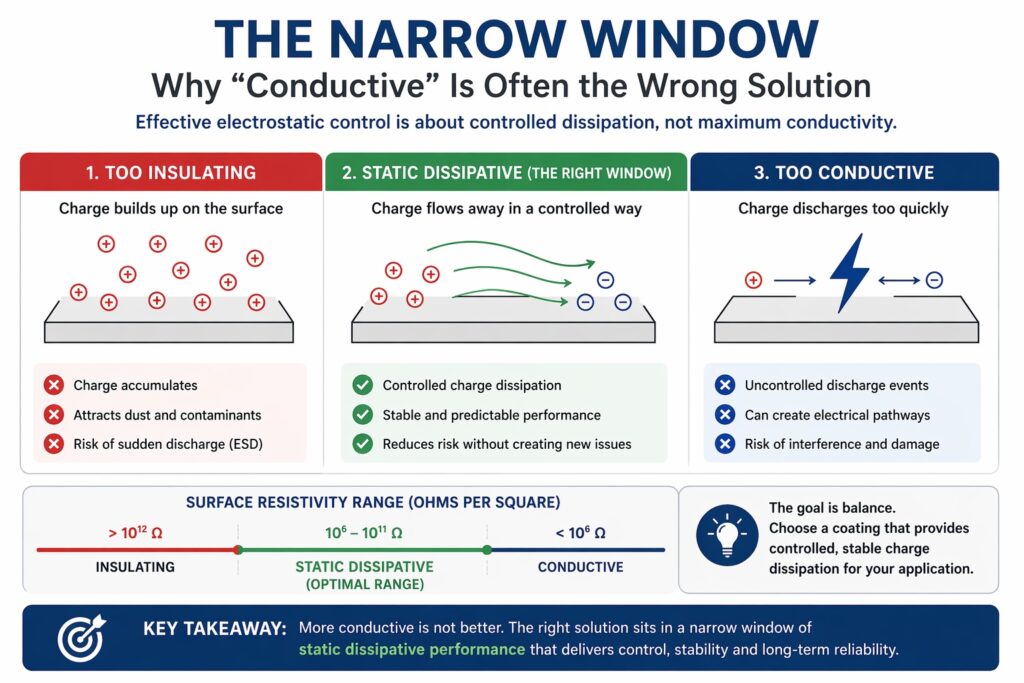
Effective electrostatic control sits within a narrow window. Static dissipative surfaces allow controlled charge flow, avoiding both charge build-up and uncontrolled discharge.
Why “More Conductive” Can Make Things Worse
Increasing conductivity without understanding the system can introduce new problems, often driven by incorrect assumptions about how ESD coatings behave in practice (see ESD paint myths explained).These may not appear immediately but can affect long-term performance and reliability.
Typical risks include:
- uncontrolled discharge events at localised points
- creation of unintended electrical pathways
- increased risk of corrosion in conductive environments
- interaction with sensitive electronics or signal paths
- reduced process stability due to inconsistent surface behaviour
See how filler-based ESD coatings can create instability over time
Why This Is a Surface Engineering Problem
Electrostatic performance is not just a material property. It is the result of how a surface behaves under real operating conditions, including movement, environment, geometry, and interaction with other materials.
This means that selecting a coating is not simply about choosing a conductivity value. It requires understanding how that surface will behave during use, and whether it can maintain consistent performance over time.
Electrical performance is only part of the engineering challenge. Before any coating can provide stable dissipative behaviour, it must first bond reliably to the substrate and maintain that adhesion throughout its service life. Many ESD coating projects fail during qualification because substrate compatibility and adhesion were never properly validated. Why ESD Coatings Fail Before Their Electrical Performance Does.
In many applications, particularly those involving motion or sensitive electronics, stability matters more than raw conductivity.
This is particularly visible in specialist applications such as electrostatic speaker diaphragm coatings, where the surface must maintain highly controlled and uniform dissipative behaviour without introducing instability, uneven charge distribution or unwanted conductive pathways.
This becomes even more important in systems where electrostatic charge is being generated continuously through movement and friction, as the surface must manage both generation and dissipation at the same time.
A More Useful Engineering Approach
Rather than asking whether a surface should be conductive, a more useful question is whether it can control charge behaviour within a defined and stable range.
This approach leads to better outcomes because it focuses on performance, not labels. It considers how charge is generated, how it moves, and how it is dissipated during real operation.
In practice, this often leads to solutions that sit within a controlled dissipative window rather than at either extreme.
Related Reading
For further insight into coating behaviour, process stability, and inspection considerations, the following pages may be useful:
Related insights:
Why Choose SCH Services?
SCH Services supports customers in understanding how coating behaviour affects real-world performance. We focus on practical, process-led guidance to ensure electrostatic control strategies are stable, repeatable, and suited to the application.
Disclaimer: This article is provided as general technical guidance only. Actual electrostatic behaviour depends on material properties, coating performance, environment, and system design. Final decisions should be validated through application-specific testing and engineering review.
