Conformal Coating Strategy & Complex Assemblies Hub
Decision framework for protecting complex PCB assemblies where geometry, connectors and boundary control define what will actually work
This hub helps you decide how to protect complex PCB assemblies.
Once assemblies move beyond simple layouts, conformal coating is no longer just an application step — it becomes a strategy decision. Geometry, connectors, keep-out requirements and contamination risk all start to define what will and will not work.
The articles in this hub focus on boundary control, connector behaviour, hybrid protection approaches, material selection and process limitations — the factors that typically drive failure in real-world assemblies.
Use this hub when the question is no longer just how to coat a PCB, but how to protect the assembly without damaging interfaces, creating risk or making the process unmanageable.
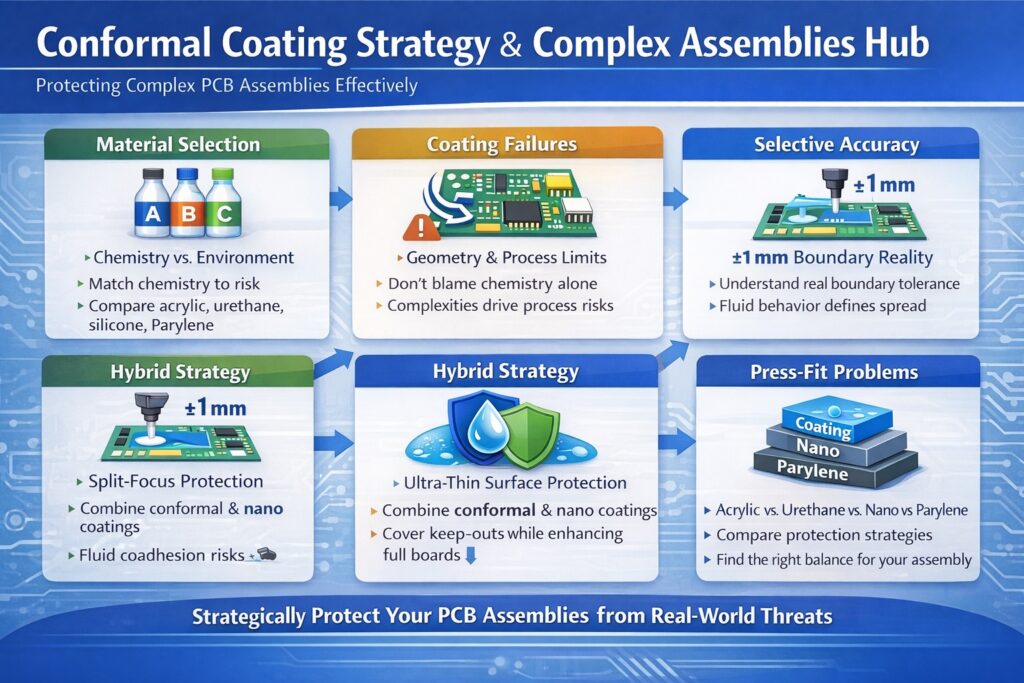
Key decisions in conformal coating strategy for complex PCB assemblies, including material selection, boundary control, connector risks and hybrid protection approaches.
Start Here: What Decision Are You Making?
- Choosing a coating approach? → Start with material selection or coating comparison.
- Dealing with connectors or keep-outs? → Review press-fit connector problems and selective coating boundary control.
- Struggling with coating failures? → Start with why conformal coating fails on complex PCB assemblies.
- Trying to protect difficult geometry? → Explore hybrid coating strategies and nano coating limitations.
Before finalising a strategy, you may also need:
- Conformal Coating Processes Hub — application methods and the wider coating process.
- Conformal Coating Masking Hub — managing keep-outs, connectors and boundary definition.
- Conformal Coating Design Hub — layout decisions that determine coating success.
- Conformal Coating Process Control Hub — converting the selected strategy into a repeatable production process.
- Parylene Basics Hub — when vapour deposition changes the protection strategy completely.
Strategy Map: Start With the Right Question
Use this map to decide what will actually work in practice — not just what looks good on a datasheet.
Start with your main constraint or risk, then follow the relevant article:
- “What coating type should we even be using?” → How to Select a Conformal Coating Material
- “Which protection approach is most suitable overall?” → Conformal Coating vs Nano Coating vs Parylene
- “Why is this assembly difficult to coat at all?” → Why Conformal Coating Fails in Complex PCB Assemblies
- “Can selective coating actually hold this boundary?” → Selective Conformal Coating Accuracy
- “Can nano coating replace conformal coating here?” → What Nano Coatings Can and Can’t Do on PCB Assemblies
- “Do we need a split-function protection approach?” → Hybrid Coating Strategy
- “Why are connectors, especially press-fit types, causing problems?” → Press-Fit Connector Coating Problems
- “What happens if coating reaches the connector interface?” → How Conformal Coating and Parylene Interfere with Press-Fit Electrical Contacts
Full Article Index
Use this section if you already know which topic you need and want direct access to the supporting articles.
| Topic | More | Article |
|---|---|---|
| How to Select a Conformal Coating Material – chemistry versus environment and serviceability | ↓ | ↗ |
| Why Conformal Coating Fails in Complex PCB Assemblies – geometry, connectors and process limits drive failure | ↓ | ↗ |
| Selective Conformal Coating Accuracy – real-world boundary control versus programmed paths | ↓ | ↗ |
| What Nano Coatings Can and Can’t Do – where nano coatings add value and where they cannot replace thicker barriers | ↓ | ↗ |
| Hybrid Coating Strategy – splitting protection across technologies | ↓ | ↗ |
| Press-Fit Connector Coating Problems – geometry, capillary action and interface sensitivity | ↓ | ↗ |
| How Conformal Coating and Parylene Interfere with Press-Fit Electrical Contacts – thin films and ingress affecting contact reliability | ↓ | ↗ |
| Conformal Coating vs Nano Coating vs Parylene – selecting the right protection strategy | ↓ | ↗ |
How to Select a Conformal Coating Material
Selecting a conformal coating is not about choosing the “best material”, but about matching chemistry to environment, geometry and serviceability requirements.
- Different chemistries behave differently under moisture, temperature and chemical exposure.
- Rework and long-term serviceability can be as important as protection performance.
- Material choice must align with application capability and masking strategy.
Why Conformal Coating Fails in Complex PCB Assemblies
Failures on dense, connector-heavy boards are often blamed on materials, but are commonly driven by process architecture, geometry and boundary control.
- Geometry and mixed surfaces drive unpredictable coating behaviour.
- Connector zones create hidden electrical risk.
- Masking and boundary definition must be solved early.
Selective Conformal Coating Accuracy
A programmed coating path does not by itself define the final coating boundary. Fluid behaviour, valve performance, process settings and PCB geometry determine where the coating actually ends.
- Boundary capability must be established using the actual coating, valve, process settings and assembly geometry.
- Tighter programmed paths do not automatically produce equally tight wet coating boundaries.
- Complex geometry, capillary behaviour and material spread increase edge variability.
For practical boundary capability and the conditions that influence selective coating accuracy, see Selective Conformal Coating Accuracy → ↑ Back to Index
What Nano Coatings Can and Can’t Do
Nano coatings are best understood as ultra-thin surface modification or protection layers, rather than universal replacements for conventional conformal coatings.
- They can provide useful hydrophobic or surface-protection behaviour in suitable applications.
- They cannot provide the same physical film build as conventional conformal coatings where thickness is part of the protection mechanism.
- They can be particularly useful as part of a broader or hybrid protection strategy.
Hybrid Coating Strategy
Some assemblies cannot be protected reliably with one coating technology alone. A hybrid approach separates different protection functions across the assembly.
- Different technologies can perform different protection roles.
- Hybrid approaches can reduce masking or interface problems in difficult areas.
- The process sequence, compatibility and function of each layer must be clearly defined.
Press-Fit Connector Coating Problems
Press-fit connectors combine tight geometry, exposed interfaces and capillary risk, making them one of the more challenging PCB features to protect around reliably.
- Environmental protection and electrical function can conflict at the connector interface.
- Capillary action can move liquid coating into hidden regions.
- Masking, keep-out definition and process selection become critical.
Press-Fit Electrical Contact Failure
Even thin coating films can disrupt connector performance where they reach critical metal-to-metal contact interfaces or migrate into hidden connection regions.
- Coating on electrical contact surfaces can interfere with connection performance.
- Capillary ingress can create hidden contamination pathways.
- Parylene deposition requires particular attention because vapour-phase deposition can reach very small accessible gaps.
Conformal Coating vs Nano Coating vs Parylene
This comparison explains how each protection approach differs according to geometry, thickness, coverage, process capability and manufacturing constraints.
- Conventional conformal coating is often a practical primary protection method for PCB assemblies.
- Nano coatings can provide useful ultra-thin surface functionality where appropriate.
- Parylene provides highly conformal vapour-deposited coverage but introduces different masking, equipment and process requirements.
Need Help Defining the Right Protection Strategy?
Complex PCB assemblies often need the protection concept to be resolved before coating materials, equipment or production settings are selected. SCH Services can review the assembly, environmental requirements and manufacturing constraints to help define a practical protection route.
- Conformal coating, nano coating and Parylene strategy selection.
- Connector and keep-out risk assessment.
- Boundary-control and masking feasibility.
- Hybrid protection strategies for difficult assemblies.
- Application-method and production feasibility review.
- Trial, validation and process-development planning.
Why Choose SCH Services?
Complex assemblies need more than a material recommendation. SCH Services helps customers define realistic coating strategies around geometry, connectors, masking, inspection and manufacturability so the protection route works in real production rather than only in theory.
- Strategy before process: protection requirements, geometry and interface risks are considered before the production route is fixed.
- Multi-technology capability: practical understanding of conformal coatings, nano coatings, Parylene and hybrid approaches.
- Production-focused decisions: masking, application, inspection, rework and scale-up are considered alongside protection performance.
- Practical validation: support can extend from feasibility and trials through to process definition and stable manufacturing.