Hybrid Coating Strategy: Combining Conformal and Nano Coatings for Complex PCBAs
Using a process-led coating strategy where one material cannot safely solve the whole assembly
Most coating failures in complex PCB assemblies are not caused by the coating material alone. They are usually caused by geometry, connector interfaces, contamination risk, boundary control and process limitations that a single coating route cannot manage reliably.
A hybrid coating strategy separates function. Conformal coating provides primary protection where thickness and insulation matter, while nano coating adds ultra-thin surface enhancement in areas that cannot safely accept thicker film build.
This topic forms part of a wider coating process control framework. See the Electronic Coating Process Control for Reliability guide for full context.
Comparing advanced coating options? Use the CytoPel coating selection matrix to compare ultra-thin, hydrophobic, PFAS-free, hard and UV-curable coating routes that may support a hybrid coating strategy.
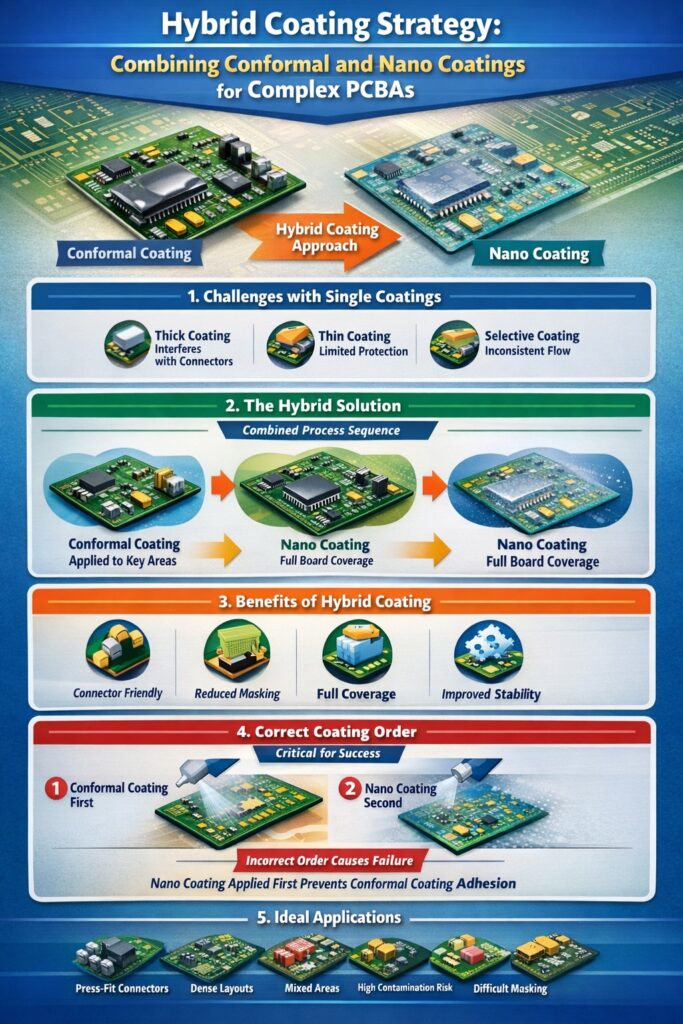
Hybrid coating combines conformal coating for primary protection with nano coating for ultra-thin surface enhancement across connector-sensitive and difficult-to-mask regions.
1) The problem with single coating approaches
Modern PCB assemblies often include press-fit connectors, tight geometries, exposed interfaces and mixed functional areas. These create conflicting requirements that a single coating approach may not resolve reliably.
- Thick coatings: provide protection but can interfere with connectors, contacts and keep-out zones.
- Thin coatings: may be safer for interfaces but offer limited insulation and physical barrier protection.
- Selective coating: improves placement but does not fully control final flow, wicking or edge behaviour.
This leads to compromise, inconsistency and increased process risk. For connector-specific risks, see Protecting Connector Interfaces Without Conformal Coating Them.
2) Hybrid coating strategy: the structured approach
A hybrid coating strategy combines conformal coating and nano coating into a defined process sequence. The aim is not to add complexity for its own sake, but to use each coating only where it fits the real function of the assembly.
- Apply conformal coating to defined protection areas.
- Keep connector-sensitive regions free from thick coating.
- Apply nano coating as an ultra-thin surface enhancement layer where appropriate.
This creates a process system, not just a coating choice.
This approach is most relevant where a single coating process cannot manage geometry, keep-outs and contamination risk reliably. For the upstream problem this solves, see Why Conformal Coating Fails in Complex PCB Assemblies.
3) Separation of function: why it works
Hybrid coating works because each coating is used for what it does best, rather than asking one coating to meet conflicting requirements across the whole PCB assembly.
- Conformal coating: thickness, insulation, environmental protection and local mechanical robustness.
- Nano coating: ultra-thin surface functionality, hydrophobic behaviour and coverage in areas where heavy film build is not acceptable.
This can reduce the need to compromise between protection and interface safety, but only when the limits of each material are understood clearly.
For nano-specific limits, see What Nano Coatings Can and Can’t Do on PCB Assemblies. For wider decision logic, see Conformal Coating vs Nano Coating vs Parylene.
Important: Nano coatings are not a direct replacement for conformal coatings. They are an ultra-thin enhancement layer used within a wider protection strategy.
4) Managing connectors and critical interfaces
Press-fit connectors and contact interfaces are high-risk areas for coating. Capillary action and coating flow can pull liquid material into holes, contacts and keep-out zones, interfering with electrical or mechanical performance.
The hybrid approach avoids this by structuring protection around function rather than trying to force one material across the whole assembly.
- Keep thick coatings away from contact interfaces.
- Use nano coating where ultra-thin surface functionality is useful.
- Reduce reliance on difficult or unstable masking where appropriate.
For the wider interaction between geometry, contamination and process limits, see Why Conformal Coating Fails in Complex PCB Assemblies and Selective Conformal Coating Accuracy.
5) Reducing masking complexity and process risk
Masking is one of the largest sources of variation in coating processes. Complex geometries and tight tolerances make masking difficult to apply consistently, especially around connectors, test points and mixed-height components.
By allowing nano coating to support surface functionality in sensitive areas, the hybrid model can reduce the burden placed on masking without removing process control where it still matters.
- Masking requirements can be reduced.
- Operator dependency can decrease.
- Repeatability can improve when the sequence is controlled.
Where teams assume selective coating alone will deliver sharp local boundaries, it is worth reviewing Selective Conformal Coating Accuracy: Why ±1 mm Is the Reality.
6) The role of nano coating in the system
Nano coatings provide ultra-thin surface behaviour rather than significant film thickness. In a hybrid strategy, their role is to add functionality where conventional conformal coating would create boundary or interface problems.
- Uniform surface treatment with minimal build.
- Hydrophobic or low-surface-energy behaviour.
- Surface coverage in regions that cannot safely accept thick coating.
They do not provide significant thickness or physical barrier protection on their own. Their limitations need to be understood clearly in system design, as discussed in What Nano Coatings Can and Can’t Do on PCB Assemblies.
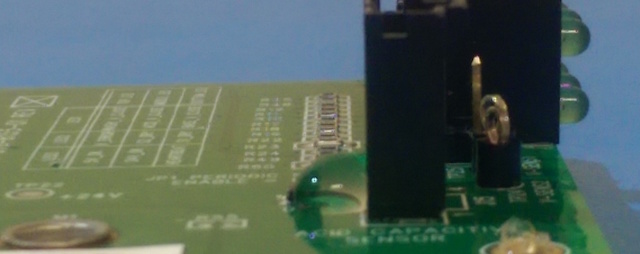
Water droplet behaviour showing how a nano coating can add hydrophobic surface performance near connector areas where thick conformal coating is not appropriate.
7) Coating sequence is critical
The coating sequence is a critical part of the hybrid process. In most hybrid conformal/nano strategies, the conventional coating must be applied first and the nano coating applied afterwards.
- Apply conformal coating first to the defined protection areas.
- Inspect and cure the conformal coating as required by the process.
- Apply nano coating second as the ultra-thin surface enhancement layer.
If nano coating is applied first, it can create a hydrophobic or low-surface-energy surface that prevents proper adhesion of the liquid coating.
Sequence matters: if nano coating is applied before liquid conformal coating, it can create a low-energy surface that prevents proper wetting and adhesion.
Sequence control should be treated as part of the wider process plan, alongside surface preparation and thickness verification.
8) Where hybrid coating delivers the most value
Hybrid coating is most effective where geometry and function conflict. It is particularly valuable when primary protection is needed in some regions, while other zones must remain free from thick-film interference.
- Press-fit connector assemblies.
- Dense PCB layouts with tight spacing.
- Mixed coated and uncoated functional areas.
- Assemblies with conductive particle or contamination risk.
- Applications where masking is difficult, unstable or highly operator-dependent.
This is why hybrid coating is often a process architecture decision rather than a simple material substitution.
9) When hybrid coating is not the right answer
Hybrid coating is not automatically the best solution. In some applications, the required environmental, electrical or thermal performance may dictate a specific coating route, even if that makes masking difficult.
- If full barrier thickness is required everywhere, nano coating cannot replace conformal coating.
- If high-temperature performance is the dominant requirement, coating selection must prioritise thermal stability.
- If masking cannot be controlled, the assembly design or process route may need review.
- If connector contamination risk is unacceptable, the protection strategy must be validated before production release.
For heat-driven applications, see High-Temperature Protective Coatings for Electronics.
10) The real decision: process architecture
Hybrid coating is not just a material selection problem. It is a process design decision.
The real engineering question is how to combine boundary control, connector safety, contamination resistance and manufacturability into one stable process.
The key choices are:
- Allow coating everywhere.
- Exclude coating from critical areas.
- Combine both approaches in a controlled sequence.
The hybrid strategy often provides the best balance between performance, manufacturability and risk when no single route can safely satisfy the whole assembly.
11) Summary: hybrid coating as a system solution
A hybrid coating strategy delivers a structured solution for complex PCB assemblies where protection requirements conflict with connector safety, masking limits or surface functionality.
- Strong primary protection from conformal coating.
- Ultra-thin surface enhancement from nano coating.
- Reduced masking complexity where appropriate.
- Improved process stability when the sequence is controlled.
For complex geometries, combining coatings can be more effective than trying to optimise a single material beyond its realistic process limits.
Related process guidance
Hybrid coating only works when it is treated as part of a wider process control system. The most relevant follow-on topics are boundary control, connector protection, surface preparation and inspection.
Process control and failure context
- Electronic Coating Process Control for Reliability
- Why Conformal Coating Fails in Complex PCB Assemblies
Boundary, connector and application control
- Selective Conformal Coating Accuracy: Why ±1 mm Is the Reality
- Protecting Connector Interfaces Without Conformal Coating Them
- Surface Preparation & Cleanliness for Reliable Coating
Verification and coating selection
Why Choose SCH Services?
SCH Services helps customers design hybrid coating strategies that work in production, not just in principle. We support process definition, boundary planning, coating sequence, masking strategy and validation for complex PCB assemblies.
Our role is to help define where each coating technology should be used, how the sequence should be controlled and how the finished process should be inspected before production release.
- Conformal Coating Solutions
- Conformal Coating Services
- Advanced Functional Coatings
- Advanced Functional Coating Services
- Conformal Coating Training
- Coating Consultancy
For support with hybrid coating feasibility, coating sequence or process validation, contact SCH Services.
This article provides general technical guidance only. Final coating strategy, material selection, masking approach, safety and compliance decisions should be validated against the specific assembly, production process, applicable standards and qualification tests.