Thickness Verification Plans (AQL, Coupons, SPC)
How to control coating build using sampling plans, witness coupons and SPC
Conformal coating thickness verification confirms that the applied film build is suitable for the design intent, reliability target and customer requirement.
Thickness control should not rely on occasional measurement alone. It should use a defined plan that combines sampling, witness coupons, measurement methods and trend monitoring.
UV inspection confirms coating presence and boundary definition, but it cannot verify film thickness.
UV inspection should also be interpreted carefully. Assemblies can appear acceptable under UV light while still containing thin coating, missed coverage, contamination or other hidden reliability risks. For practical examples, see Why UV Inspection Can Give False Pass Results.
This topic forms part of a wider coating process control framework. See the Electronic Coating Process Control for Reliability guide for full context.
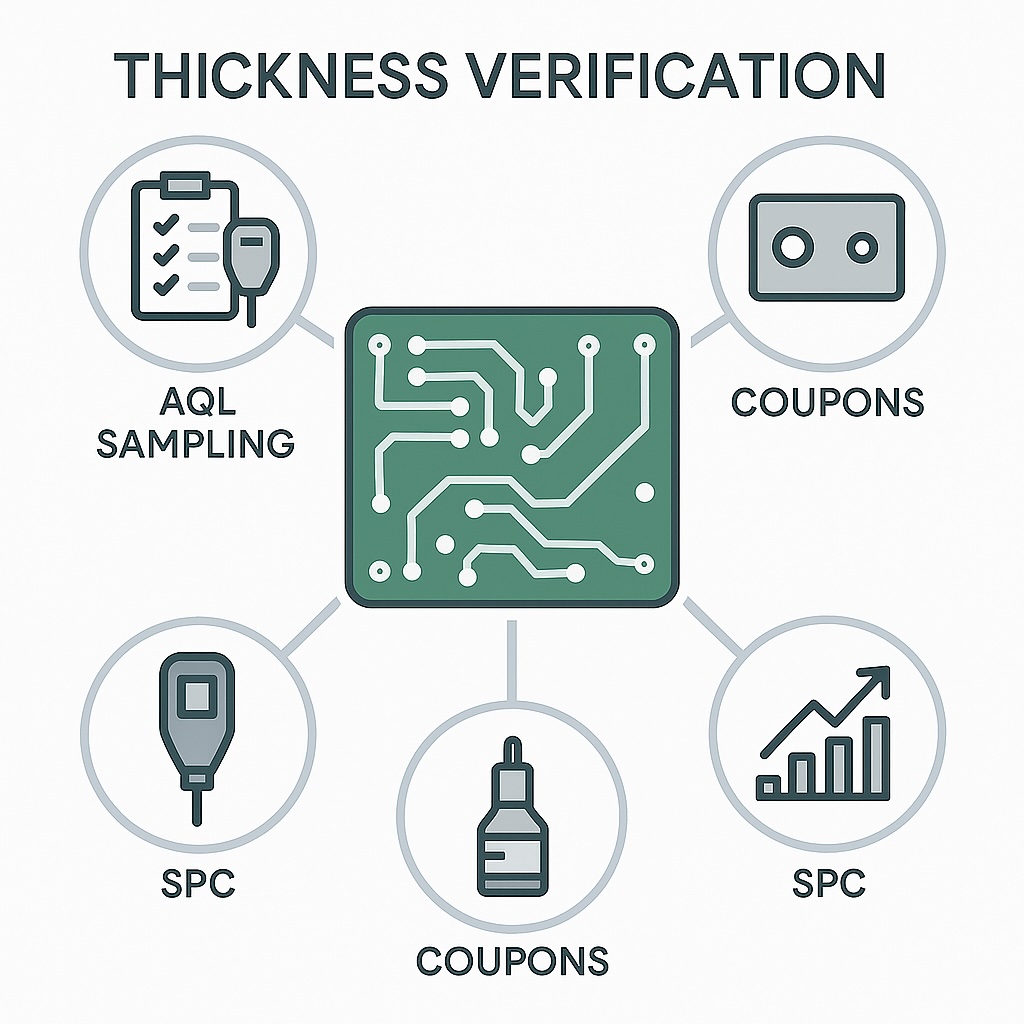
Thickness verification combines sampling, coupons, SPC monitoring and suitable measurement tools to control coating build.
Quick Links
Why thickness verification matters
Thickness directly affects coating performance. If the film is too thin, insulation or barrier protection may be insufficient. If the film is too thick, defects such as cracking or delamination can occur.
Thickness verification supports defensible acceptance decisions and helps prove that the coating process is stable, especially where customers require objective evidence.
However, one thickness reading does not always represent the whole PCB assembly. Local geometry, drainage, pooling, shadowing and measurement location can all affect film build. For a practical production warning, see Why One Coating Thickness Reading Can Be Misleading.
It should be reviewed alongside surface preparation, test coupons and witness boards, and wider process validation.
AQL sampling for conformal coating thickness verification
AQL, or Acceptable Quality Level, provides a statistically based plan to check a defined number of boards in each lot.
Thickness measurements can be taken at defined locations across the AQL sample to support batch conformity without measuring every unit.
- Choose inspection levels and AQL values appropriate to product risk.
- Define measurement locations such as edges, accessible pads, high-risk areas and representative coating zones.
- Specify the measurement method and acceptance limits before production starts.
- Escalate to tightened sampling when trends drift or failures occur.
Key point: AQL is a sampling method, not a process control method by itself. It must be supported by defined measurement locations, reaction rules and process evidence.
Witness coupons for conformal coating thickness verification
Witness coupons and test coupons allow repeatable measurement without relying only on customer hardware.
Coupons can reflect the coating process window, including application method, viscosity, environment, cure and chamber loading.
- Use coupon geometries that reflect component density, surface finish and coating challenges.
- Capture pre-cure and post-cure readings if solvent loss affects final build.
- Use coupons where destructive measurement or cross-sectioning may be required.
- Archive coupon data and images for traceability and customer evidence packs.
For deeper guidance, see Test Coupons & Witness Boards.
SPC for conformal coating thickness verification
SPC, or Statistical Process Control, tracks thickness over time so drift and special-cause variation can be detected before defects escape.
SPC is most useful when thickness data is collected consistently from defined locations and linked to a reaction plan.
- Define control limits from stable baseline data.
- Log key inputs such as viscosity, temperature, line speed, cure profile and batch conditions.
- Use control charts to identify drift, instability or special-cause events.
- Trigger corrective actions such as maintenance, recipe review, retraining or process hold when rules are violated.
SPC data must lead to action. Recording data without reaction rules creates paperwork, not control.
Thickness trends can also move when coating viscosity changes during production. Solvent loss, temperature change, material age or inconsistent replenishment can alter coating flow and film build even when the application settings remain unchanged. For a practical process-control warning, see the bulletin Conformal Coating Viscosity Drift: The Hidden Cause of Process Variation.
Thickness can also drift across a production run as material condition, temperature, replenishment practice, equipment behaviour and operator adjustments change over time. For a practical production example, see the bulletin Why Conformal Coating Thickness Changes During Production Runs.
Thickness measurement methods
The correct measurement method depends on coating type, substrate, thickness range, accessibility and whether destructive testing is acceptable.
- Eddy-current gauges: fast, non-destructive readings on suitable metallic substrates.
- Optical interference / reflectometry: non-contact measurement for transparent coatings, Parylene and ultra-thin films.
- Destructive cut-back and microscopy: useful on coupons or test pieces where detailed validation is required.
For reliable results, instruments should be calibrated to the substrate and coating system. Reference standards or coupons should be used before production measurement to support accuracy and repeatability.
Summary
Robust conformal coating thickness verification combines AQL sampling, witness coupons, SPC monitoring and fit-for-purpose measurement tools.
The goal is not simply to prove that one board passed. The goal is to show that the coating process is capable, stable and producing the required film build over time.
A passing thickness result also does not automatically prove complete coating coverage. Critical areas can still be missed, shadowed or poorly protected even when the measured coating thickness is within specification. For a practical inspection warning, see the bulletin Coating Thickness Passes but Coverage Still Fails.
The same principle applies to masking. Correctly protected keep-out areas do not prove that the coated areas are defect-free. De-wetting, contamination, fish eyes, craters, thin coverage and adhesion loss can still occur even when masking has done its job. See Why Perfect Masking Still Produces Conformal Coating Defects.
Why Choose SCH Services?
SCH Services helps customers build practical coating thickness verification plans that work in production, not just in documentation.
We support measurement method selection, witness coupon strategy, inspection planning, operator training and process troubleshooting where thickness variation affects coating reliability.
- Conformal Coating Solutions
- Conformal Coating Services
- Conformal Coating Training
- Coating Consultancy
- Thickness Measurement Equipment
- UV Inspection Equipment
For support with thickness verification, witness coupons or coating inspection plans, contact SCH Services.
This article provides general technical guidance only. Final thickness verification plans, sampling levels, measurement methods, acceptance limits and process controls should be validated against the specific assembly, coating chemistry, customer specification, production method and applicable standards.