
Nano Coatings for Electronics & Precision Components
Ultra-thin coating technologies for surface control, contamination management and selective functional performance
Nano coatings for electronics are not a single coating type, but a technology platform used to deliver ultra-thin functional performance.
They are typically selected where coating thickness must remain minimal, but surface behaviour, contamination control or selective protection is still required.
In many applications, nano coatings are considered as an alternative to conformal coating or Parylene where full barrier protection is not necessary, or where conventional coatings would introduce risk through thickness, masking complexity or interference with functional interfaces.
Depending on the chemistry and application method, nano coatings can deliver hydrophobic and oleophobic behaviour, low surface energy performance, contamination resistance, anti-smudge functionality and selective low-build protection while preserving tolerances, connectors, optics and fine geometries. For route comparison, start with the Coating Selection Guide. For behaviour classification, use the surface vs film vs barrier guide.
Selection check: Choose nano coatings when the requirement is ultra-thin functional performance, surface behaviour or selective low-build protection. If the application needs corrosion protection, dielectric isolation or long-term environmental reliability, compare nano coating vs conformal coating before selecting the route.
You Are in the Right Place If…
- Coating thickness must remain extremely low
- Connectors, contacts, optics or precision features cannot tolerate heavy build
- You need hydrophobic or oleophobic surface behaviour
- Contamination control or cleanability is a key requirement
- You are trying to reduce masking complexity or process risk
- You are exploring alternatives to conformal coating or Parylene for specific areas
If the real requirement is full environmental protection or long-term corrosion resistance, nano coatings alone are unlikely to be sufficient. For common boundary errors, see limitations of hydrophobic coatings.
What Nano Coatings Actually Represent
Nano coatings describe the thickness and delivery method, not a single performance outcome.
A nano coating may be hydrophobic, oleophobic, chemically resistant, abrasion-resistant or PFAS-free depending on the material system used. Many of these effects are achieved using low surface energy systems such as fluoropolymer coatings for electronics, but alternative chemistries are also used depending on regulatory and performance requirements.
Where the distinction between surface behaviour, film-forming coatings and true barrier protection matters, see our surface vs film vs barrier guide. If the application depends mainly on water behaviour, review when to use hydrophobic coatings.
The diagram below compares nano coatings, conformal coating and Parylene for electronics, focusing on thickness, masking requirements and protection level.
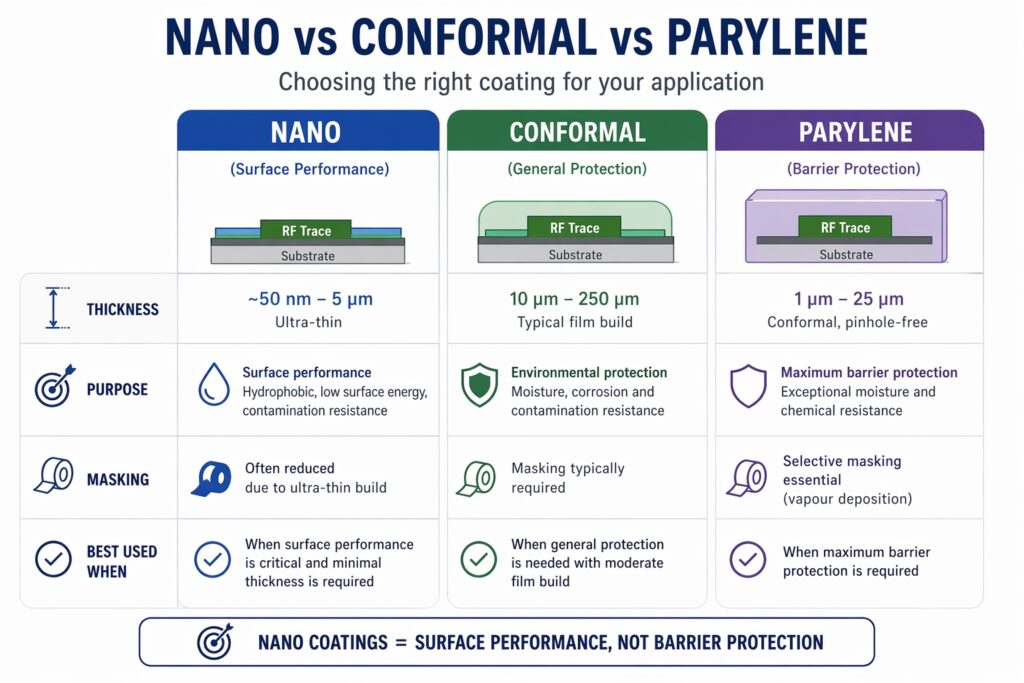
Comparison of nano coatings, conformal coating and Parylene highlighting thickness, masking requirements and protection differences.
Where Nano Coatings Fit
Correct selection depends on whether the requirement is surface behaviour, dimensional control or true protection. For direct comparison against protective systems, see nano coating vs conformal coating.
If nano coating is not enough
→ For full PCB protection, corrosion resistance or environmental durability, review conformal coating solutions
→ For ultra-uniform coverage, complex geometry and high-performance barrier protection, review Parylene coating solutions
→ For surface behaviour only, review hydrophobic coatings
→ For film-forming selective protection, review transitional film-forming coatings
Typical Uses for Nano Coatings
- Low-build hydrophobic or oleophobic protection on PCB assemblies
- Connector-adjacent areas where conventional coating build creates risk
- Sensors, optics and precision components where tolerances are critical
- Surface contamination control or improved cleanability
- Selective functional protection where full conformal coating is unnecessary
- Applications where masking reduction may be possible after validation
Nano coatings are normally evaluated as part of a wider coating selection process rather than treated as a direct substitute for conformal coating or Parylene. For the difference between water repellency and protection, see why hydrophobic coatings don’t protect electronics.
Implementation Pathways
- Customer-Led Evaluation – Materials evaluated and applied in-house where suitable coating capability exists
- SCH-Enabled Implementation – Support with material selection, process development, training and equipment
- SCH Coating Services – Controlled coating application for feasibility, validation or production work
For customers who want to evaluate nano coatings on real components before committing to internal setup, SCH provides advanced functional coating services for application, validation and production coating support.
Because nano coatings are highly sensitive to surface preparation, contamination, handling and application method, small process changes can significantly affect performance. Visual appearance or water beading alone is not a reliable validation method, so coating behaviour must be confirmed under real operating conditions.
Need Help Choosing the Correct Route?
If you are unsure whether your application needs nano coating, hydrophobic coating, ultra-thin coating, conformal coating or Parylene, SCH can review the part, exposure conditions and performance requirement before recommending a coating route.
Why Choose SCH Services?
SCH supports nano coating projects from initial evaluation through to controlled implementation, ensuring ultra-thin coating performance is matched to the real application requirement.
- 🔬 Ultra-Thin Coating Knowledge – Understanding of low-build functional coating behaviour
- 🛠️ Process Development Support – Practical support with surface preparation, application control and validation
- 💧 Surface Performance Focus – Hydrophobic, oleophobic and contamination-control coating routes
- 🔗 Integrated Coating Strategy – Linking nano coatings with conformal coating, Parylene and advanced functional coating routes where required
📞 +44 (0)1226 249019 | ✉ sales@schservices.com | 💬 Discuss Your Application ›
