Mon - Thur 7.30-15.30   Fri 7.30-14.00
Filler-free ESD coating using conductive polymer technology

Fillerโ€‘Free ESD Coating: The Next Generation of Static Control


When you hear โ€œESD coating,โ€ most people picture a paint loaded with carbon or metal particles. But thatโ€™s exactly where conventional solutions fall short. The future lies in filler-free ESD coatings, and ProShieldESD is leading that shift.

Unlike traditional ESD paints and molded plastics that depend on conductive fillers, ProShieldESD uses a pure polymer backbone to deliver permanent, homogeneous static dissipation. Itโ€™s a technology that doesnโ€™t just improve coatings โ€” it transforms how industries approach ESD control.

For a broader overview of permanent static control technologies, see our ProShieldESD coating platform.


Why Filler-Based Solutions Fail

Fillerโ€‘based ESD coatings and conductive plastics have long been the defaultโ€”but they come with built-in compromises:
โ€ข Segregation & clustering: Conductive particles (carbon, metal) can shift or clump during mixing, altering performance.
โ€ข Variable conductivity: Rather than a uniform layer, resistivity varies across a surface โ€” creating weak zones.
โ€ข Drift over time: Particles wear, get damaged, or shift, especially under stress or in low humidity.
โ€ข Limited retrofit potential: You canโ€™t reliably convert existing surfaces with molded ESD plastics โ€” you need custom parts or high-cost replacements.

Many of these issues are explored in more detail in our ESD Control Knowledge Hub, including humidity sensitivity and long-term performance drift.


How ProShieldESD Changes the Game

1. Conductivity built in, not added

ProShieldESDโ€™s conductivity comes from a 100% conductive polymer matrix โ€” no fillers, no additives. The result is a coating whose static control is intrinsic and integral, not surface-limited.

2. Multi-chemistry platform

What makes this even more powerful is that the same foundational technology can be adapted across chemistries โ€” PU, epoxy, water-based, solvent-based โ€” and still maintain the same performance. Thatโ€™s the platform difference.

3. Universal retrofit

Existing assets like floors, walls, metal structures, plastics, foams, or cartons can be coated directly. Thereโ€™s no need to replace with engineered parts or rework your infrastructure.

4. Stability under extremes

Unlike filler-based coatings that fail under low humidity or heavy use, ProShieldESD remains stable. It doesnโ€™t drift. It doesnโ€™t degrade. It doesnโ€™t need reapplication.

Use Cases Across Industries

Because itโ€™s a platform (not a single product), ProShieldESDโ€™s filler-free coating adapts to multiple sectors:

  • Electronics & Semiconductor โ€” critical work surfaces, benches, ESD-safe trays
  • Aerospace & Defence โ€” composite structures, metal racks, test jigs
  • Military & Rugged Systems โ€” field-grade housings, transit cases
  • Automotive & Battery โ€” factory floors, battery enclosures
  • Energy & Chemicals โ€” piping, drums, containment vessels
  • RF & Antenna โ€” radomes, enclosures where signal integrity matters
  • Packaging & Logistics โ€” cartons, foams, crates
  • Explosives & Pyrotechnics โ€” safe work surfaces under low-humidity

These are examples, not limits โ€” the platform extends into applications where traditional filler-based ESD materials struggle to maintain stable conductivity, particularly under low humidity, mechanical wear, or long-term use. This is why platform-based solutions such as the ProShieldESD filler-free ESD coating platform are increasingly adopted.


Filler-Free vs Filler-Based: A Side-by-Side Comparison

Aspect Filler-Based Coatings / Plastics Filler-Free (ProShieldESD Platform)
Dependence on particles Yes (carbon, metal powders) No โ€” conductivity built into polymer backbone
Uniformity Varies, prone to weak spots Homogeneous across entire surface
Drift / degradation Likely over time Stable, permanent, low maintenance
Retrofit ability Limited to purpose-made parts Can be applied to existing assets
Humidity / environment impact Sensitive, loses performance Maintains conductivity in diverse conditions
Chemistry flexibility Fixed for each formulation Platform supports multiple chemistries

The Bigger Picture: Platform Thinking

Yes โ€” weโ€™re talking filler-free coating techniques here. But what elevates it is positioning this as a platform โ€” one that scales, adapts, and future-proofs static control solutions.

โ€ข The same technology underpins every variant (PU, epoxy, water-based, solvent-based).
โ€ข Performance doesnโ€™t change even if the formulation does.
โ€ข It allows ESD control to be modular, systemic, and unified across operations.

That means less disruption, fewer specialty parts, and more reliability across your entire facility.


Getting Started

Transitioning to filler-free ESD control doesnโ€™t require a total overhaul. ProShieldESDโ€™s retrofit-friendly approach means you can roll out pilot sections โ€” floors, benches, enclosures โ€” and expand gradually, all while maintaining full operational continuity.

๐Ÿ“ž Call: +44 (0)1226 249019

โœ‰ Email: sales@schservices.com

๐Ÿ’ฌ Contact Us:

๐ŸŒ Learn more: ProShieldESD Platform Page

ProShield ESD permanent dissipative coating applied across multiple substrates for long-term static control

Introducing ProShield ESD: A New Era in Dissipative Coatings


Electrostatic discharge (ESD) is a silent but costly risk in industries where sensitive electronics, packaging, and materials must be protected. Traditional anti-static coatings โ€” including temporary sprays, carbon fillers, and metal-based additives โ€” have long been used to manage static. In reality, many of these solutions degrade over time, deliver uneven performance, and create hidden costs through repeated reapplication.

ProShield ESD represents a new generation of dissipative coatings. It is designed to provide permanent static protection, broad substrate compatibility, and a lower lifetime cost in a single, scalable solution.

For a deeper technical explanation of why filler-based ESD paints lose performance over time, see the Conductive Polymer Technology hub.


Why Industries Need a Better Static Control Solution

Industries such as electronics manufacturing, automotive, aerospace, and medical devices demand higher levels of reliability than ever before. However, many conventional ESD protection methods struggle to meet modern requirements:

  • Limited lifespan โ€“ Traditional coatings can degrade, requiring frequent reapplication.
  • Narrow compatibility โ€“ Performance can vary widely across plastics, foams, packaging, and flooring.
  • High hidden costs โ€“ Short service life increases downtime, rework, and material waste.

As electronic components become smaller and more sensitive, and supply chains more demanding, manufacturers need static control solutions that deliver reliable, long-term performance rather than temporary fixes.

Fundamentals of static control and resistance ranges are explained in the ProshieldESDย FAQs.


What Makes ProShield ESD Different?

ProShield ESD is engineered to deliver uniform, dissipative performance without relying on temporary sprays or unstable conductive fillers. Instead, it provides a consistent static control layer designed to remain effective for the working life of the substrate.

Key benefits of ProShield ESD

  • Permanent ESD protection โ€“ Designed to eliminate routine reapplication cycles.
  • Low-cost solution โ€“ Positioned to reduce both upfront and lifetime costs.
  • Versatile substrate compatibility โ€“ Effective on plastics, foams, packaging, walls, and flooring.
  • No carbon or metal fillers โ€“ Consistent performance without contamination risks.
  • Lifecycle reliability โ€“ Protects components during production, handling, and transport.

Applications Across Modern Industries

ProShield ESD is suited to a wide range of environments where static control is critical, including:

  • Electronics manufacturing โ€“ Protecting semiconductors and circuit assemblies from ESD damage.
  • Automotive and aerospace โ€“ Safeguarding sensitive onboard systems with long-term static protection.
  • Medical devices โ€“ Supporting reliability where performance and safety are essential.
  • Logistics and packaging โ€“ Enabling ESD-safe handling and storage of high-value components.

Typical industry use cases are outlined in more detail on our ProShield ESD applications page.


A Smarter, More Sustainable Approach

By reducing the need for repeated coating applications, ProShield ESD helps lower downtime, minimise material waste, and cut overall operating costs. This approach supports modern sustainability goals while improving process efficiency and reliability.


The Future of Dissipative Coatings

ProShield ESD is more than a single product โ€” it is a long-term static control strategy for industries that cannot afford compromise. By combining permanent performance, wide compatibility, and reduced lifetime cost, it sets a new benchmark for dissipative coatings.

Businesses that adopt ProShield ESD gain measurable advantages in reliability, cost control, and compliance โ€” helping secure performance in an increasingly demanding manufacturing landscape.

If youโ€™re evaluating alternatives to traditional ESD paints, speak to our team via the contact page to discuss suitability and cost.

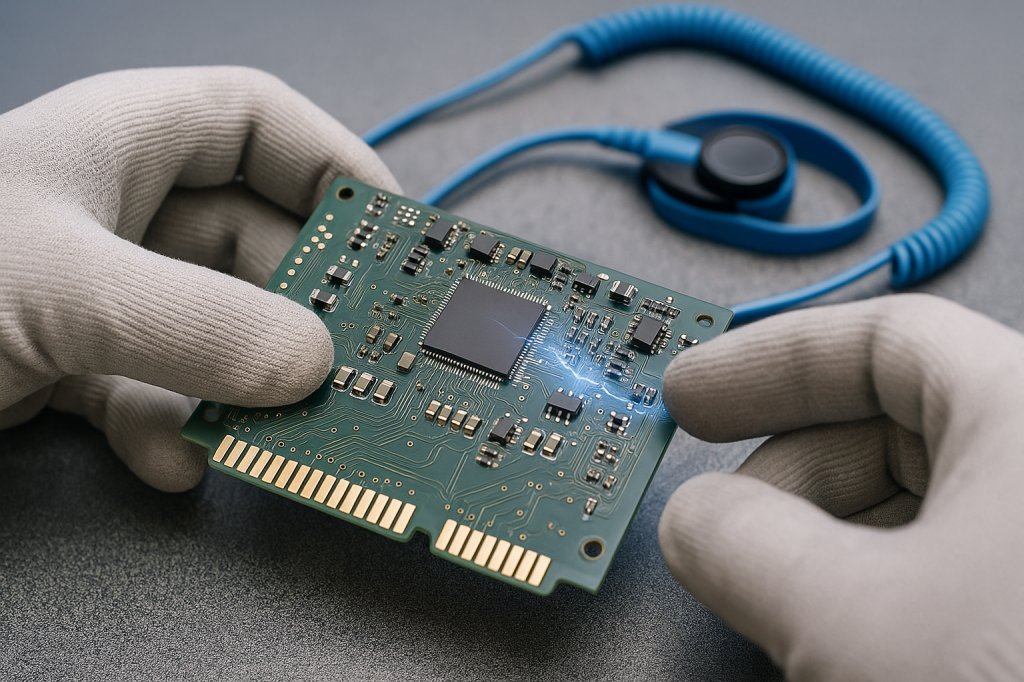
Static control and electrostatic discharge protection in industrial electronics manufacturing

Why Static Control Matters More Than Ever in Modern Industries


In todayโ€™s high-tech manufacturing and logistics environments, static electricity is far more than an occasional nuisance โ€” it represents a significant commercial, quality, and safety risk. Across electronics manufacturing, medical devices, automotive systems, aerospace, and logistics, uncontrolled electrostatic discharge (ESD) can damage sensitive components, disrupt production, and compromise long-term reliability.

The Hidden Risk of Electrostatic Discharge (ESD)

Electrostatic discharge occurs when two objects with different electrical charges come into contact or close proximity, allowing charge to transfer rapidly. While a human may only feel a static shock at around 3,000 volts, modern electronic components can be permanently damaged by discharges as low as 30 volts. As electronics continue to shrink and performance densities increase, tolerance to ESD continues to decline.

This means effective static control is no longer optional โ€” it is a fundamental requirement for modern manufacturing and handling environments.

Industry Impact: Where ESD Causes the Most Damage

  • Electronics Manufacturing โ€“ ESD can cause latent damage to semiconductors, leading to early-life failures, reduced yield, and costly field returns.
  • Automotive & Aerospace โ€“ Modern vehicles and aircraft rely heavily on complex electronics; ESD-related failures can impact safety-critical systems.
  • Medical Devices โ€“ Reliability is essential. ESD damage in medical electronics can compromise performance and patient safety.
  • Logistics & Packaging โ€“ Poor static control increases the risk of component damage during storage and transport and can introduce ignition hazards in sensitive environments.

Why Static Control Is Becoming More Critical

  • Component Miniaturisation โ€“ Smaller geometries and thinner insulating layers increase ESD sensitivity.
  • Extended Global Supply Chains โ€“ ESD damage can occur at any stage, from manufacture through shipping and final assembly.
  • Compliance and Quality Expectations โ€“ Standards and customer requirements increasingly demand robust ESD controls.
  • Waste Reduction and Sustainability โ€“ Preventing scrap and rework lowers environmental impact and total cost.

Modern Approaches to Static Control

Traditional static control methods โ€” such as temporary sprays or heavily filled conductive paints โ€” often degrade over time, require frequent reapplication, or introduce contamination risks. Modern ESD strategies focus on permanent, homogeneous dissipation methods that provide stable performance throughout the product lifecycle.

Innovative conductive polymer technologies, such as those used in ProShieldESD, enable uniform static dissipation across a wide range of substrates including plastics, foams, paper, cardboard, packaging, and flooring. These solutions provide long-term protection without the drawbacks associated with carbon or metal-filled systems.

Static Control as a Long-Term Strategy

Effective static control is not a one-off fix โ€” it is a strategic decision that supports quality, safety, and operational efficiency. Organisations that invest in robust ESD protection reduce downtime, minimise losses, and protect their reputation for reliability.

For businesses operating in high-reliability industries, controlling static electricity is not simply good practice โ€” it is mission-critical.

Learn more about advanced static control solutions: ProShieldESD

0
  • Your current order total is £0.00 โ€” you must have an order with a minimum of £75.00 to place your order.
0
Your Cart
Your cart is empty
  • Your current order total is £0.00 โ€” you must have an order with a minimum of £75.00 to place your order.
Calculate Shipping
  • Your current order total is £0.00 โ€” you must have an order with a minimum of £75.00 to place your order.

Conformal Coating UK

Technical banner showing PCB and process icons representing conformal coating, masking, inspection and training on the SCH technical knowledge hub.
Conformal Coating UK
Privacy Overview

This website uses cookies so that we can provide you with the best user experience possible. Cookie information is stored in your browser and performs functions such as recognising you when you return to our website and helping our team to understand which sections of the website you find most interesting and useful.