The Technology Behind Filler-Free ESD Coating
Why intrinsically conductive polymer technology offers a more stable approach to static control
Filler-free ESD coating changes how static control is achieved. Most conventional ESD paints and conductive plastics rely on carbon or metal fillers to create conductive paths. This can work, but performance depends on filler network continuity, dispersion and environmental conditions.
ProShieldESD takes a different approach. Conductivity is built into an intrinsically conductive polymer backbone rather than suspended particles. This delivers a more uniform, predictable electrical response and reduces dependence on percolation-driven filler networks.
This technology is applied across multiple engineering routes, including anti-static coating for plastic, upgrades to industrial equipment surfaces, work surfaces and facility areas, and solutions for hazardous environments where insulating materials allow charge to accumulate.
This diagram shows how filler-free ESD coatings differ from conventional carbon-filled systems.
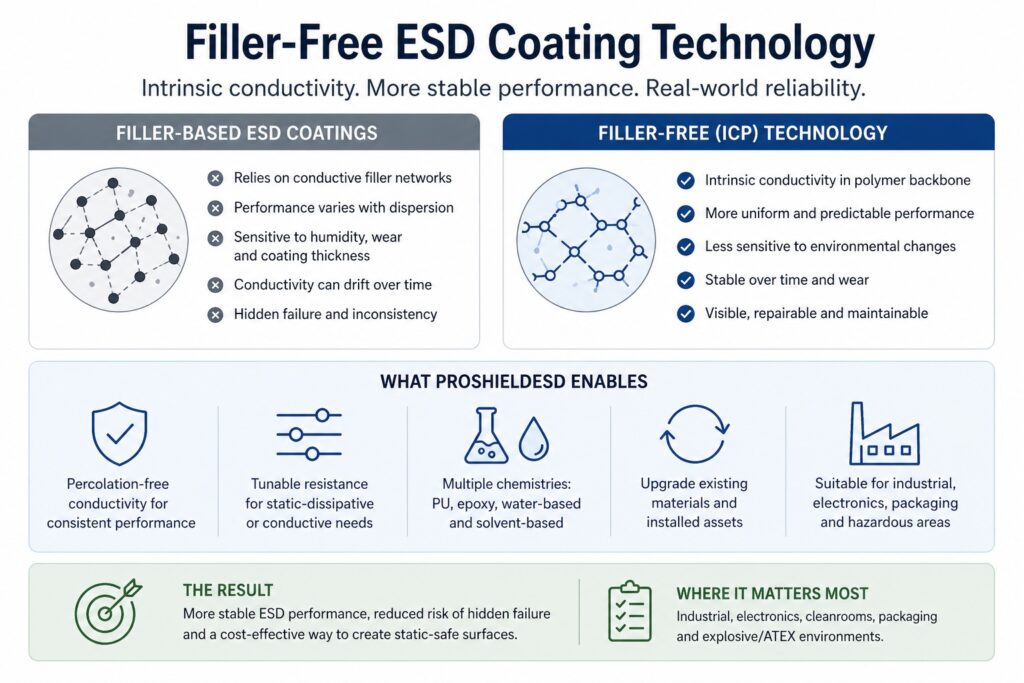
Comparison of filler-based ESD coatings and filler-free conductive polymer technology showing stability, uniform conductivity and reduced hidden failure risk
Why Filler-Based ESD Paints Fall Short
Traditional ESD paints are typically epoxy or polyurethane systems loaded with conductive fillers such as carbon black or metal powders. These systems rely on filler networks rather than intrinsic conductivity.
- Fillers can clump, segregate or settle during mixing and application
- Conductivity can vary across the surface if dispersion is inconsistent
- Resistance can drift over time, particularly with humidity changes
- Thin or worn coatings can lose conductivity as networks break down
- Maintenance, rework and inconsistency introduce hidden cost
These limitations are not just theoretical. In real applications, filler-based systems often show inconsistency, wear-related drift and contamination risk. See why carbon-filled ESD paints and moulded anti-static plastics can fail for a practical breakdown.
Key point: Filler-based systems depend on conductive particle networks. If that network is disrupted, electrical performance changes.
Why This Matters in Real Applications
In practical environments, the limitations of filler-based systems become a reliability issue, not just a material characteristic.
- Uneven filler distribution creates localised conductivity variation
- Ageing and wear degrade performance over time
- Visual inspection does not always indicate electrical performance
- Testing only samples small areas, not full surfaces
These effects become more critical in controlled environments and safety-related applications.
In these environments, surface behaviour is only part of the risk. Frequently handled tools and accessories can also generate and transfer static charge during use. See our Insight article: Non-Sparking Tools Are Not Electrostatic Safe.
For high-risk conditions, see ProShieldESD for Explosive & ATEX Environments.
Percolation vs Intrinsic Conductivity
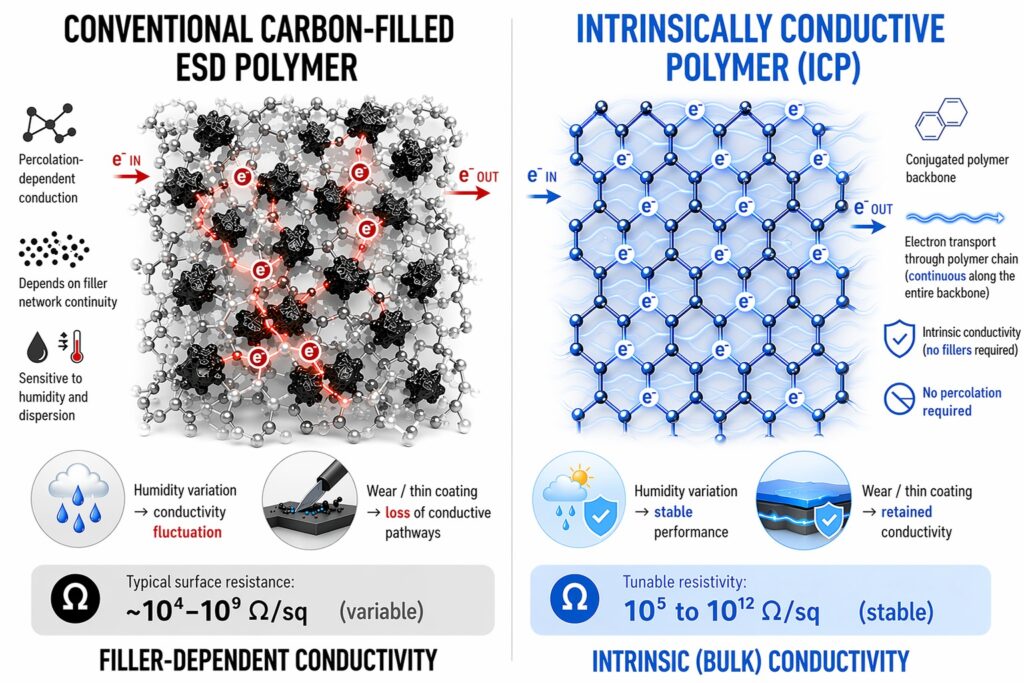
Comparison of carbon-filled ESD coatings and intrinsically conductive polymer coatings.
Carbon-filled systems rely on particles forming a continuous pathway through the coating. Intrinsically conductive polymer systems conduct through the polymer backbone itself, making performance less dependent on dispersion and particle contact.
What ProShieldESD Changes
- Filler-free, percolation-independent conductivity
- More uniform electrical performance across the surface
- Reduced sensitivity to dispersion, wear and environmental variation
- Ability to upgrade existing materials rather than replace them
- Flexibility across multiple coating chemistries
For measured performance data across real substrates, see ProShieldESD ESD coating testing results, including resistance values recorded on plastics, flooring, packaging and handling materials.
From Technology to Application
Filler-free ESD coating is not used in isolation. It is applied through defined solution routes depending on the material, surface, operating environment and risk.
- ProShieldESD Solutions Overview
- Anti-Static Coating for Plastic
- Static Control for Industrial Equipment
- Static Control for Work Surfaces & Facilities
- Static Control for Packaging & Logistics
- Static Control in Hazardous Environments
This approach links material behaviour to real operating conditions rather than treating ESD as a standalone material property.
How SCH Services Supports Implementation
- Assessment of substrate and operating environment
- Selection of appropriate coating chemistry
- Trial coating and validation
- Upgrade and retrofit strategies
- Support through subcontract coating services
For application examples, see Applications of the ProShieldESD Coating Platform.
Why Choose SCH Services?
- Technical guidance on filler-free ESD systems
- Application-focused support, not just material supply
- Experience across industrial and controlled environments
- Practical implementation and testing support
Disclaimer: This page provides general technical guidance only. Final performance and suitability must be validated against application requirements and relevant standards.