Conformal Coating Thickness Targets
Defining ranges by chemistry and function
Setting the correct conformal coating thickness targets is one of the easiest ways to improve long-term product reliability. Too thin and you lose moisture and contamination protection. Too thick and you risk bubbles, cracking, meniscus build-up and rework.
This guide explains how to define realistic thickness windows by chemistry and function so engineers and coating suppliers are aligned.
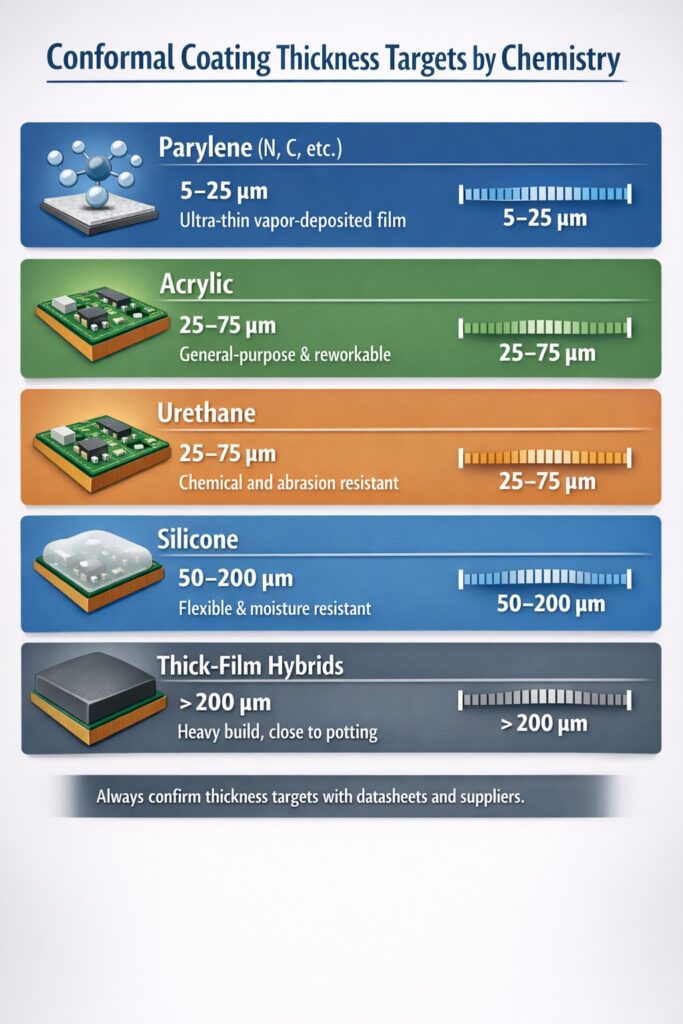
Typical conformal coating thickness ranges by chemistry. Acrylic and urethane coatings are generally specified within the same IPC range (25–75 µm), while silicones are applied thicker and Parylene achieves performance at much lower thickness.
Why coating thickness matters in PCB design
- Barrier protection: Thickness strongly influences resistance to moisture and ionic contamination.
- Dielectric strength: More film generally raises breakdown voltage up to a limit.
- Mechanical behaviour: Over-thick coatings can crack on edges, ribs and tall components.
- Process yield: Excessive thickness increases bubbles, voids and cure time issues.
- Cost efficiency: Extra material, masking and cycle time increase production cost.
The goal is a controlled thickness window that balances protection, manufacturability and cost.
Typical thickness ranges by chemistry
Every datasheet is different, but most conformal coating thickness targets fall into predictable bands. Use the following as a design starting point, then refine with your coating partner.
| Chemistry | Typical dry film range (µm) | Notes |
|---|---|---|
| Parylene (N, C, etc.) | 5–25 µm | Ultra-uniform vapour-deposited films; effective at much lower thickness than typical liquid coatings. |
| Acrylic | 25–75 µm | General-purpose; easy to apply and rework. |
| Urethane | 25–75 µm | Typically specified in the same band as acrylics; chosen for chemical resistance and durability rather than inherently greater thickness. |
| Silicone | 50–200 µm | Flexible; often used where condensation and thermal cycling are important. |
| Thick-film hybrids | > 200 µm | Closer to a heavy protective build than a conventional conformal coating; drainage and cure control become critical. |
Always confirm target ranges with the product datasheet, qualification standard and coating supplier.
Where do nano-coatings fit?
Nano-coatings (hydrophobic / oleophobic fluoropolymer treatments) are extremely thin surface films, typically 0.1–2 µm. They are not considered conformal coatings and do not provide the moisture barrier, insulation or environmental protection of acrylics, silicones, urethanes or Parylene.
They are ideal for water repellency, anti-wetting behaviour and improved cleanability, but should not be used where electrical, corrosion or condensation protection is required.
More information: SCH Nano-Coatings Overview
Linking thickness to function and environment
Choose thickness based on what you are protecting against:
- Benign environments: Use lower-end ranges.
- Industrial environments: Use mid-range values.
- Condensing or harsh environments: Use upper-end values, while still respecting chemistry-specific process limits and drainage design.
- Mixed technologies: Align Parylene and liquid thicknesses to avoid clearance or fit issues.
How to specify coating thickness on drawings
Avoid vague notes like “apply thin even coat”. Specify:
- A clear thickness window in µm.
- The thickness measurement method (eddy-current, optical, coupons).
- Whether thickness applies only to flat coupon areas or also complex geometry.
- Any known exceptions where reduced thickness is acceptable.
- Relevant standards or customer specifications.
Design tips to avoid over-thick coating
- Add drain paths at the base of tall component clusters.
- Break up dams formed by connectors or shields.
- Avoid sharp edges where cracking occurs under thick films.
- Consider selective coating for high-thickness chemistries.
- Flag unavoidable pools as accepted variations in drawings.
Working with your coating partner on thickness control
- Review layout together to identify risk areas.
- Run process trials to build real data.
- Agree a nominal range and tolerance.
- Define SPC or AQL checks for ongoing control.
Once agreed, thickness becomes a shared design–process contract.
Why Choose SCH Services?
Choosing the right thickness target is not just a materials question. SCH Services helps customers align chemistry, coating method, inspection approach and real geometry limits so thickness windows are practical, measurable and repeatable in production.
- 📏 Practical Thickness Guidance – Support defining realistic thickness windows by chemistry, function and environment.
- 🛠️ Process-Aware Support – Advice that reflects drainage, meniscus build-up, geometry effects and inspection practicality.
- 🔍 Verification & Control – Help selecting suitable measurement methods, coupons and ongoing process checks.
- 📈 Better Yield, Less Rework – Recommendations aimed at avoiding over-build, thin spots and thickness-related defects.
- 🌍 Integrated Technical Capability – Consultancy, coating services, training and support equipment from one specialist partner.
📞 Call: +44 (0)1226 249019
✉ Email: sales@schservices.com
💬 Contact Us ›