Conformal Coating Design Checklist (DfM/DfCC)
Pre-release conformity review for conformal coating and Parylene
A structured conformal coating design checklist (DfM/DfCC) is one of the easiest ways to avoid late rework, uncoatable boards and reliability surprises. Before a design is released, walk through this pre-release review to confirm that coating, masking and inspection have all been considered, not bolted on at the end.
Further reading: Wikipedia – Design for Manufacture (DFM)
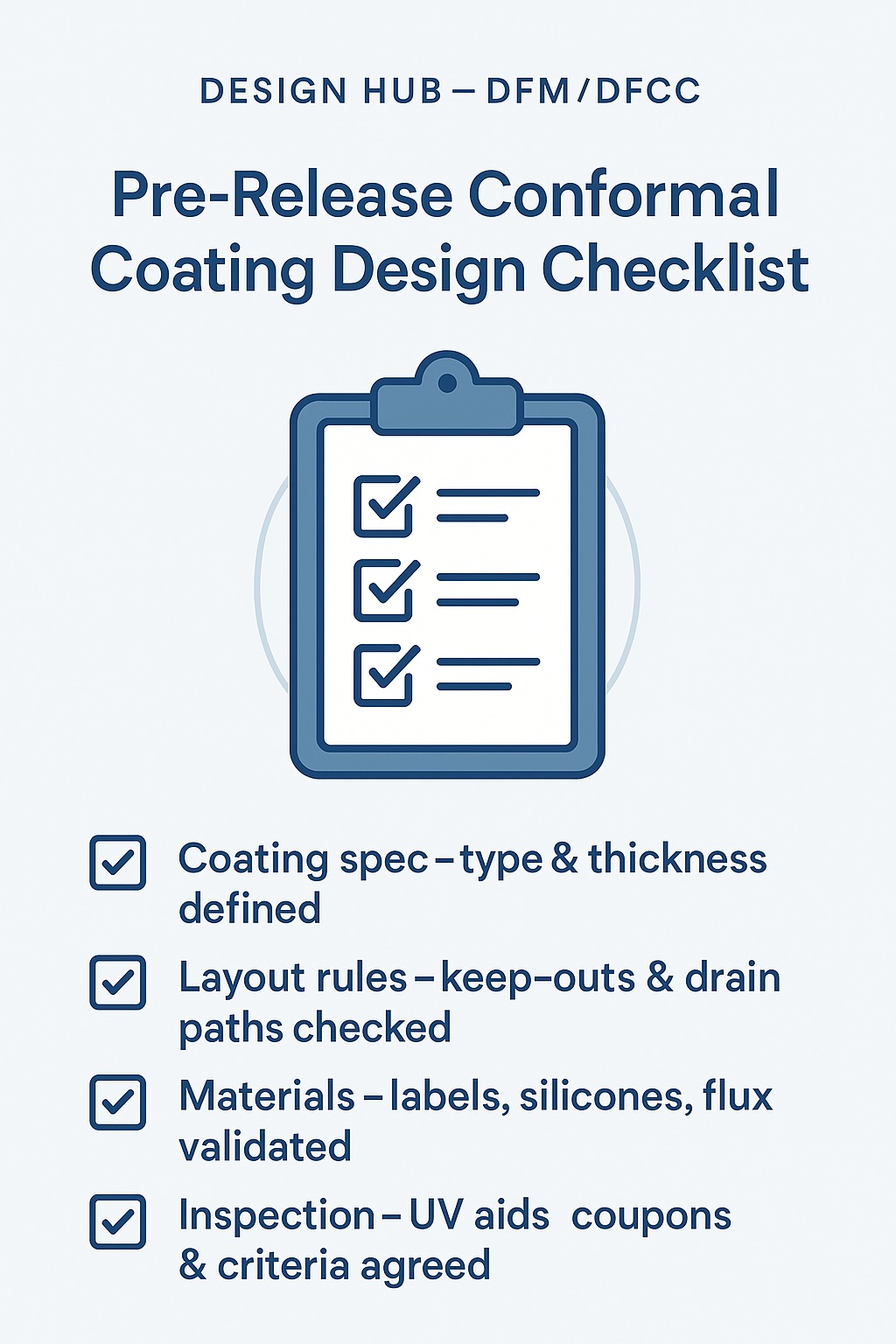
1. Lock down the coating requirement before release
- Specify the coating type (acrylic, urethane, silicone, Parylene, etc.) and main functions (moisture, condensation, salt-mist, high-voltage support).
- Define the target thickness range by chemistry and environment (e.g. 25–50 µm liquid, 10–25 µm Parylene) and reference any applicable standards.
- Identify coated vs uncoated areas at assembly level: boards, sub-assemblies, mechanical parts and enclosure surfaces.
- Agree the application method (selective spray, dip, Parylene, manual touch-up) and confirm it is compatible with the layout and standoff heights.
- Ensure all coating requirements are captured in a controlled document, such as a coating spec, drawing notes or a dedicated DfM/DfCC checklist.
2. Check keep-outs, maskable features and handling surfaces
- Confirm there are clearly defined keep-out zones around connectors, test points, switches, mating surfaces and grounded chassis points.
- Provide masking-friendly geometry: parallel pin arrays, consistent spacing, and space for masking boots, tapes or custom masks.
- Reserve handling edges or tooling holes so the board can be clamped and transported without touching coated critical areas.
- Ensure any label positions, barcodes or QR codes remain readable after coating, or are kept fully free of coating.
- Document any no-coat requirements directly on the fabrication or assembly drawing, not just in email or tribal knowledge.
3. Review layout for coverage, edges and drain paths
- Check tall parts, shields and connectors for shadowing that could block spray or line-of-sight Parylene coverage.
- Verify edge coverage at card guides, panel edges and slot cut-outs; avoid sharp lips and bathtub geometries that trap coating.
- Provide drain paths so liquid coatings can flow off the board without pooling under components or in corners.
- Confirm that clearance and creepage distances are still valid when coated, or that you are not relying on coating where standards do not allow it.
- Use simple design rules for minimum gaps, component spacing and orientation that have been validated with your coating process.
4. Validate materials and compatibility in the BOM
- Check for silicone greases, potting, gaskets or keypads that could inhibit coating cure or adhesion.
- Review labels, inks, adhesives and conformal coating masks for compatibility with the chosen chemistry and cure temperature.
- Confirm that flux residues, cleaning chemistry and rinse routines deliver a surface that meets ionic cleanliness and adhesion requirements.
- Identify any special materials (magnetics, elastomers, plated springs, high-CTE parts) that may need adhesion tests or alternative protection.
- Record any approved alternates or substitutions that have already been qualified for coating.
5. Plan for test, inspection and rework access
- Define UV inspection aids: tracers, legends, arrows or inspection viewpoints that make coverage quick to verify.
- Include test coupons or witness boards on the panel to monitor coverage, thickness and adhesion by lot.
- Ensure there is physical access for ATE probes and any post-coat functional testing, or clearly define pre-coat test stages.
- Consider reworkability: is there space to remove coating locally, replace parts and re-coat without damaging neighbours?
- Agree sampling plans and acceptance criteria (AQL, thickness windows, visual limits) with manufacturing and the coater.
6. Capture the DfM/DfCC checklist and handover
- Create a simple, controlled checklist (DfM/DfCC) that must be completed before each new design or major revision is released.
- Include sign-off fields for design, manufacturing, quality and the conformal coating / Parylene process owner.
- Store the checklist and coating specification in your PLM or document control system, not just on individual PCs.
- Make sure contract manufacturers and coating partners receive the latest revision and know where to find it.
- Feed field returns, NCRs and process issues back into the checklist so it improves with each product generation.
7. How SCH can support your design reviews
SCH works with OEMs, contract manufacturers and design teams to review layouts, materials and specifications before volume release. We can help you turn this conformal coating design checklist into a practical DfM/DfCC procedure, run pilot builds and generate evidence that your design is truly coating-ready.
- Design reviews focused on coating-friendly layouts and keep-outs.
- Material compatibility checks and adhesion / test coupon plans.
- Support in defining coating specs, thickness ranges and inspection criteria.
If you would like an independent review or a customised DfM/DfCC checklist for your products, contact SCH and we can help you build a robust pre-release conformity review process.
Why Choose SCH Services?
Good coating results start with disciplined release control. SCH Services helps customers turn coating requirements into practical pre-release checks so masking, materials, inspection and rework risks are identified before they become production problems.
- 📋 Structured DfM/DfCC Support – Practical help building coating-ready review checklists for new designs and major revisions.
- 🛠️ Cross-Functional Design Input – Guidance covering layout, masking, materials, thickness, inspection and rework access in one review process.
- 🔍 Early Risk Reduction – Support identifying uncoatable features, compatibility problems and inspection gaps before release.
- 📈 Better Handover Control – Recommendations that improve communication between design, manufacturing, coating partners and quality teams.
- 🌍 Integrated Technical Capability – Consultancy, coating services, training and process troubleshooting from one specialist partner.
📞 Call: +44 (0)1226 249019
✉ Email: sales@schservices.com
💬 Contact Us ›