Why Conformal Coating Adhesion Can Fail Even on a Clean Surface
Practical guidance on surface energy, substrate compatibility, cure state, hidden contamination and surface treatment
Conformal coating adhesion failure can occur even when a PCB assembly or substrate appears perfectly clean. Successful adhesion depends on more than visible cleanliness.
Successful adhesion depends on more than visible cleanliness. Surface energy, substrate chemistry, material compatibility, cure state, previous processing, handling and microscopic contamination can all affect how effectively a coating wets and bonds to a surface.
When conformal coating adhesion fails on an apparently clean surface, the correct question is therefore not simply “Is the surface clean?” but “Is the surface in the correct condition for this coating to bond reliably?”
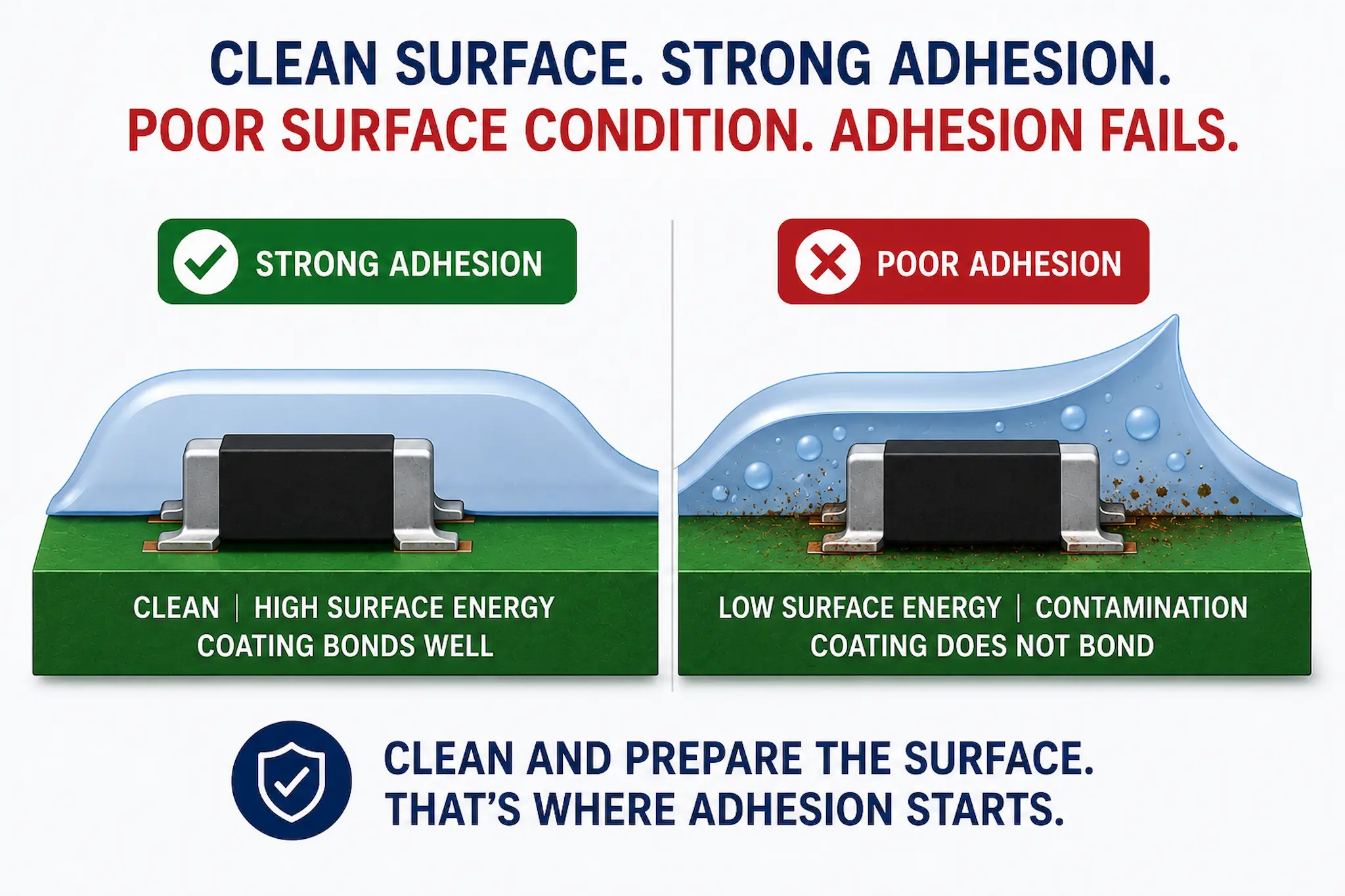
Conformal coating adhesion depends on surface condition. Low surface energy or contamination can prevent the coating from bonding reliably.
Engineering Observation
Adhesion failures can appear as local lifting, peeling, blistering, delamination or coating removal during masking and de-masking even when the underlying surface looks visually clean.
In some cases the coating may initially appear acceptable and only lose adhesion after thermal cycling, humidity exposure, mechanical handling or other environmental testing.
Why Adhesion Can Fail on an Apparently Clean Surface
Surface Energy
A liquid coating must wet the substrate sufficiently before it can form a reliable bond. If the surface energy of the substrate is too low relative to the coating, the liquid may not spread or interact effectively with the surface.
This can result in poor wetting, local pull-back or weak adhesion even where no obvious contamination is visible.
Substrate Compatibility
PCB assemblies contain many different materials including solder mask, component bodies, metals, plastics, adhesives, labels and other polymers.
A conformal coating that adheres strongly to one material may behave differently on another. Localised adhesion problems can therefore be associated with a particular substrate rather than the overall cleanliness of the assembly.
Cure State and Material History
The condition of the underlying material can change with curing, ageing, temperature exposure and previous manufacturing processes.
For example, a polymer surface that has recently been processed may present a different surface condition from the same material after extended storage or additional thermal exposure.
Process history should therefore be considered when an adhesion problem appears after a manufacturing change even if the nominal material specification has remained the same.
Contamination That Cannot Be Seen
Very small quantities of oils, silicones, release agents, fingerprints, processing residues or other low-surface-energy materials can affect coating adhesion without producing an obvious visible deposit.
A board can therefore look clean under normal inspection while still containing enough contamination to interfere with coating wetting or bonding.
Previous Cleaning and Handling
Cleaning itself can change surface condition. Poor rinsing may leave residues, while handling after cleaning can reintroduce contamination.
Changes in cleaning chemistry, drying, gloves, packaging, storage or the time between cleaning and coating can all affect the final surface presented to the coating process.
When Primers or Plasma Treatment May Be Considered
Where a substrate is inherently difficult to bond to, cleaning alone may not provide the required surface condition.
Depending on the coating system and substrate, an adhesion promoter, primer or plasma treatment may be used to improve coating adhesion.
Adhesion Promoters and Primers
An adhesion promoter or primer can create a more compatible interface between the substrate and coating. However, it should be treated as part of a controlled coating system rather than as a universal correction for unexplained adhesion failure.
Plasma Treatment
Plasma treatment can modify the surface condition and increase surface energy on suitable materials, improving wetting and potentially adhesion.
The effectiveness of plasma treatment depends on the substrate, treatment parameters, time between treatment and coating, and the coating material being applied.
Practical Findings
- A visually clean surface is not necessarily a high-energy or coating-compatible surface.
- Adhesion can vary between different materials on the same PCB assembly.
- Microscopic contamination can affect adhesion without being visible during normal inspection.
- Cleaning, rinsing, drying and subsequent handling can all influence final surface condition.
- Changes in material batches or manufacturing history can create new adhesion behaviour without an obvious visual difference.
- Adhesion promoters and plasma treatment may improve adhesion on suitable substrates but should be validated as part of the complete process.
- Repeated failure on the same component or substrate often indicates a material-specific or process-specific issue rather than random coating variation.
Process Note: Clean and Coatable Are Not the Same
Cleaning is intended to remove unwanted contamination, but coating adhesion also depends on the physical and chemical condition of the surface that remains.
A reliable process therefore considers both cleanliness and surface suitability.
Actions When Adhesion Fails
- Identify exactly which materials or locations show poor adhesion.
- Compare affected areas with surfaces where adhesion remains acceptable.
- Review cleaning chemistry, rinsing, drying and handling controls.
- Check for possible silicone, oil, release-agent or handling contamination.
- Review whether substrate materials, suppliers or material batches have changed.
- Check whether thermal processing, storage time or other manufacturing history has changed.
- Review coating material condition and cure requirements.
- Consider whether surface-energy assessment or controlled wetting evaluation would help identify the problem.
- Where appropriate, evaluate an approved primer, adhesion promoter or plasma treatment using representative production materials.
- Validate any process change against the required adhesion and environmental performance before production release.
Escalation Point
Further engineering review is appropriate where adhesion failures are recurring, material-specific, appearing after environmental testing, associated with production changes or cannot be explained by normal cleaning and process checks.
In these cases, review the complete interface between the substrate and coating, including material compatibility, surface condition, contamination, surface energy, coating chemistry, application, cure and previous manufacturing history.
Related Guidance
- Common Causes of De-Wetting After Cleaning — Practical guidance explaining why visually clean PCB assemblies can still reject conformal coating because of contamination, residues and surface-energy issues.
- Silicone Contamination from Masking Materials — Guidance explaining how low-surface-energy contamination can create de-wetting, fisheyes and local adhesion failures.
- Fingerprints and Handling Contamination Before Conformal Coating — Practical guidance covering contamination introduced during handling before coating.
- Conformal Coating Surface Preparation and Cleanliness — Deeper technical guidance covering contamination control, cleaning effectiveness and surface preparation.
- Conformal Coating Bulletin Library — Practical operational guidance covering coating defects, contamination, masking, inspection and process-control issues.
Need Help With Conformal Coating Adhesion?
SCH Services can support coating adhesion investigation, surface preparation review, coating trials, process development and evaluation of primers, adhesion promoters or surface-treatment options where coating performance is inconsistent.
Why Choose SCH Services?
SCH Services combines practical conformal coating production experience with process engineering, cleaning and contamination knowledge, surface preparation and coating troubleshooting.
Our approach considers the complete coating interface rather than assuming that visible cleanliness alone determines adhesion.
This helps identify whether poor adhesion is being driven by contamination, substrate compatibility, surface energy, material condition, coating cure or previous manufacturing processes.
Technical Guidance Disclaimer
The information provided in this bulletin is general technical guidance only. Surface preparation, cleaning methods, adhesion promoters, plasma treatment, coating materials, cure conditions and adhesion requirements should always be validated against the specific assembly, substrate materials, production process, operating environment and reliability requirements.
SCH Services can provide application-specific engineering support where adhesion investigation, coating trials, testing, validation or process development is required.