Flux Residues Causing Conformal Coating Failure
Why residues left from soldering can cause de-wetting, corrosion, leakage and coating reliability problems
Bulletin Category: Cleaning, Contamination & Surface Problems | Typical Environments: PCB assembly, selective coating, dip coating, hand-soldered assemblies, no-clean flux processes, rework areas and mixed-technology boards.
Flux residues are one of the most common hidden causes of conformal coating problems. A board can look acceptable, pass electrical test and still contain residues that interfere with coating flow, adhesion and long-term reliability.
The issue is often not the presence of flux alone. The problem is whether the residue is compatible with the coating process, whether it is trapped under components, whether it attracts moisture and whether it remains active after coating.
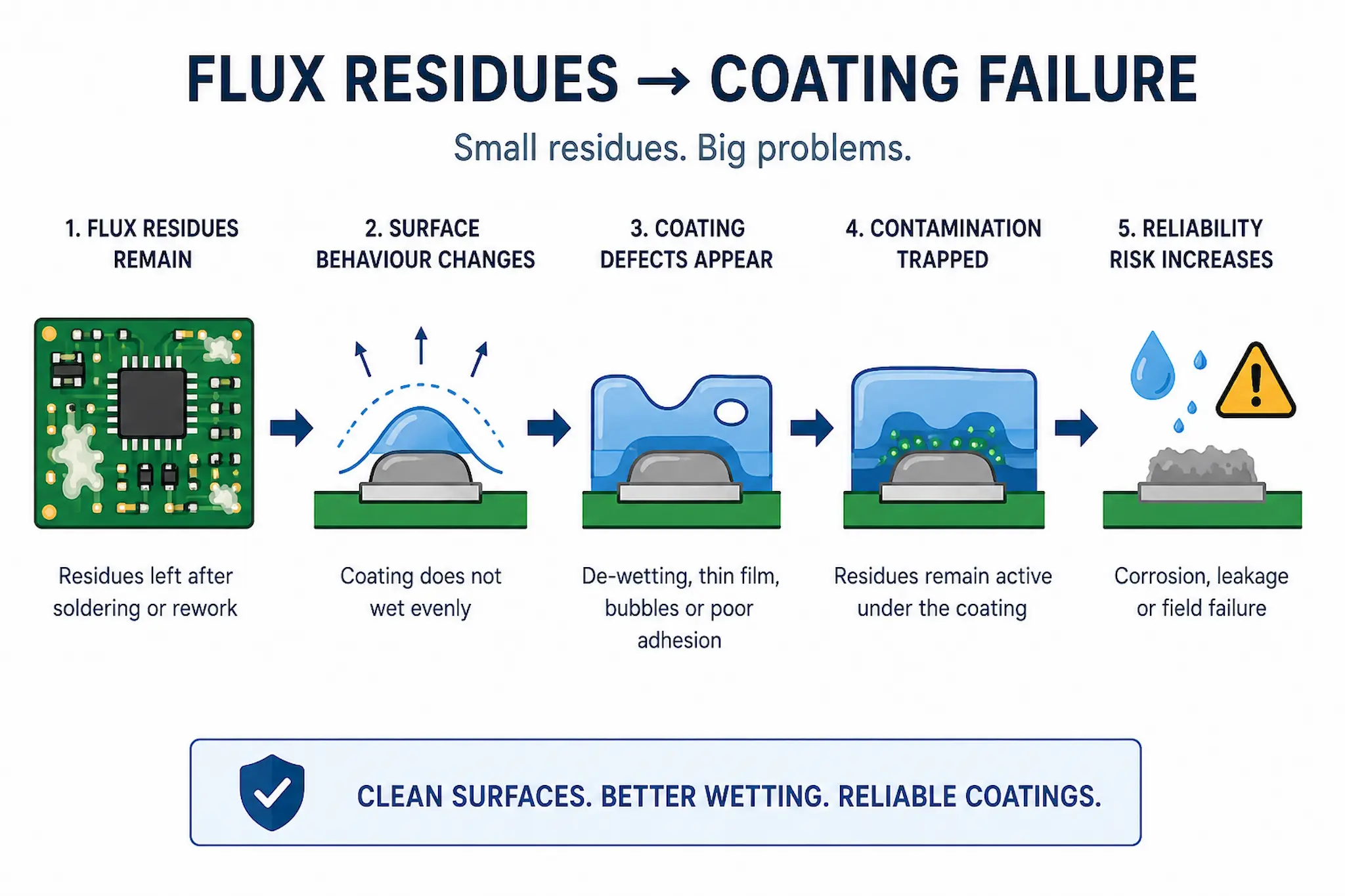
Flux residues left after soldering can alter surface behaviour, create coating defects and increase long-term reliability risks.
Engineering observation
Flux residue problems are often misread as coating material faults, poor spray technique or random de-wetting. In production, the defect pattern usually tells a different story.
- Coating pulls away from solder joints, component terminations or hand-reworked areas.
- Localised de-wetting appears around flux-rich zones rather than across the whole board.
- Defects repeat on similar areas of the assembly but not always on every board.
- White residues, tacky areas or dull staining may appear after cleaning, drying or coating.
- Electrical leakage or corrosion can appear later, even where the coating looked acceptable at inspection.
Why flux residues cause coating failure
Flux residues can affect conformal coating in several ways. The visible coating defect is often only the symptom.
Surface energy change
Residues can change how the coating wets the surface, creating localised pull-back, fisheyes or thin coverage.
Moisture attraction
Some residues can attract or retain moisture, increasing the risk of leakage paths, corrosion and coating breakdown. Residual moisture trapped within the assembly before coating can further increase these risks, particularly beneath low-standoff components and dense PCB layouts. See Moisture Trapped Before Conformal Coating for practical guidance on identifying and preventing moisture-related coating failures.
Entrapment under coating
Once coated, active residue may become sealed beneath the coating, making later failure harder to diagnose.
Simple production failure path
After soldering, rework or incomplete cleaning
Coating does not wet evenly
De-wetting, thin film, bubbles or poor adhesion
Leakage, corrosion or field failure
Production note: the board can pass visual inspection before coating and still contain residues capable of causing coating or reliability problems.
No-clean flux does not mean no-risk flux
No-clean flux is often misunderstood. It does not automatically mean the board is suitable for every conformal coating process without review.
Process note: A no-clean process may be acceptable when the flux, soldering profile, residue level, coating chemistry and operating environment have all been validated together.
Changing any one of these factors can change the coating result.
Practical checks before blaming the coating
- Compare defects with soldering, rework and flux application locations.
- Inspect around component leads, terminations, connectors and hand-soldered areas.
- Check whether failures occur after a flux, solder paste, cleaning chemistry or wash setting change. Also review whether handling, inspection, masking or storage activities may have introduced contamination after cleaning. See Fingerprints and Handling Contamination Before Conformal Coating for guidance.
- Review drying before coating, especially under low-standoff components.
- Use test coupons or witness boards where possible to separate coating behaviour from board-specific contamination.
- Escalate repeated localised de-wetting, corrosion, leakage or adhesion failures into a cleaning and contamination review.
Recommended actions
- Map the defect location against soldering and rework areas.
- Confirm the flux type, soldering process and cleaning status.
- Review whether residues are visible, tacky, crystalline, white, glossy or localised.
- Check drying and storage conditions before coating.
- Run a controlled comparison using known-clean boards, production boards and reworked boards.
- Only adjust coating parameters once contamination has been ruled out.
Escalation point
If coating defects repeatedly appear around solder joints, reworked areas or flux-heavy zones, treat the issue as a contamination and process-control problem before treating it as a coating application problem.
Related SCH guidance
- De-wetting in conformal coating
- Corrosion and ionic contamination
- Surface preparation and cleanliness before conformal coating
- Boards Look Clean but Still Fail Conformal Coating
- Cleaning Process Changes Causing New Conformal Coating Defects
- Moisture Trapped Before Conformal Coating
- Conformal coating process control
- Conformal coating inspection and quality hub
Need help investigating contamination-related coating defects?
SCH Services supports conformal coating process reviews, defect investigation, cleaning and surface preparation advice, operator training and coating process improvement.
Why choose SCH Services?
SCH Services works with conformal coating, Parylene, masking, cleaning, inspection and coating process control in real production environments. Our support is based on practical coating experience, process troubleshooting and operator training rather than theory alone.
- Practical coating process and defect investigation experience.
- Support for cleaning, masking, inspection and coating control.
- Training and consultancy for production teams.
- UK-based coating services, technical support and process development.
Disclaimer: This bulletin provides general technical guidance only. Flux residue behaviour, coating compatibility, cleanliness requirements and reliability risk depend on the materials, board design, process conditions, coating chemistry and end-use environment. Final process decisions should be validated using appropriate production trials, inspection methods, customer requirements and applicable standards.