Conformal Coating Process Control Hub
Why coating success depends on process control, not just material selection
Most coating failures are not caused by the coating material alone.
Even when the correct coating is selected, real PCB assemblies introduce risk through contamination, masking limitations, component geometry, drying conditions, thickness variation and inspection interpretation.
Conformal coating process control is the difference between a coating that works in theory and a coating process that works repeatedly in production.
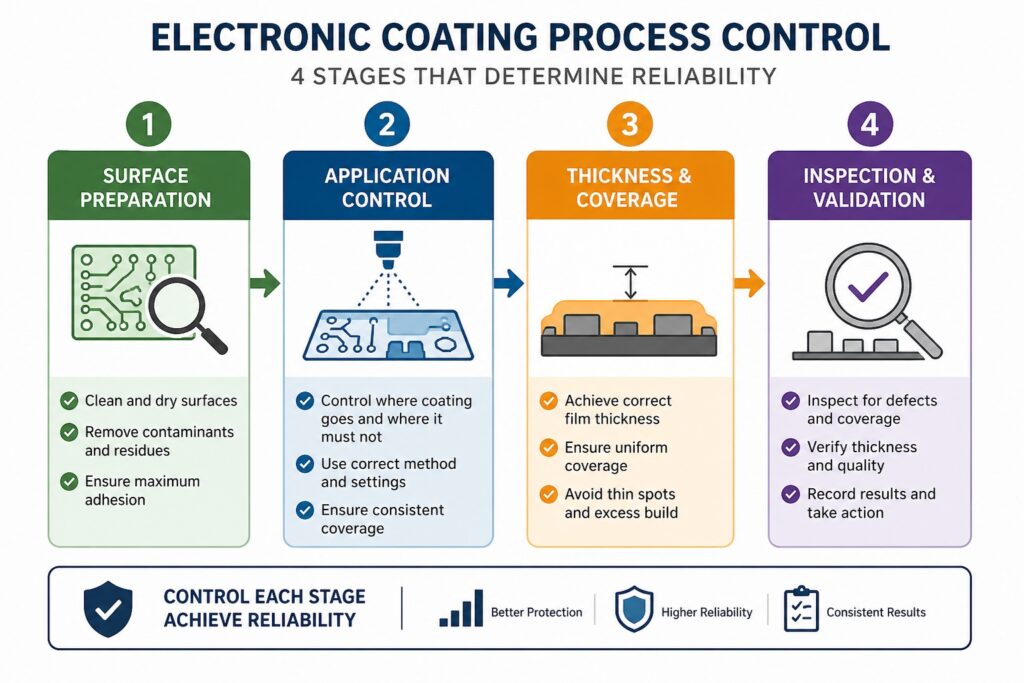
Four-stage framework showing how preparation, application, thickness control and inspection combine to stabilise conformal coating reliability in production.
Where is your coating process becoming unstable?
- Investigating adhesion, cleaning or contamination issues → Surface Preparation Hub
- Reviewing application consistency or masking variation → Application Methods Hub
- Checking thickness, curing or verification → Thickness, Curing & Verification Hub
- Reviewing inspection and acceptance criteria → Inspection & Quality Hub
- Investigating recurring failures or coating defects → Defects Hub
What This Process Control Framework Covers
Reliable coating performance is achieved by controlling the process from preparation through to final inspection.
This process control framework breaks coating control into four practical stages: surface preparation, application control, thickness and coverage, and inspection and validation.
1. Surface Preparation
Contamination, residues and surface condition directly affect coating adhesion and long-term reliability.
2. Application Control
Geometry, masking and coating method determine coverage, edge definition and process consistency.
3. Thickness, Cure & Coverage
Film thickness, cure state and uniformity influence environmental protection, electrical performance and process repeatability.
4. Inspection & Validation
Inspection defines what is acceptable, what requires rework and how objective evidence of process control is maintained.
Process Control Stages in Detail
1. Pre-Coating Control
Before coating is applied, the assembly condition and validation method must be defined.
- Conformal Coating Surface Preparation Hub — cleaning, contamination, surface condition and preparation before coating.
- Surface Preparation & Cleanliness — including how cleaning and surface condition affect adhesion.
- What Is Plasma Cleaning? — why plasma can improve surface condition in some applications but cannot compensate for wider process instability.
- Test Coupons & Witness Boards — establishing objective validation evidence before production release.
2. Application Control
Application control determines where the coating goes, where it must not go, and how consistently the process can be repeated.
- Conformal Coating Application Methods Hub — spray, dip, selective and other application-route guidance.
- Conformal Coating Masking Hub — keep-out control, connector protection and repeatable masking strategies.
- Selective Coating Accuracy
- Hybrid Conformal / Nano Coating Strategy
- Protecting Connector Interfaces Without Conformal Coating Them
3. Outcome Control
Outcome control verifies whether the coating process has produced the required coverage, film build, cure state and evidence of protection.
- Conformal Coating Thickness, Curing & Verification Hub
- Conformal Coating Thickness Verification
- Test Coupons & Witness Boards
- Inspection Standards & Methods
Common Outcome Control Traps
- UV trace ≠ correct protection — coating presence does not confirm thickness, continuity or reliability. See Why UV Trace Does Not Guarantee Correct Coating Coverage.
- One thickness reading ≠ assembly thickness — local geometry can produce major thickness variation across a PCB. See Why One Coating Thickness Reading Can Be Misleading.
- Stable settings ≠ stable thickness — solvent loss, temperature and material ageing can change film build during production. See Why Conformal Coating Thickness Changes During Production Runs.
- Thickness pass ≠ coverage pass — critical areas can remain inadequately protected despite meeting thickness requirements. See Coating Thickness Passes but Coverage Still Fails.
- Perfect masking ≠ defect-free coating — contamination, wetting, cure and adhesion problems can still occur within correctly masked areas. See Why Perfect Masking Still Produces Coating Defects.
- Fixed machine settings ≠ fixed viscosity — material condition can alter flow, edge definition and final film build. See Viscosity Drift in Conformal Coating Processes.
4. Failure & Risk Understanding
Understanding common failure mechanisms helps define realistic controls before the process reaches production.
- Conformal Coating Defects Hub — symptom identification, failure mechanisms and root-cause troubleshooting.
- Why Conformal Coating Fails in Complex PCB Assemblies
- Why Conformal Coating Processes Fail
Recurring coating problems are rarely caused by one isolated variable. They often emerge when several small process variables drift outside control simultaneously, making structured process review more effective than repeatedly adjusting individual machine settings.
Where Coating Processes Commonly Go Wrong
Production coating failures often result from several small uncontrolled variables rather than one obvious defect.
- Contamination that is not visible during routine inspection, including residues introduced by cleaning, handling or masking materials. See Silicone Contamination from Masking Materials.
- Inconsistent masking leading to variable keep-out control.
- Complex geometry preventing reliable coverage.
- Excessive or insufficient coating thickness.
- Viscosity and material-condition drift during production.
- Incomplete drying, cure or handling control. Assemblies that appear dry after cleaning can still retain moisture beneath low-standoff components, connectors or contamination residues. See Moisture Trapped Before Conformal Coating.
- Unclear inspection criteria and inconsistent rework decisions.
From Coating Selection to Process Control
Coating selection defines what should work. Process control determines what does work repeatedly in real production conditions.
If the coating type is still uncertain, start with the Coating Selection Guide.
If the coating type is already selected but the process is unstable, continue through the process control topics above or review the Conformal Coating Processes Hub.
Related Reliability, Inspection & Process Stability Hubs
- Conformal Coating Processes Hub
- Conformal Coating Surface Preparation Hub
- Conformal Coating Application Methods Hub
- Conformal Coating Masking Hub
- Conformal Coating Thickness, Curing & Verification Hub
- Conformal Coating Inspection & Quality Hub
- Conformal Coating Defects Hub
- Conformal Coating Design Hub
Need Practical Support Stabilising Your Coating Process?
SCH Services supports coating reliability by combining practical production experience with process development, masking, inspection, equipment knowledge and operator training.
- Root-cause investigation for unstable coating results and recurring defects.
- Review of cleaning, masking, material preparation, viscosity, application, curing and inspection controls.
- Production scale-up and NPI process development.
- Operator and engineering training for repeatable process control.
- Support equipment and masking solutions for practical process implementation.
Why Choose SCH Services?
SCH combines practical conformal coating production experience with process engineering, equipment, masking, inspection and training. This allows coating instability to be investigated across the complete production process rather than by changing individual settings in isolation.
- Process-led troubleshooting: cleaning, contamination, material preparation, viscosity, masking, application, cure and inspection can be evaluated together.
- Production experience: practical understanding of manual, spray, dip and selective coating processes.
- Validation and scale-up: support from trials and NPI through to stable production processes.
- Integrated implementation: consultancy, coating services, training, masking and support equipment can be combined where required.