Nano Coatings for Electronics & Precision Components

Ultra-thin coating technologies for hydrophobic and oleophobic performance, surface control, and selective protection

This page explains SCH’s nano coatings platform as a practical material and process route within the wider advanced functional coatings system.

What Nano Coatings Are Used For

Nano coatings are used where the objective is not full barrier encapsulation, but controlled surface performance delivered through an ultra-thin film.

In electronics and precision components, these technologies are typically selected where conventional conformal coating or Parylene may add unnecessary thickness, increase masking burden, or interfere with functional interfaces.

Depending on the chemistry and application method, nano coatings can support hydrophobic and oleophobic behaviour, low surface energy performance, contamination resistance, anti-smudge functionality, and limited protection while preserving tolerances, connectors, optics, and fine geometries.

What Nano Coatings Actually Represent

Nano coatings represent a technology platform used to deliver ultra-thin, hydrophobic, oleophobic, and PFAS-free performance depending on the selected chemistry.

Nano coatings describe the thickness and delivery route, not the function alone. A nano coating may be hydrophobic, oleophobic, durable, abrasion-resistant, or PFAS-free depending on the chemistry used.

How This Fits Within SCH’s Coating Platform

Within this advanced functional coatings platform, nano coatings may support hydrophobic coating strategies, ultra-thin coating requirements, or PFAS-free development pathways depending on the real application requirement.

SCH’s nano coatings platform is not limited to fixed product sets. Materials are selected, evaluated, and developed according to the application, process route, durability target, and regulatory requirement.

Established systems such as LT Series, UVX, and OPX remain relevant, but they should be understood as execution routes within a wider and expandable coating platform rather than the full limit of available chemistry options.

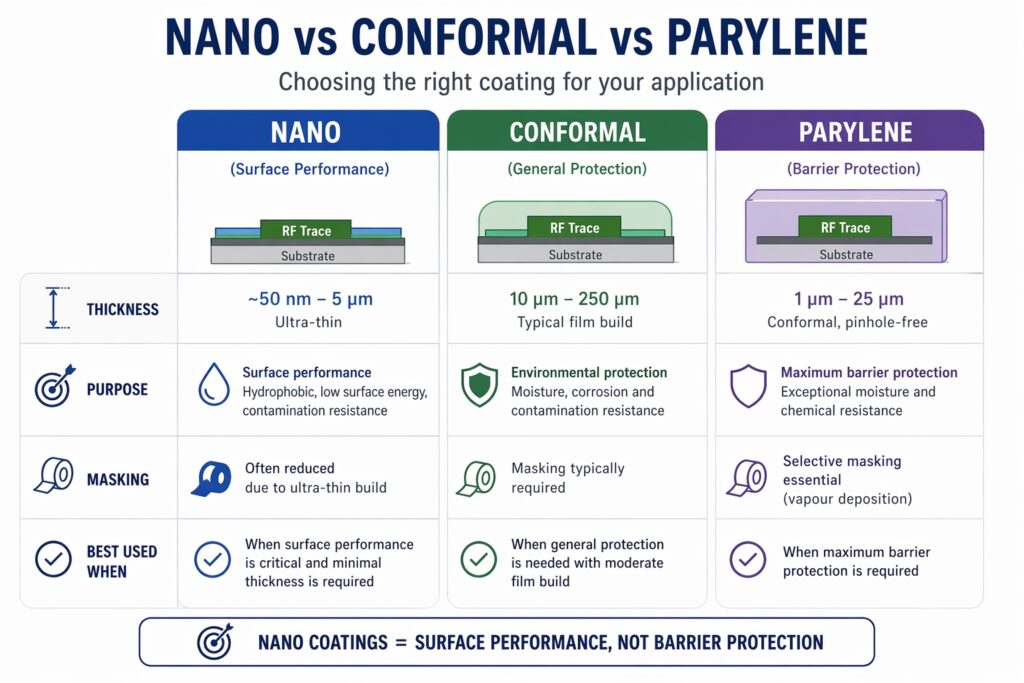
The diagram below compares nano coatings, conformal coating, and parylene for electronics, focusing on thickness, masking requirements, and protection level.

Nano coatings compared with conformal coating and parylene for electronics showing thickness, masking requirements, and protection level

Comparison of nano coatings, conformal coating, and parylene for electronics and PCB assemblies, highlighting thickness, masking requirements, and protection differences.

Understanding these differences is critical when selecting ultra-thin coatings for PCB assemblies or deciding when full barrier protection is required.

Where Nano Coatings Fit

Nano coatings are not a replacement for every conformal coating or Parylene application. They solve different problems and should be selected based on the actual performance requirement, not simply because they are thinner.

Requirement Best Fit
Full environmental barrier protection Parylene coating
General moisture and corrosion protection Conformal coating
Ultra-thin surface performance Nano coatings
Hydrophobic or oleophobic surface behaviour Nano coatings, depending on chemistry
Reduced masking burden where low build is critical Nano coatings, subject to validation

Correct selection depends on whether the real requirement is barrier protection, dimensional control, water repellency, oil repellency, contamination resistance, durability, or a broader process simplification objective.

When Nano Coatings Are the Right Route

Nano coatings are typically the right route when the project requires low-build functional performance rather than a conventional protective barrier.

  • Film thickness must remain minimal
  • Connectors, contacts, optics, or precision features cannot tolerate heavy build
  • Hydrophobic or oleophobic surface performance is part of the objective
  • Contamination control, anti-smudge behaviour, or low surface energy is needed
  • Selective coating strategies may reduce masking burden or process complexity
  • The project may require a fluorinated or non-fluorinated route depending on regulatory and material strategy

Nano coatings are usually the wrong route where the real requirement is full environmental sealing, high corrosion margin, or a true barrier layer across the whole assembly.

Coating Technology Groups

Nano coatings within SCH’s platform can be grouped by function rather than by individual product. This allows coating selection to be driven by performance requirements rather than fixed material choices.

Fluoropolymer Ultra-Thin Coatings

Used where low surface energy, hydrophobic or oleophobic behaviour, and chemical resistance are primary requirements.

These systems are commonly used where both water and oil repellency are required, rather than hydrophobic performance alone. This is particularly relevant for touch surfaces, displays, optics, and components exposed to repeated handling where anti-smudge and anti-contamination performance matter.

  • Established fluoropolymer systems, including LT Series
  • UV-cure fluoropolymer coatings
  • PFPE-based nano coatings

Durable Surface Protection Coatings

Used where abrasion resistance, handling durability, and long-term surface stability are required at minimal thickness.

  • OPX-type ultra-thin coatings
  • Hybrid fluoropolymer or polysilane systems
  • Wear-resistant nano coatings

Non-Fluorinated / PFAS-Free Coatings

Used where regulatory, environmental, or lifecycle requirements require reduced reliance on fluorinated chemistry.

  • PFAS-free nano coatings
  • Modified surface energy coatings
  • Alternative hydrophobic chemistries

UV-Cure Functional Coatings

Used where curing speed, throughput, and surface hardness are key process drivers.

  • UVX-type systems
  • UV-cure nano coatings

Surface Modification Treatments

Used where the objective is to change surface behaviour rather than apply a conventional protective layer.

  • Hydrophobic and oleophobic surface modifiers
  • Anti-fouling, anti-smudge, and contamination-control treatments
  • Surface energy modification chemistries for targeted functional behaviour

Coating Strategies & Functional Stacks

In most applications, a single coating system is sufficient. However, where requirements vary across an assembly or surface, selective coating strategies may be used.

Selective Protection Strategy

Used where different areas of an assembly require different levels of protection or functionality.

  • Conformal coating applied to critical protection zones
  • Ultra-thin nano coating applied to exposed or functional areas

Protection + Surface Behaviour Strategy

Used where base protection is required but surface contamination, wetting, or fouling still affects performance.

  • Base coating providing environmental protection
  • Ultra-thin hydrophobic or oleophobic surface treatment to control contamination, wetting, fouling, or handling effects

These approaches are application-specific and must be validated to ensure compatibility, adhesion, and long-term performance.

Material Selection Approach

SCH approaches nano coatings as a material and process selection exercise, not as a fixed product shortlist. The correct coating route depends on balancing performance, process practicality, and longer-term requirements.

  • Hydrophobic or oleophobic performance target
  • Required durability, abrasion resistance, and chemical exposure
  • Film thickness limits and dimensional constraints
  • Application route, such as dip, spray, UV-cure, wipe, or hybrid processing
  • Production speed, cure method, and process integration needs
  • Environmental, EHS, and PFAS-related material strategy

This means the best solution may come from an established product route, a modified material route, or a newer chemistry under evaluation. The platform is intended to grow as customer requirements and available chemistries develop.

Established Nano Coating Routes

SCH’s nano coatings platform currently includes several established routes with different performance and processing profiles. These should be viewed as current execution routes within the platform, not as the full limit of future material options.

  • LT Series – room-temperature fluoropolymer route for simple low-build hydrophobic and low surface energy performance
  • UVX – UV-cure route for rapid processing and harder surface performance
  • OPX – ultra-thin abrasion-resistant route for durable surface protection

These routes represent different ways of achieving surface performance and should be selected according to application environment, throughput, durability requirements, and process constraints.

Key point: Nano coatings are a technology route, not a guarantee of a specific outcome. Hydrophobic performance, oleophobic performance, durability, chemical resistance, and process suitability depend on the actual chemistry and application method.

Typical Applications

Typical applications for nano coatings on PCB assemblies and precision components include:

  • PCB assemblies requiring ultra-thin functional protection without adding significant thickness
  • Connector-adjacent areas where heavy coating build would interfere with electrical or mechanical function
  • Optics, sensors, and precision parts where dimensional change must be minimised
  • Touch surfaces, displays, and user-interface components requiring anti-smudge, fingerprint resistance, and easy-clean behaviour
  • Assemblies where masking large numbers of critical areas would be impractical
  • Projects requiring hydrophobic or low surface energy surface behaviour for contamination control
  • Development work exploring alternatives to conventional conformal coating or heavier barrier systems

When to Engage SCH

  • When thickness, masking burden, or surface behaviour are all affecting the decision
  • When it is unclear which chemistry route best fits the application
  • When hydrophobic, oleophobic, anti-smudge, or durability performance needs validation
  • When conformal coating, parylene, and low-build coatings all appear technically possible and the selection needs to be narrowed properly

Process Considerations

Nano coating performance depends heavily on process control. At very low thickness, small changes in cleanliness, application, or curing can significantly affect the final result.

  • Surface cleanliness and preparation directly affect wetting and adhesion
  • Application method must match geometry, throughput, and repeatability requirements
  • Viscosity, withdrawal speed, and solids content influence final film build
  • Curing or drying conditions affect surface behaviour and durability
  • Validation testing should reflect the actual operating environment

For most projects, material selection and process development should be treated as a combined activity. SCH supports this through consultancy, training, and coating services.

Limitations and Reality Checks

  • Nano coatings do not automatically provide the same environmental protection as conformal coating or Parylene
  • Hydrophobic or oleophobic performance does not necessarily equal corrosion resistance
  • Durability varies significantly depending on chemistry, substrate, and use conditions
  • Not every assembly will benefit from reduced masking or ultra-thin film build
  • Performance claims must be validated under real operating conditions

Where maximum barrier protection or long-term harsh-environment resistance is required, nano coatings may need to form part of a wider coating strategy rather than act as the sole solution.

Common Failure Modes

  • Loss of hydrophobic or oleophobic performance due to wear, contamination, or handling
  • Inconsistent coating caused by poor surface preparation or unstable application control
  • Incorrect expectation of barrier protection from a low-build surface-modifying coating
  • Durability mismatch between the selected chemistry and the actual operating environment

How SCH Supports Nano Coating Projects

SCH supports nano coating projects from initial evaluation through to implementation as part of a practical, validated coating strategy.

  • Assessment of whether nano coating technology is the correct route
  • Selection of suitable coating chemistries based on performance requirement
  • Feasibility trials and sample evaluation
  • Process development for dip, spray, UV-cure, wipe, or hybrid methods
  • Testing support for wetting behaviour, durability, and dimensional impact
  • Integration with conformal coating, Parylene, or PFAS-free strategies where required

This ensures nano coatings are selected and implemented as part of a practical, validated coating strategy rather than a simple material substitution. Where required, SCH can also support related conformal coating services, training, and consultancy.

Why Choose SCH Services?

SCH supports nano coating projects from initial evaluation through to implementation, ensuring the selected coating technology matches the actual surface performance, process, and reliability requirement.

  • 🧠 Application-Led Selection – Nano coatings are matched to the actual technical objective, not chosen by label alone.
  • πŸ› οΈ Process Development Support – Practical support for dip, spray, UV-cure, and hybrid application methods.
  • πŸ”¬ Surface Performance Understanding – Experience with hydrophobic and oleophobic behaviour, low surface energy, and ultra-thin functional protection.
  • πŸ“ˆ From Feasibility to Production – Support from trials and evaluation through to implementation.
  • πŸ”— Integrated Coating Strategy – Ability to combine nano coating approaches with conformal coating, Parylene, and PFAS-free development pathways.

πŸ“ž Call: +44 (0)1226 249019 | βœ‰ Email: sales@schservices.com | πŸ’¬ Discuss Your Application β€Ί

↑ Back to top

Disclaimer: This content is provided for general technical guidance only. Coating selection, material compatibility, and process performance must be validated through testing under actual application conditions and relevant industry standards.