Setting Up a Conformal Coating Production Line
Practical guidance for turning coating requirements into a controlled, repeatable production process
A conformal coating production line should be designed around the assemblies, coating specification, production volume and required quality controls rather than around a particular coating machine.
Once the basic coating facility and application method have been selected, the engineering challenge is to convert them into a repeatable production process. That means defining the sequence of operations, establishing process parameters, balancing capacity between stages, controlling material condition, validating the process and creating a clear inspection and release method.
The objective is not simply to apply coating. It is to repeatedly produce assemblies that meet the required coverage, keep-outs, thickness, cure and workmanship requirements at the required production rate.
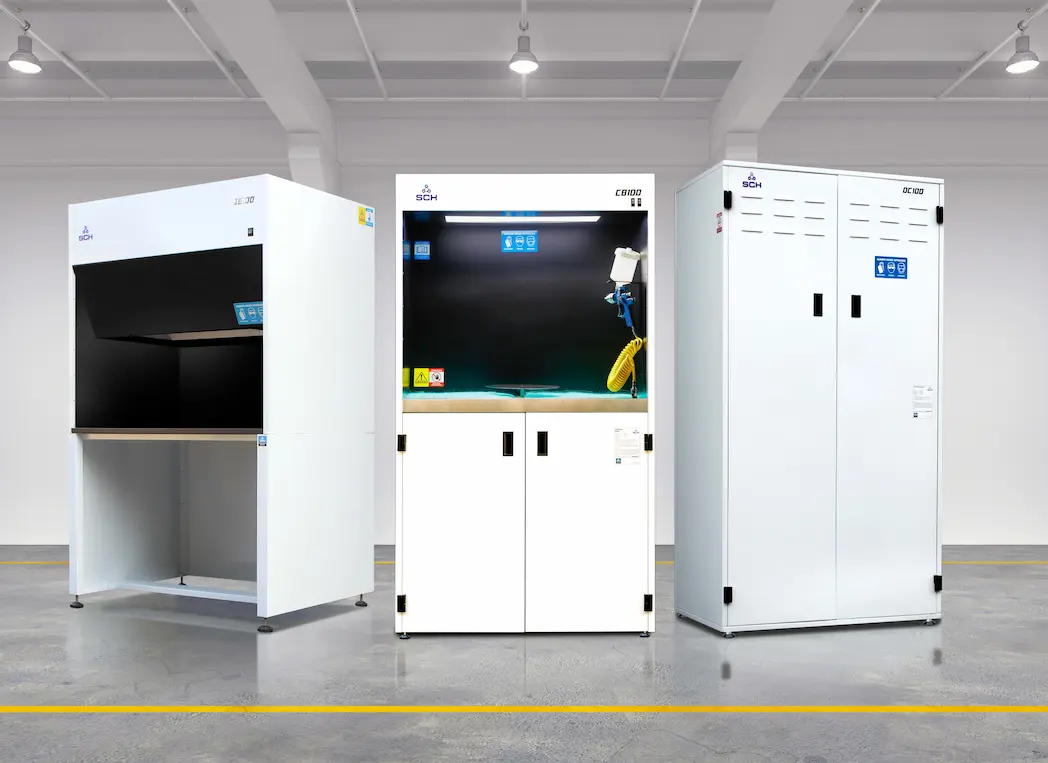
SCH conformal coating production equipment combining a spray booth, UV inspection booth and drying cabinet for application, inspection and controlled drying.
Article Quicklinks
| Topic | Jump |
|---|---|
| 1) Define the process requirements | 🔗 |
| 2) Establish production demand and capacity | 🔗 |
| 3) Select and define the application process | 🔗 |
| 4) Build the process sequence | 🔗 |
| 5) Create the process control plan | 🔗 |
| 6) Inspection and quality assurance | 🔗 |
| 7) Validate before full production | 🔗 |
| 8) Scale the bottleneck, not the whole line | 🔗 |
| Common production-line failure points | 🔗 |
| Download the technical bulletin | 🔗 |
1. Define the Process Requirements
Start with the product requirements before deciding how the coating line will operate. Customer drawings, coating specifications, approved materials and workmanship requirements should define what the production process has to achieve.
Typical requirements to establish
- Coating chemistry: the approved coating type and specific material
- Coverage: areas that must be coated and any required edge or component coverage
- Keep-outs: connectors, contacts, test points, holes or other areas that must remain uncoated
- Thickness: minimum, nominal or maximum requirements where specified
- Application requirements: any customer-defined or material-manufacturer requirements
- Drying or curing: required conditions and minimum time before handling, inspection or release
- Inspection: visual, UVA, thickness or other verification requirements
- Acceptance criteria: permitted defects, workmanship expectations and rework rules
- Traceability: material batch, process batch, operator, inspection and other records where required
Process principle: The production line should be designed to achieve the specification. The specification should not be adjusted to suit the equipment that happens to have been purchased.
2. Establish Production Demand & Capacity
Production volume should be understood before equipment capacity is selected. Monthly demand alone is not enough. Batch size, product mix, available working hours, changeovers, drying or curing time and manual operations can all influence the required line capacity.
Consider the complete cycle
- Assemblies per day, week or month
- Typical and maximum batch sizes
- Number of different products or coating materials
- Cleaning or preparation time
- Masking time
- Application time
- Flash-off, drying or curing dwell time
- De-masking and finishing time
- Inspection and thickness-measurement time
- Changeover and cleaning time between products or materials
- Rework allowance
The fastest operation does not necessarily determine the output of the line. A spray or selective coating process may apply material very quickly while masking, drying, de-masking or inspection consumes considerably more production time.
Capacity should therefore be evaluated across the complete process, not from the coating-machine cycle time alone.
3. Select & Define the Application Process
The application method should match the assembly geometry, coating requirements, keep-outs, expected volume and level of automation required.
Common liquid conformal coating methods
- Manual spray: flexible and relatively simple to establish, but dependent on operator technique and good process control. See the CB100 Conformal Coating Spray Booth for an example of a dedicated manual spray-coating workstation.
- Selective coating: useful for repeat production and controlled application to defined areas, with programming, fixturing and maintenance requirements
- Dip coating: capable of efficient batch processing where product geometry and keep-outs are suitable
- Brush coating: useful for localised work, touch-up, rework and some low-volume applications
Different methods require different parameters to be controlled. These may include spray pressure, material flow, gun distance, number of passes, robot speed, valve settings, dip immersion speed, dwell time, withdrawal speed, drainage angle or brush technique.
Note: Parylene is deposited using a vacuum deposition process rather than a conventional liquid coating line. Although many of the same principles of preparation, masking, process control, inspection and traceability apply, the application equipment and production cycle are fundamentally different.
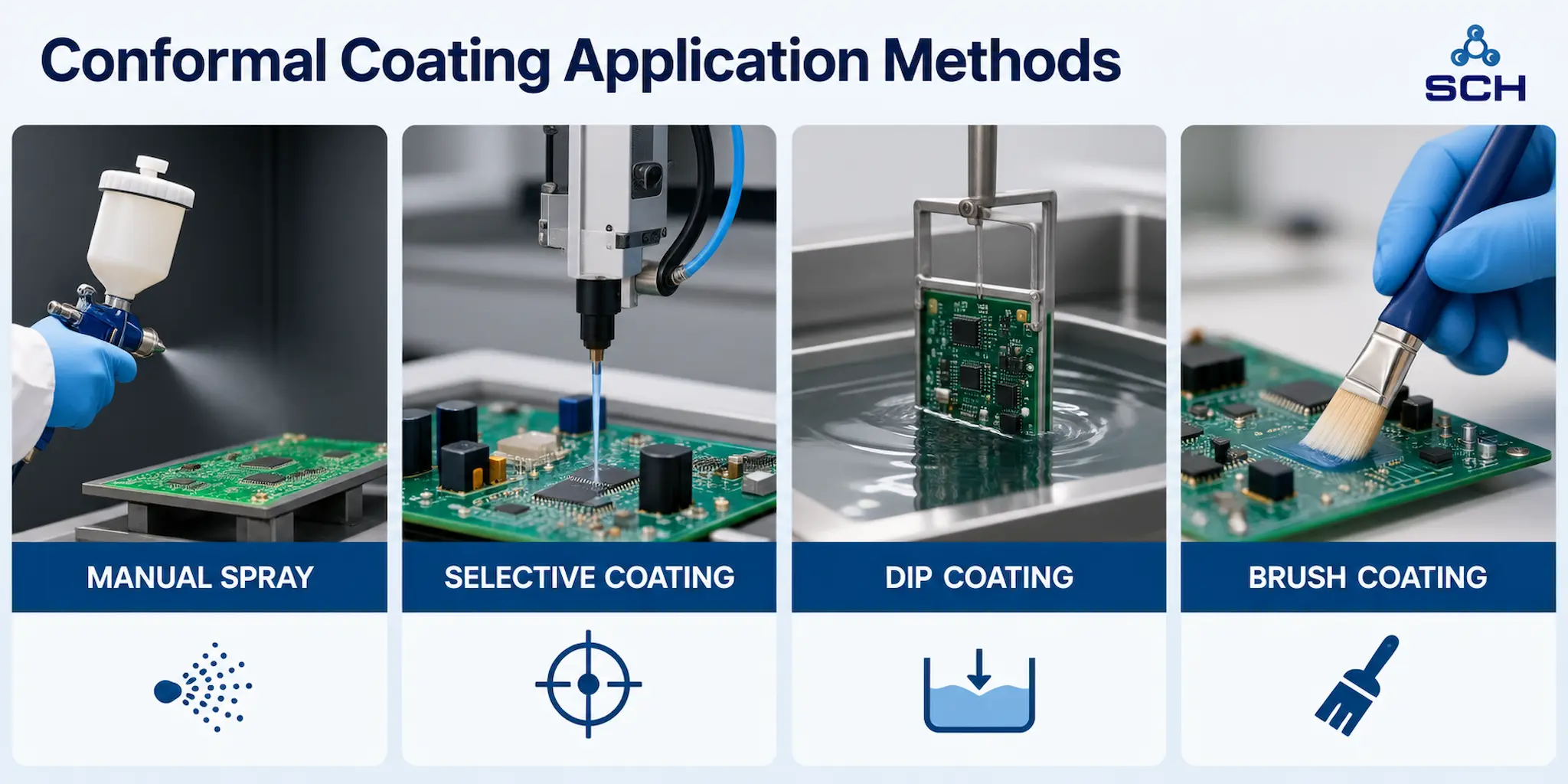
Common conformal coating application methods include manual spray, selective coating, dip coating and brush coating. The appropriate method depends on the assembly, coating requirements and production volume.
4. Build the Production Sequence
Once the requirements and application method are known, define the process sequence that every production batch will follow.
A typical liquid conformal coating sequence may include
- Incoming or pre-process checks – confirm product, documentation, cleanliness and any preparation requirements
- Cleaning or preparation – where required by the approved process
- Masking – apply and verify keep-out protection. See our Conformal Coating Masking Solutions for masking materials and options.
- Material preparation – mixing, conditioning, viscosity adjustment or equipment loading where required
- Application – spray, selective, dip, brush or other approved method
- Flash-off or drainage – where required by the material and application process
- Drying or curing – ambient, cabinet, thermal, UV, moisture or other chemistry-specific process. See SCH’s conformal coating drying and curing equipment for controlled drying solutions.
- De-masking and finishing – remove masking without damaging the coating
- Inspection and measurement – verify coverage, keep-outs, workmanship and thickness where required
- Rework or release – route defects through the defined rework process or release conforming product
The actual sequence may differ between products and materials. The important point is that the required stages and hand-off points are deliberately defined rather than left to individual operator interpretation.
A controlled line has a defined route for the product and a defined status for the batch at every stage.
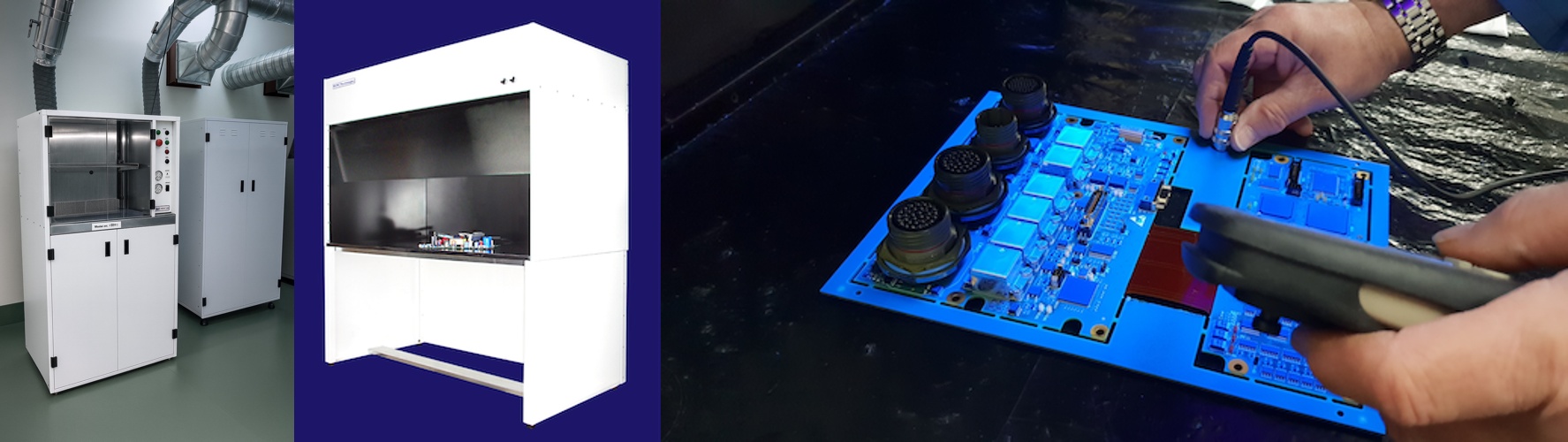
Different stages of a conformal coating production process require different equipment and controls, from application and drying through to inspection and thickness verification.
5. Create the Process Control Plan
A conformal coating line becomes repeatable when the important process variables are identified, controlled and recorded where appropriate.
Typical controls may include
- Material: manufacturer, product, batch or lot, shelf life and opened-container control
- Material condition: mixing, temperature and viscosity where relevant
- Application parameters: pressure, flow, speed, passes, dwell, withdrawal rate or machine recipe depending on the method
- Environmental conditions: temperature and humidity where they materially influence the coating process
- Flash-off: minimum or controlled time where specified
- Drying or curing: time, temperature, UV exposure or other required cure conditions
- Thickness: defined measurement method, frequency and measurement location
- Witness samples or coupons: where useful for process verification
- Inspection: defined criteria and inspection frequency
- Rework: approved methods and escalation rules
Process parameters should be based on the coating manufacturer’s technical data, customer requirements and internal validation rather than informal operator preference. Where viscosity is an important process variable, see Conformal Coating Viscosity Process Control. For measurement methods, see Conformal Coating Thickness Measurement.
6. Build Inspection & Quality Assurance Into the Line
Inspection should be designed into the production process rather than added after coating problems appear.
Inspection may include
- Coverage: confirm required areas are coated
- Keep-outs: confirm connectors, contacts, holes or other protected areas remain acceptable
- Workmanship: identify bubbles, pinholes, dewetting, runs, pooling, contamination, cracking, lifting or other relevant defects
- UVA inspection: where the coating contains a suitable fluorescent tracer
- Thickness: verify coating thickness using the approved method where required
- Traceability: retain inspection and process records appropriate to the customer and product requirements
UVA fluorescence can assist with coverage inspection, but fluorescence alone does not demonstrate that the coating is at the required thickness or that every aspect of the film is acceptable.
For equipment used to support these checks, see UV Inspection Booths and Conformal Coating Thickness Measurement Equipment.
7. Validate the Process Before Full Production
New coating processes should be demonstrated on representative assemblies before the production method is treated as established.
Typical validation activities may include
- Trial or first-off coating runs
- Confirmation of masking effectiveness and coating boundaries
- Coverage inspection
- Thickness measurement where required
- Drying or cure verification
- Review of defects and rework requirements
- Confirmation that the proposed batch size is manageable
- Recording the application parameters that produced the accepted result
- Customer or internal first-off approval where required
The purpose of validation is to establish an acceptable process window and convert successful trials into repeatable production instructions.
Practical principle: Do not rely on an operator remembering how the successful trial was coated. Capture the important settings, materials, masking method, curing conditions and inspection requirements so the result can be reproduced.
8. Scale the Bottleneck, Not Necessarily the Whole Line
A well-designed conformal coating process should be capable of growing without rebuilding every production stage at the same time. If masking limits output, additional masking capacity or improved masking methods may provide the greatest benefit. Where drying or curing becomes constrained, additional controlled capacity may be required. If application becomes the limiting operation, a second application station or greater automation may then be justified. Inspection, handling, material preparation and changeover time can also become bottlenecks as production volumes increase.
Measure where production time is actually being consumed before deciding which equipment or workstation needs to be expanded.
Common Production-Line Failure Points
Many coating defects originate upstream of the point where they are finally discovered.
- Inadequate preparation or cleaning – contamination may lead to poor wetting, adhesion or local defects
- Masking variation – inconsistent placement or inappropriate masking materials can create coating ingress, poor boundaries and rework
- Material-condition drift – viscosity, solvent loss, mixing or contamination can change application behaviour
- Uncontrolled application parameters – operator or machine variation can change coverage and film build
- Incorrect flash-off, drainage or curing – can influence bubbles, solvent entrapment, surface finish or coating performance
- Insufficient drying capacity – can create WIP congestion and encourage premature handling
- Poor de-masking technique – can damage otherwise acceptable coating
- No defined thickness strategy – variation may only be discovered after significant production has been completed
- Inspection without defined criteria – different operators may make different acceptance decisions
Where repeat defects occur, use the Conformal Coating Defects Hub to investigate the defect and then trace the cause back to the production stage that creates it.
What a Controlled Production Line Should Deliver
- Repeatable coating coverage and film build
- Controlled keep-outs and masking boundaries
- Defined and repeatable drying or curing
- Predictable production capacity
- Clear inspection and acceptance decisions
- Reduced avoidable defects and rework
- Traceable process and material information where required
- A process that can be scaled as demand increases
The result should be a production system that operators can follow consistently rather than a coating process that depends on individual experience or memory.
Download the Technical Bulletin
For an offline reference, the original SCH technical bulletin is also available as a PDF.
Related Guidance
Need Help Developing a Conformal Coating Production Process?
SCH can support organisations establishing a new coating process or improving an existing production line through application-method selection, equipment selection, masking, drying and curing, inspection, thickness measurement, process development and operator training.
Explore Conformal Coating ProcessesConformal Coating Training
Why Choose SCH Services?
SCH’s approach is based on practical coating production as well as equipment and process development. We operate conformal coating processes ourselves, develop and use coating equipment, train operators and help customers establish repeatable production methods.
This allows equipment selection, masking, application, drying, inspection and process control to be considered as parts of one production system rather than as isolated purchases.
This article provides general technical guidance only. Final coating-material selection, process parameters, facility requirements, equipment configuration, safety controls and acceptance criteria should be confirmed against the specific assemblies, coating manufacturer’s technical information, customer requirements and applicable standards. Appropriate competent specialists should be used where formal safety, extraction, electrical, fire, environmental or statutory assessment is required.