
Engineering Runs for Parylene Coating: Proving the Process Before Production
A controlled engineering run turns coating assumptions into production evidence
A Parylene coating requirement can look straightforward on a drawing: select a grade, define a thickness, identify the areas that must remain coating-free and send the assembly for coating. In practice, several important manufacturing decisions may still be unresolved.
Masking behaviour, surface preparation, part geometry, chamber loading, coating thickness, demasking and inspection can all influence the final result. These variables are much easier to resolve on a small number of representative assemblies than after a full production batch has been committed.
An engineering run provides a controlled step between quotation or process definition and repeat production. Its purpose is not simply to demonstrate that Parylene can be deposited. It is to establish whether the proposed manufacturing process produces an acceptable, measurable and repeatable result.
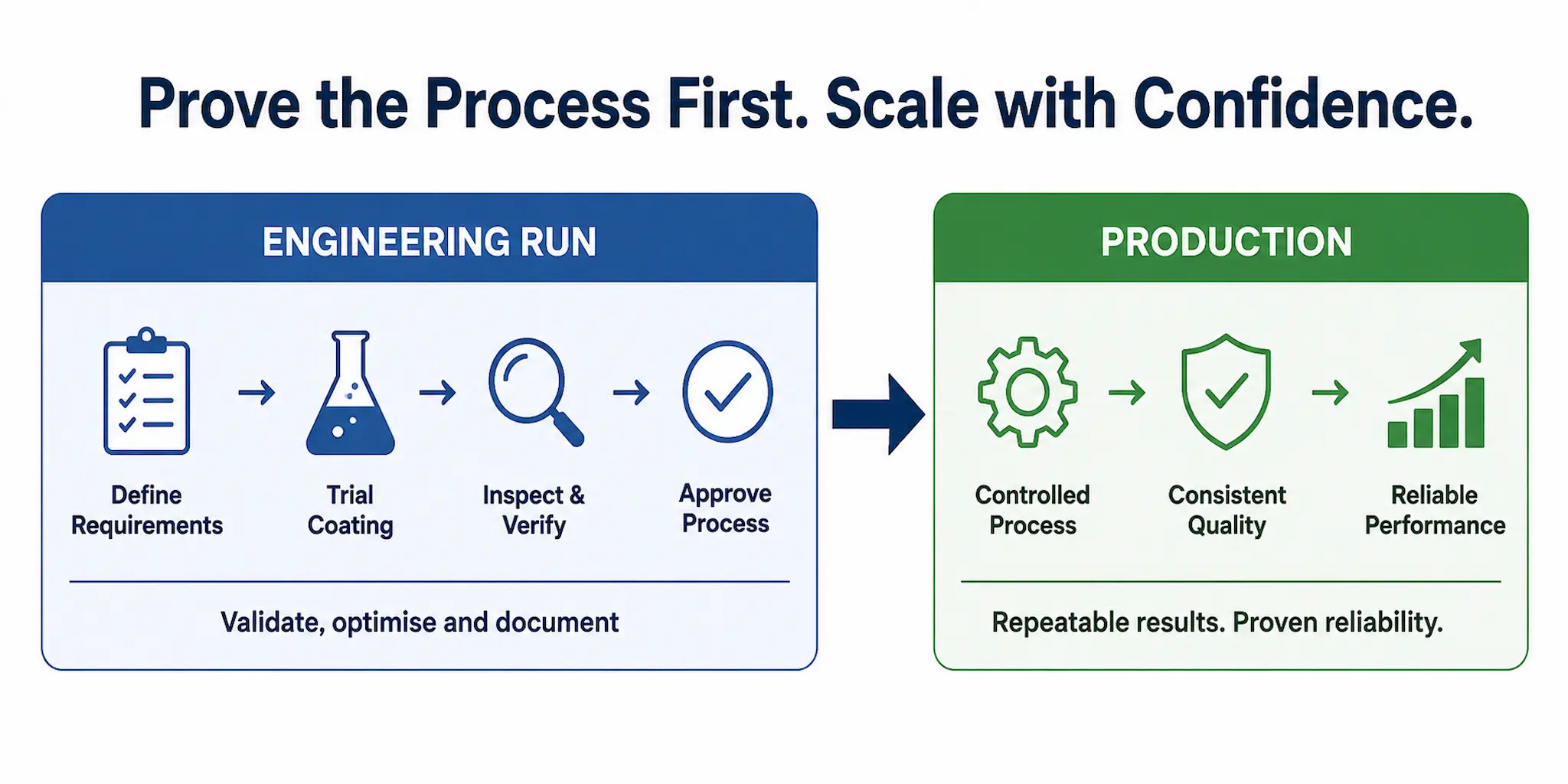
A Parylene engineering run helps define, test and verify the coating process before controlled production.
What is a Parylene engineering run?
At SCH, an engineering run, or E-run, is a controlled pre-production coating run used to develop, confirm or refine the proposed process on representative customer parts.
The exact scope depends on the application. For a relatively simple PCB, the main questions may be masking and thickness. For a complex sensor, mechanical assembly or high-reliability product, the engineering run may also need to consider cleaning, drying, adhesion promotion, sensitive materials, geometry, inspection and subsequent environmental testing.
Key point: an engineering run is a process-development and verification stage. It should not automatically be treated as formal product qualification unless the qualification requirements, test methods and acceptance criteria have been specifically agreed.
For the wider production-control framework, see Parylene as a Manufacturing System: From Deposition to Controlled Production.
What should an engineering run establish?
A useful E-run should answer the practical questions that would otherwise remain assumptions when production begins.
1. Coating requirement
Confirm the Parylene grade, target thickness, coated areas, exclusions and any application-specific requirements before the process is fixed.
2. Surface preparation
Establish whether cleaning, drying, bake-out or adhesion promotion is required and identify materials or residues that could influence coating performance.
3. Masking method
Confirm how connectors, contacts, holes, sensors, sealing faces or other coating-free areas will be protected and whether the masking produces an acceptable boundary.
4. Loading and fixturing
Determine how parts should be orientated, supported and distributed within the chamber so that the process can be repeated consistently.
5. Thickness control
Verify that the proposed process produces the required coating thickness and determine how thickness will be monitored or measured in production.
6. Inspection and acceptance
Establish what will be inspected after coating and demasking, how conformity will be demonstrated and what constitutes an acceptable finished part.
Why representative customer parts matter
Witness coupons are valuable for monitoring deposition and measuring coating thickness, but they cannot reproduce every feature of the actual product.
Real assemblies may contain connectors, cavities, sharp geometry, elastomers, plastics, adhesives, labels, solder residues or components that behave differently during preparation, vacuum exposure, deposition or demasking.
This is why an engineering run should normally use parts that are representative of the intended production assembly. Where sacrificial or non-functional samples are used, any differences that could affect the coating process should be understood.
A successful coating on a flat witness coupon confirms useful process information, but it does not by itself prove that every feature of a complex assembly has been successfully processed.
A practical Parylene engineering-run workflow
The E-run should be treated as a short engineering cycle rather than simply a small production batch.
Step 1 – Review
Review drawings, coating specification, materials, coating-free areas, thickness requirement and known service conditions.
Step 2 – Define
Agree the proposed cleaning, masking, preparation, deposition and inspection route and identify any unresolved questions.
Step 3 – Process
Run representative assemblies using the proposed Parylene process and suitable witness or measurement samples where required.
Step 4 – Inspect
Demask and inspect the coated assemblies. Record thickness and other agreed process or acceptance information.
Step 5 – Review results
Compare the finished parts against the drawing, specification and agreed expectations. Identify anything that needs changing before production.
Step 6 – Control
Once the result is accepted, capture the important process controls so subsequent batches can follow the established production route.
Masking is often one of the most important E-run decisions
Parylene is deposited from the vapour phase and can coat exposed surfaces throughout complex assemblies. Areas that must remain free from coating therefore need to be identified and protected deliberately.
An E-run allows masking materials, boots, tapes, plugs, temporary fixtures or other methods to be assessed on the real geometry before they become part of a repeated manufacturing process.
The trial can also expose practical issues that are difficult to resolve from a drawing alone, including access for masking, boundary position, demasking difficulty, risk of damage and the amount of labour required for each assembly.
For more detail, see Parylene Masking: Silicone Boots, Tapes & Custom Shapes.
Thickness must be demonstrated, not assumed
The amount of Parylene introduced into a process and the nominal deposition target do not remove the need for suitable verification. Part geometry, chamber loading and measurement location all need to be considered when deciding how the coating requirement will be demonstrated.
Engineering runs provide an opportunity to establish the relationship between the target process and the measured result before routine production begins. Depending on the product and requirement, this may include witness coupons, direct measurements or other agreed verification methods.
The required thickness should also be technically justified. Increasing thickness affects material consumption, deposition time and chamber throughput, so excessive thickness can add cost without necessarily providing a proportional improvement in performance.
See Parylene Thickness Strategy for the wider relationship between protection, performance and process cost.
Surface preparation should be part of the trial
A deposition trial is less useful if the production surface-preparation route has not also been defined. Cleaning, residual moisture, outgassing and surface condition can all influence the final coating system.
If production parts will be cleaned, baked, plasma treated or exposed to an adhesion promoter, the E-run should normally represent that intended route closely enough to make the result meaningful.
Changing the preparation method after the trial can introduce a new process variable and may reduce the value of the original evidence.
For further guidance, see Parylene Cleaning, Surface Preparation & Adhesion Control.
What information can come out of an engineering run?
The output should be more useful than a statement that the parts were successfully coated. Depending on the project, an E-run can establish or support:
- The practical coating process route
- Cleaning and preparation requirements
- Masking locations and masking methods
- Part orientation and fixturing
- Target Parylene grade and thickness
- Witness coupon or thickness-measurement strategy
- Demasking method
- Visual and dimensional inspection requirements
- Customer acceptance of representative coated parts
- Realistic processing and labour times
- Production batch-loading assumptions
- Information needed to refine production costing
Not every project requires every item. The purpose is to identify the variables that matter for the particular assembly and control them before volume increases.
An E-run can improve production costing as well as technical confidence
Early quotations sometimes have to be based on drawings, photographs, estimated masking time and assumed chamber loading. These are reasonable starting points, but they may not represent the actual production effort.
An engineering run provides real process information. Masking and demasking time can be measured, material use can be reviewed, practical loading density can be established and the actual coating cycle can be understood.
This can be particularly important when moving from prototypes to larger recurring batches. The cost of Parylene is influenced by both part-level work and batch-level processing, so accurate production pricing becomes easier once the real process has been demonstrated.
Engineering run, qualification run and production run are not the same thing
| Stage | Primary purpose | Typical outcome |
|---|---|---|
| Engineering run | Develop and verify the practical coating process | Defined process route and representative coated parts |
| Qualification run | Demonstrate compliance against defined qualification requirements | Test evidence against agreed criteria |
| Production run | Manufacture parts using the released process | Repeatable production output under controlled conditions |
The stages may be combined on some projects, but that should be a deliberate decision rather than an assumption.
When is a Parylene engineering run particularly useful?
An E-run is especially valuable when one or more aspects of the production process are not yet proven.
- A new assembly is being coated with Parylene for the first time
- The drawing contains complex or numerous coating keep-out areas
- Sensitive connectors, sensors, seals or mechanical interfaces require masking
- A specific or narrow thickness range must be achieved
- New substrate materials, adhesives, plastics or elastomers are present
- Cleaning, bake-out, plasma treatment or adhesion promotion requires validation
- The assembly has complex geometry or restricted vapour access
- The customer needs representative coated parts for functional or environmental evaluation
- The intended production volume makes accurate processing time and chamber loading important
- A previous Parylene process is being transferred between equipment, sites or suppliers
From engineering run to controlled production
The real value of an E-run appears after the trial. Once the process has produced an acceptable result, the important parameters need to be translated into controlled production instructions.
This may include the preparation route, masking method, part orientation, chamber loading, Parylene grade, target thickness, witness strategy, demasking method and inspection criteria.
Where the engineering run identifies a problem, the process should be changed deliberately and the effect verified rather than allowing production operators to compensate informally from batch to batch.
That approach connects directly with the wider principle of treating Parylene as a controlled manufacturing system: stable production depends on stable inputs, defined methods and appropriate verification.
Related Parylene guidance
These supporting articles cover the main technical areas that may need to be considered during an engineering run:
Why Choose SCH Services?
SCH Services supports Parylene projects from initial process review and engineering runs through to controlled repeat production. The objective of an engineering run is to resolve practical manufacturing questions early, establish evidence from representative parts and reduce uncertainty before larger batches are released.
Support can include process review, cleaning and preparation strategy, masking development, Parylene deposition, thickness verification, inspection and production scale-up.
If you are considering Parylene for a new assembly or need to establish a production-ready process, contact SCH Services to discuss whether an engineering run would be appropriate.
Disclaimer: This article provides general technical guidance only. Parylene coating requirements, process controls, inspection methods and qualification requirements should be defined and validated for the specific product, materials, operating environment and applicable customer or industry requirements. Representative trials and engineering runs do not replace formal qualification testing where this is required.
