Parylene Coating for PCB Protection
Thin-Film Protection for High-Reliability Printed Circuit Boards
← Back to the Parylene Applications Hub ← Back to Technical Articles Hub
Parylene coating for PCB protection provides an ultra-thin, pinhole-free barrier that protects complex assemblies from moisture, chemicals, ionic contamination and corrosion.
Unlike conventional liquid conformal coatings, Parylene is deposited from the vapour phase, delivering perfectly conformal coverage even under components, inside tight gaps and around sharp edges.
Understanding how Parylene compares to traditional coating methods is critical when selecting a protection strategy — see Parylene vs conformal coating for a full comparison.
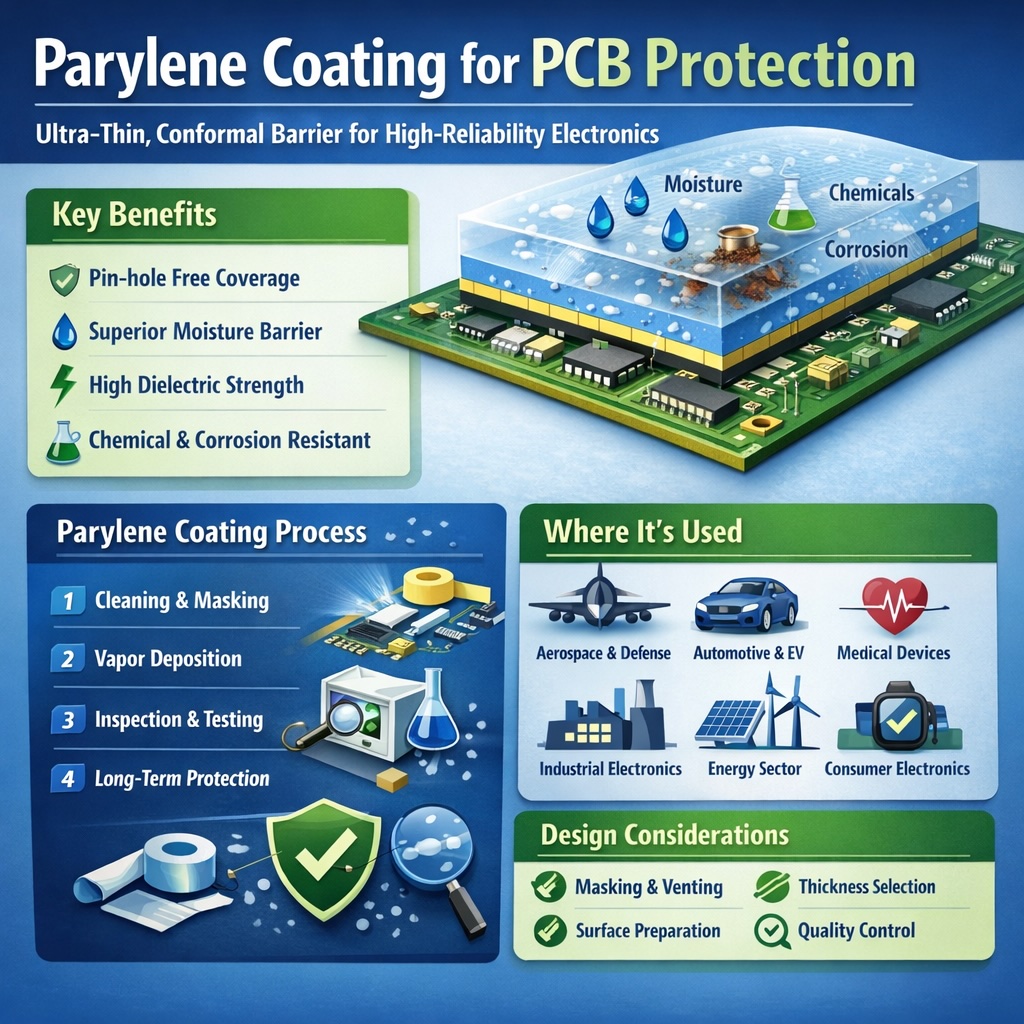
Parylene coating provides ultra-thin, uniform protection across PCB assemblies, including complex geometries and under-component coverage.
Why use Parylene coating for PCB protection
- True 3D conformity – coats all exposed surfaces including under components and inside tight gaps
- Excellent moisture and corrosion barrier – very low water vapour transmission rate (WVTR)
- High dielectric strength at low thickness – supports dense PCB designs
- No pinholes or pooling – uniform film without meniscus effects
- Low thermal and mechanical stress – room-temperature deposition
- Chemical resistance – protects against fuels, oils and aggressive environments
- Long-term stability – non-migrating and chemically inert
These properties make Parylene suitable where failure risk, downtime or inaccessibility make reliability critical.
Where Parylene adds value
- Aerospace and defence systems
- Automotive and EV electronics
- Industrial control systems
- Medical and diagnostic devices
- Energy and outdoor electronics
- Wearables and compact consumer devices
Not all assemblies require Parylene. The decision depends on geometry, environment and process capability.
Design and DFM guidelines
- Masking strategy – connectors, test points and interfaces must be defined
- Access for vapour – ensure coverage inside cavities
- Thickness selection – typically 5–25 µm depending on requirement (see guide)
- Material compatibility – finishes, plastics and substrates must be considered
- Cleanliness and surface condition – critical for adhesion and long-term reliability
For challenging substrates, surface activation techniques such as plasma cleaning are often required to achieve reliable adhesion.
Typical Parylene coating process
- Specification and review
- Cleaning and preparation
- Masking
- Parylene deposition
- Demasking
- Inspection and testing
- Documentation and traceability
Why Choose SCH Services?
SCH Services provides complete Parylene solutions including coating services, equipment, materials and training, supported by process-led engineering and validation.
- ✈️ 25+ Years Experience
- 🛠️ Process-led support
- 📈 Scalable solutions
- 🌍 Global reach
- ✅ Focus on reliability and repeatability
📞 +44 (0)1226 249019 | ✉ sales@schservices.com | 💬 Contact Us ›