Masking for Parylene
Masking methods, materials, and keep-out strategies for Parylene coating
← Back to the Parylene Basics Hub
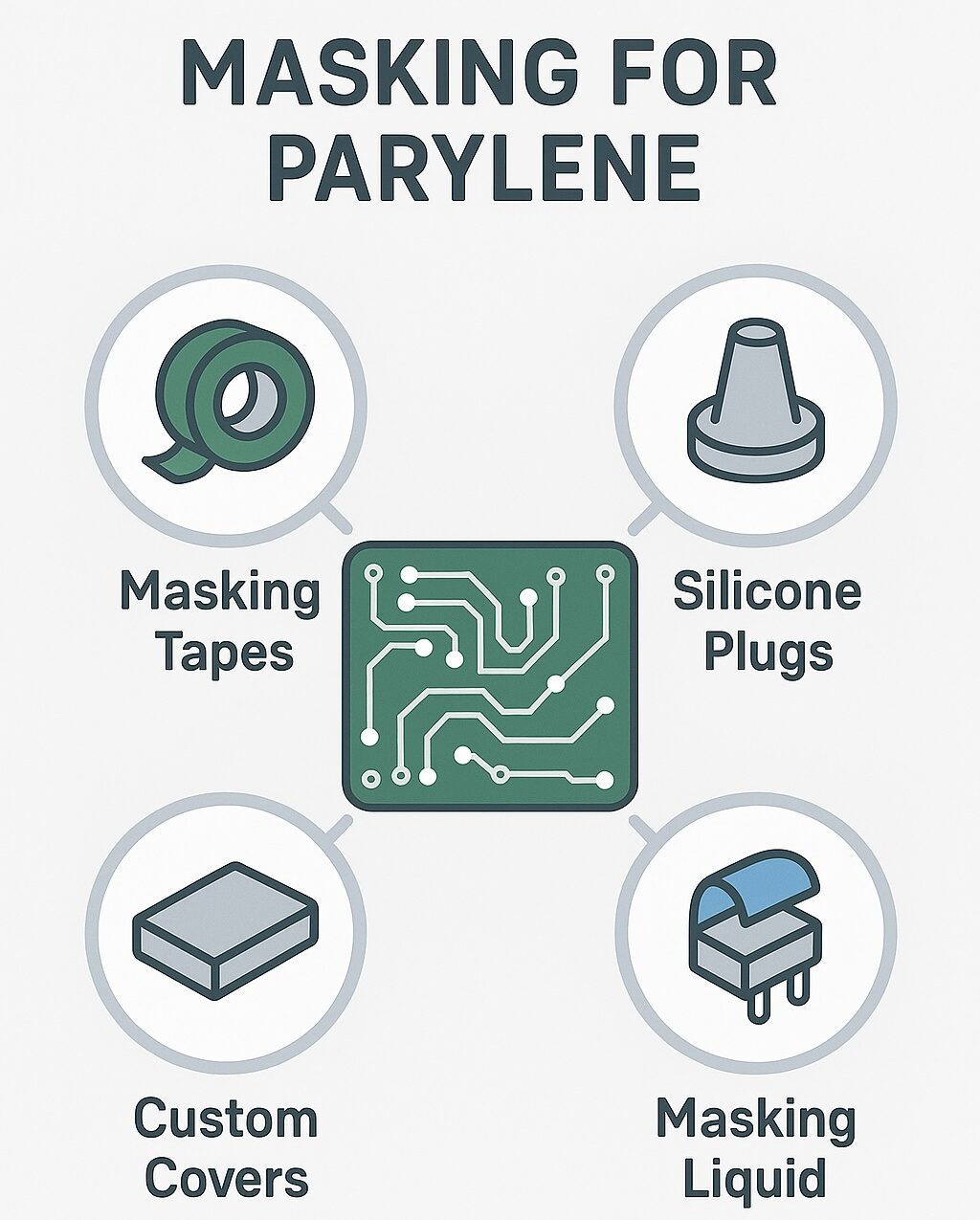
Parylene masking prevents coating on keep-out areas during vacuum CVD and drives crisp edge definition. This guide covers mask types (reusable silicone boots, tapes & dots, custom shapes), vacuum-compatible materials, and a step-by-step process to avoid leakage, feathering, or wicking.
For a production-focused view of common masking problems and how to prevent them, see Parylene Masking Failures: Common Problems & How to Prevent Them.
Quick Links
Why Masking Matters in Parylene
- Parylene deposits everywhere line-of-sight and by diffusion—unmasked gaps, vents, and threads will coat.
- Sharp edges around connectors and mating surfaces protect functionality and speed reassembly.
- Proper masking reduces rework and the need for Parylene removal.
Masking quality also has a direct effect on process yield, connector cleanliness and demasking effort. For the most common production failures, see Parylene Masking Failures.
Background: Parylene basics · deposition parameters
Mask Types: Boots, Tapes & Custom Shapes
- Reusable Boots: Best edge quality and speed for connectors, switches, and headers. Choose sizes that compress slightly for a vacuum seal.
- Tapes & Dots: Flexible for odd keep-outs; burnish edges firmly. Use tabbed dots for fast demask.
- Custom Shapes: CNC/3D-printed or die-cut masks for complex geometries, threaded holes, and multi-level features.
Choosing the wrong mask type is one of the fastest ways to create leakage, residue or demasking damage. See Parylene Masking Failures for examples and prevention strategies.
Vacuum-Compatible Materials
- Prefer low-outgassing silicones and fluoro-elastomers for boots; avoid softeners that migrate.
- Use high-temperature, low-residue adhesives for tapes; pre-bake rolls to stabilise.
- Reject porous foams or paper liners that vent under vacuum.
Material compatibility also matters for surface condition and long-term bond strength. If you are seeing lift, residue-related failures or coating peel-back near masked areas, see Parylene Adhesion: Causes of Failure & Solutions.
Standards & guidance: IPC-CC-830 · IPC A 610
Application Workflow
- Design & DFM: Define keep-outs and pull clearances early; select mask types per feature.
- Prep: Clean board; pre-bake masks; verify fit on a golden sample.
- Apply: Fit boots fully; burnish tapes at edges; plug/vent holes as needed.
- Verify: Use inspection for edge seal before loading.
- Deposit: Load per CVD parameters; avoid mask shift during fixturing.
- Demask: Remove slowly at shallow angle; avoid tearing fillets.
- Inspect: Confirm edges/keep-outs; repair locally or, if needed, use micro-abrasion.
If you are formalising these requirements into drawings or work instructions, see How to Specify Parylene Coating. For new or complex assemblies, the proposed masking method can also be evaluated during a Parylene engineering run so that mask fit, boundary definition, demasking and inspection can be assessed on representative parts before production.
Need operator training? We run masking masterclasses for Parylene lines.
Edge Control & Common Defects
- Feathered edges: Improve compression or change mask type.
- Leakage under tape: Re-burnish; replace tape; consider a boot or custom mask.
- Wicking into gaps: Plug vents/through-holes; review fixturing and load orientation.
For a dedicated engineering guide to masking-related coating failures, see Parylene Masking Failures: Common Problems & How to Prevent Them.
See the Defects Hub for de-wetting, capillary/wicking, and delamination guidance.
Process Controls & Inspection
- Document mask IDs, lot codes, and reuse cycles; retire worn boots.
- Thickness plans: AQL, coupons & SPC using optical meters or eddy-current gauges.
- Inspection gates: Magnification checks of coverage/edges, white-light finish, and keep-out verification against drawings.
Where masking choices influence local build-up, dielectric clearance or process cost, it is worth aligning inspection with the Parylene Thickness Specification Guide.
Special Cases
- Connectors & headers: Use sized boots; verify mating face and latch areas remain clean.
- Press-fit & threaded features: Seal threads and vents with custom plugs/shapes.
- Cavities & under-components: Add temporary fillers or change orientation to limit diffusion paths.
Some of these masking decisions also influence whether Parylene remains the best overall coating choice compared with liquid-applied alternatives. For broader selection guidance, see Parylene vs Conformal Coating.
If post-coat cleanup is required, see Parylene removal by micro-abrasion.
Why Choose SCH Services?
Partnering with SCH Services means more than just outsourcing — you gain a complete, integrated platform for
Conformal Coating, Parylene & ProShieldESD Solutions, alongside equipment, materials, and training, all backed by decades of hands-on expertise.
- ✈️ 25+ Years of Expertise – Specialists in coating technologies trusted worldwide.
- 🛠️ End-to-End Support – Guidance on coating selection, Parylene grades, masking, inspection, and ProShieldESD integration.
- 📈 Scalable Solutions – From prototype batches to high-volume production, SCH grows with your needs.
- 🌍 Global Reach – Responsive support across Europe, North America, and Asia.
- ✅ Proven Reliability – Built on quality, consistency, and customer satisfaction.
📞 Call: +44 (0)1226 249019
✉ Email: sales@schservices.com
💬 Contact Us ›