Moisture Trapped Before Conformal Coating
Why residual moisture can cause conformal coating failures even when assemblies appear clean and dry
Bulletin Category: Cleaning, Contamination & Surface Problems | Typical Environments: Washed assemblies, humid storage areas, dense PCB layouts, low-standoff components, selective coating, batch coating and assemblies exposed to humidity testing.
One of the common hidden causes of conformal coating failure is moisture that remains within the assembly before coating begins. The board may appear clean and dry during inspection, but residual moisture can remain under components, around residues, inside narrow gaps or within materials that absorb or hold water.
Once conformal coating is applied, that moisture can become trapped beneath or within the coating system. The defect may not appear immediately. It may only become visible after curing, humidity exposure, thermal cycling, powered testing or field operation.
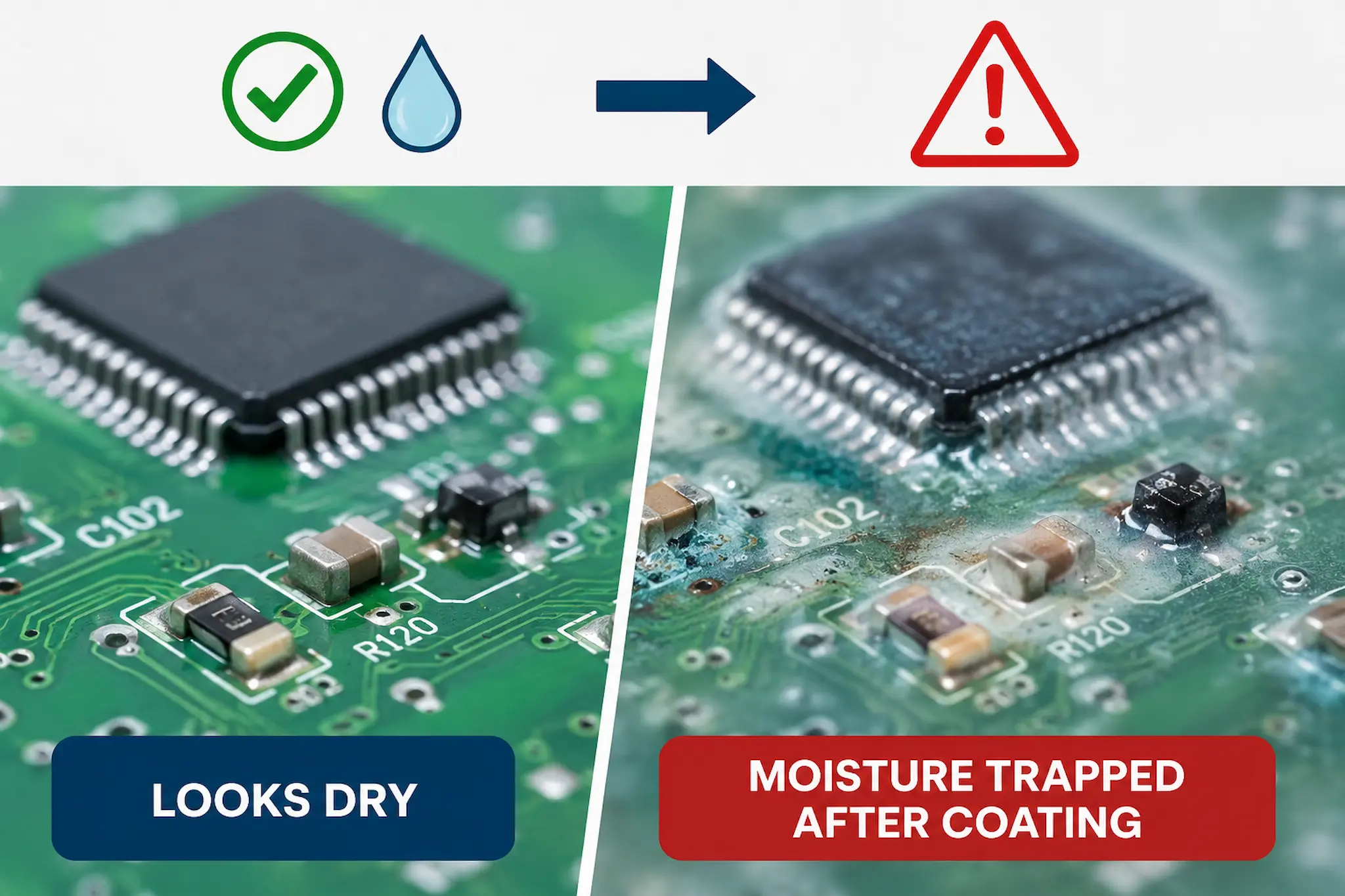
Boards can appear clean and dry before coating, yet residual moisture may remain and only reveal itself later through corrosion, white residues or reliability failures.
Engineering Observation
The assembly passed cleaning and looked dry before coating. The coating applied normally and may have passed initial visual inspection. Later, white residues, hazing, local corrosion, adhesion loss or electrical leakage appeared.
Investigation often starts with the coating material, but the real cause may be moisture already present on or within the assembly before the coating process started.
Why It Happens
The board is not fully dry after cleaning
Cleaning can leave moisture under components, connectors, shields, low-standoff parts and other areas where liquid is slow to drain or evaporate.
Residues hold moisture
Flux residues, ionic contamination and other surface residues can retain moisture even when the visible surface of the board appears acceptable.
Storage conditions allow moisture uptake
Assemblies stored in humid areas, left uncovered or moved between different temperature zones can absorb moisture or suffer condensation before coating.
Materials release moisture later
Some components, labels, tapes, plastics, substrates and packaging materials can absorb moisture and release it later during cure, test or service exposure.
What We Commonly Find
- White residues or cloudy areas appear after coating, curing or environmental exposure.
- Corrosion appears under coating even though coating coverage looks acceptable.
- Failures occur around dense component areas, connectors or low-clearance parts.
- Adhesion loss is localised rather than spread evenly across the board.
- Leakage current increases during humidity or powered testing.
- Coating thickness passes inspection, but the assembly still fails reliability testing.
Process Note
Conformal coating is not a drying process. If moisture is present before coating, the coating can seal that moisture into the assembly instead of removing it.
A board looking dry is not the same as the board being dry enough for coating.
Recommended Actions
- Review the drying process after cleaning, not only the cleaning chemistry.
- Check whether moisture can remain beneath components, connectors, shields or low-standoff devices.
- Control the time between cleaning, drying, storage and coating.
- Review humidity and temperature conditions in storage and production areas.
- Consider controlled bake-out where appropriate for the assembly, components and materials.
- Look for residues as well as moisture, because residues can hold moisture and increase corrosion risk.
- Use process checks, witness boards or inspection evidence to confirm repeatability.
The aim is to prevent moisture from being sealed into the assembly before the coating is expected to protect it.
Escalation Point
If defects appear after coating, curing, humidity testing or field exposure, do not investigate the coating material in isolation. Review the full process from cleaning through drying, storage, handling, coating and cure.
SCH can support coating failure reviews, cleaning and drying process assessment, surface preparation reviews, coating process audits and practical production trials where trapped moisture or residues are suspected.
Related Guidance
Need Help With Moisture-Related Coating Failures?
SCH Services supports manufacturers with conformal coating process reviews, coating defect investigation, cleaning and surface preparation assessment, coating trials and practical production guidance.
Why Choose SCH Services?
SCH Services combines coating production, process troubleshooting, training and practical engineering support. We work with real assemblies, production constraints, cleaning limitations, drying risks, masking problems and coating process variation.
- Practical conformal coating production experience.
- Support with coating defects, contamination, masking, cleaning and process control.
- Training and consultancy for operators, engineers and production teams.
- Process-led guidance based on manufacturing reality, not only material datasheets.
Disclaimer: This bulletin provides general technical guidance only. Moisture-related coating failures can depend on board design, residues, cleaning chemistry, drying process, coating material, cure conditions, storage environment and end-use exposure. Final process decisions should be validated against the applicable product requirements, customer specifications, qualification tests and production controls.