
Conformal Coating Surface Preparation Hub
Cleaning, contamination control, adhesion preparation and pre-coating process stability for PCB coating
This hub focuses on preparing PCB assemblies so that conformal coating can wet, adhere and remain reliable in production.
Surface preparation includes more than cleaning. Drying, contamination control, handling discipline, material condition, surface energy, storage and the time between preparation and coating can all influence the finished coating.
Many coating defects are symptoms of an earlier preparation problem. Flux residues, cleaning chemistry, fingerprints, silicone transfer, retained moisture, poor rinsing, low-energy surfaces or re-contamination after cleaning can all create coating failures even when the coating material and application equipment are correct.
Use this hub to understand the core preparation controls and then follow the supporting Bulletins where apparently clean or dry assemblies still fail during coating.
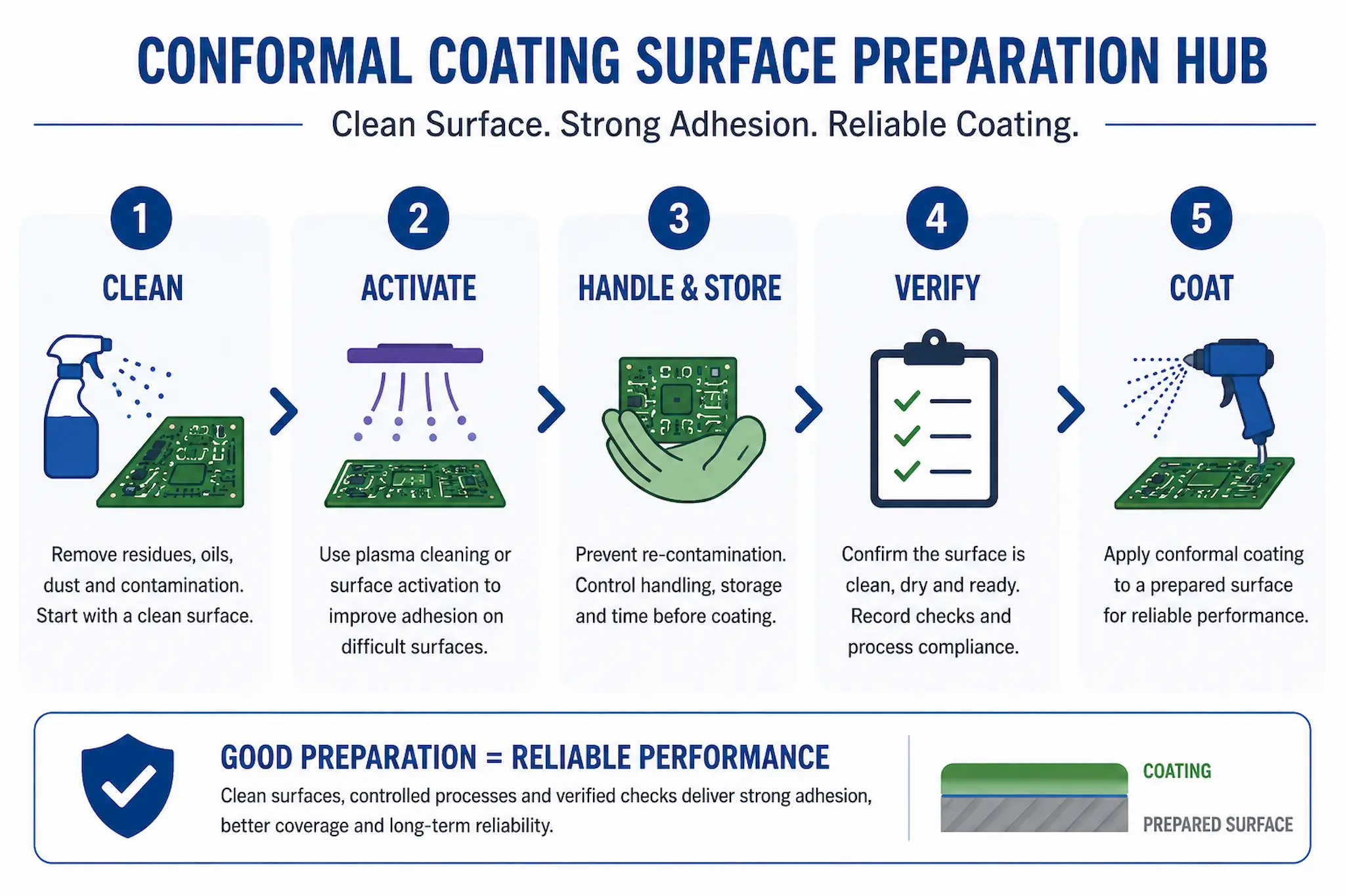
Surface preparation extends from cleaning and drying through handling, activation and final verification immediately before conformal coating.
Where Are You in the Preparation Process?
- The coating pulls away, fisheyes or will not wet correctly → De-Wetting & Poor Wetting
- I am concerned about residues, corrosion or ionic contamination → Corrosion & Ionic Contamination
- Boards appear dry but failures occur after coating → Moisture & Drying Failures
- Problems appear around hand-contact, masking or rework areas → Handling & Silicone Contamination
- I am considering plasma treatment or surface activation → Plasma Cleaning & Surface Activation
- I need a controlled production preparation process → Surface Preparation & Process Control
Surface Preparation Index
| Topic | Summary | Article |
|---|---|---|
| Surface Preparation & Cleanliness – cleaning, contamination control and coating readiness | ↓ | Read ↗ |
| Plasma Cleaning & Surface Activation – adhesion improvement for difficult surfaces | ↓ | Read ↗ |
| De-Wetting & Poor Wetting – contamination, residues and low-surface-energy failures | ↓ | Read ↗ |
| Corrosion & Ionic Contamination – residues and electrochemical reliability risk | ↓ | Read ↗ |
| Surface Preparation & Process Control – controlled cleaning, drying, handling and production release | ↓ | Read ↗ |
Preparation Failures & Supporting Guidance
A board can look clean, dry and ready for coating while still carrying hidden preparation risks. These supporting Bulletins show where failures commonly enter the process.
Moisture Can Remain After Cleaning
Residual moisture can remain beneath low-standoff components, inside connectors, in narrow gaps or within hygroscopic residues even when the assembly appears dry. Once coating is applied, that moisture can become trapped and contribute to white residues, bubbles, adhesion loss, corrosion or electrical leakage.
Visually Clean Does Not Mean Coating-Ready
Thin films of cleaning chemistry, flux activators, ionic residues, oils or other contamination may be invisible under normal inspection while still changing wetting, adhesion or long-term reliability.
Bulletin: Boards Look Clean but Still Fail Conformal Coating ↗
Handling Can Re-Contaminate a Cleaned PCB
Cleaning only controls the surface at one point in time. Fingerprints, gloves, packaging, inspection, masking and rework can introduce oils, salts or other contamination immediately before coating.
Bulletin: Fingerprints and Handling Contamination Before Conformal Coating ↗
Silicone and Masking Materials Can Contaminate the Surface
Silicone oils, release agents, unsuitable masking materials and contamination transferred from tools or elastomers can create highly localised low-surface-energy areas. These commonly appear later as de-wetting, fisheyes, craters or local adhesion loss.
Small Cleaning-Process Changes Can Create New Defects
A change in cleaning chemistry, concentration, wash settings, rinse quality, drying time, board loading or maintenance can alter the real surface condition even when the cleaning process still appears operational.
Bulletin: Cleaning Process Changes Causing New Conformal Coating Defects ↗
Cleaning Does Not Guarantee Correct Wetting
A cleaned assembly may still reject coating if residues remain, surface energy is low, cleaning chemistry has been redistributed or contamination has been introduced after cleaning.
Surface Preparation & Cleanliness
A coating can only interact with the surface condition that actually reaches the coating station. Cleaning is therefore one element of preparation rather than the complete preparation process.
- Identify flux residues, oils, dust, fingerprints, silicone and process chemicals that may affect coating.
- Define the required cleanliness condition for the assembly and coating chemistry.
- Ensure rinsing removes cleaning chemistry rather than redistributing it.
- Dry the assembly sufficiently before coating, particularly beneath components and within restricted geometry.
- Protect cleaned assemblies from re-contamination during storage, masking, inspection and movement.
- Verify preparation against coating wetting, adhesion and product reliability requirements.
Plasma Cleaning & Surface Activation
Plasma treatment can remove some surface contamination and increase surface energy, making it useful where conventional cleaning alone does not provide the required wetting or adhesion.
- Identify whether the problem is contamination, low surface energy or another adhesion mechanism before adding plasma.
- Validate plasma chemistry, power, exposure time and treatment parameters against the actual substrate.
- Control the delay between plasma treatment and coating because activated surfaces can change with time.
- Ensure plasma does not damage sensitive polymers, components or surface finishes.
- Use plasma as a controlled preparation step rather than as compensation for an unstable cleaning process.
De-Wetting & Poor Wetting
De-wetting occurs when the liquid coating cannot form and maintain a stable film over the surface. The visible defect appears during coating, but the root cause is often already present before application begins.
- Check for silicone, fingerprints, oils, flux residues and cleaning chemistry.
- Review whether the assembly was genuinely dry before coating.
- Investigate low-surface-energy materials, solder-mask variation and component materials.
- Review handling, masking and rework steps for re-contamination after cleaning.
- Separate surface-condition problems from viscosity, atomisation or application-equipment problems.
Corrosion & Ionic Contamination
Conformal coating does not neutralise ionic contamination trapped beneath the film. When contamination, moisture and electrical bias combine, corrosion, leakage current or electrochemical migration can occur beneath an apparently intact coating.
- Control ionic residues before coating rather than relying on the coating as compensation.
- Review flux chemistry, rinse effectiveness and cleaning-process stability.
- Consider contamination trapped beneath components or within difficult-to-clean geometry.
- Ensure assemblies are properly dried after aqueous cleaning.
- Link cleanliness requirements to the actual voltage, humidity and reliability risk of the finished product.
↑ Back to Index · Read Corrosion & Ionic Contamination Guide ↗
Surface Preparation & Process Control
A reliable surface-preparation system controls the complete route from cleaning through coating rather than treating cleaning as a single isolated operation.
- Define cleaning chemistry, concentration, wash and rinse conditions.
- Control drying time and conditions after cleaning.
- Define how cleaned boards are handled, stored and transported.
- Control gloves, tools, masking materials and work surfaces that contact cleaned assemblies.
- Set maximum time limits between cleaning, activation and coating where required.
- Record process changes because apparently small cleaning changes may alter coating performance.
- Define inspection or verification criteria before release to coating.
Connect Surface Preparation to the Wider Coating Process
Preparation establishes the surface condition; the application and inspection processes must then preserve and verify it.
- Conformal Coating Processes Hub – complete coating workflow and process fundamentals.
- Application Methods Hub – spray, dip and selective-coating behaviour after preparation.
- Masking Hub – understand where masking materials and handling can introduce contamination or surface changes.
- Defects Hub – route wetting, adhesion, corrosion and contamination symptoms to likely causes.
- Inspection & Quality Hub – inspection and verification of the finished coating process.
Need Help With Cleaning, Contamination or Adhesion?
SCH Services can review the complete pre-coating route to determine whether the problem originates in cleaning, drying, handling, contamination, surface energy or the coating process itself.
Useful information to send us includes: the PCB or assembly, coating material, flux and cleaning chemistry, cleaning process, drying method, storage and handling route, masking materials, defect photographs and any pattern in when or where failures occur.
- Cleaning-process and rinse review.
- Drying and retained-moisture investigation.
- Handling and contamination-route assessment.
- Silicone and low-surface-energy troubleshooting.
- De-wetting and adhesion investigation.
- Plasma-cleaning and activation assessment.
- Production process validation and operator training.
Process Consultancy
Conformal Coating Training
Discuss Your Process
Why Choose SCH Services?
SCH Services combines practical coating, cleaning, masking, inspection and process-engineering experience, allowing preparation failures to be investigated as part of the complete manufacturing process.
- Process-led troubleshooting – preparation, coating and inspection considered together rather than in isolation.
- Cleaning and contamination review – practical assessment of residues, drying, handling and process changes.
- Adhesion and wetting support – investigation of de-wetting, surface energy and material compatibility.
- Plasma and activation knowledge – support where additional surface treatment is technically justified.
- Training and production support – from process development through repeat coating production.
📞 Call: +44 (0)1226 249019 | ✉ Email: sales@schservices.com | 💬 Contact Us ›
Disclaimer: This content provides general technical guidance on conformal coating surface preparation, cleaning, drying, contamination control, surface activation and adhesion. Final cleaning methods, cleanliness limits, drying conditions, handling controls, plasma treatment and coating processes must be validated against the specific PCB assembly, material set, coating chemistry, operating environment, customer specification and applicable standards.
