PFAS-Free Coatings for Electronics, PCBs & Precision Components
Alternative coating strategies where regulatory risk, material selection and technical performance must be balanced
PFAS-free coatings for electronics and PCBs are increasingly adopted to reduce regulatory risk, meet compliance requirements and support long-term material strategy. These coatings act as alternatives to traditional fluorinated systems, but the challenge is not simple substitution — it is selecting solutions that deliver the required performance under real operating conditions.
In most cases, successful adoption requires a controlled transition rather than a direct material swap. PFAS-free coatings therefore sit within a broader advanced functional coatings approach, where performance, process and regulatory considerations must be evaluated together.
In practice, PFAS-free solutions may be implemented as surface treatments, film-forming coatings or barrier systems, depending on the required chemistry, performance level and exposure conditions. These may overlap with hydrophobic coatings, ultra-thin coatings or film-forming coating strategies depending on the application.
For full coating route comparison, start with the Coating Selection Guide. For behaviour classification, use the surface vs film vs barrier guide.
Key reality: PFAS-free is rarely a direct substitution. In most applications, moving away from fluorinated coatings requires re-evaluating coating behaviour, process and validation strategy.
Selection check: PFAS-free is not a coating type by itself. First define whether the application needs surface behaviour, ultra-thin coating, film-forming protection or barrier performance. Then assess whether a PFAS-free option is viable within that route. If you are comparing specific PFAS-free CytoPel options against ultra-thin, hard or UV-curable coating routes, use the CytoPel coating selection matrix.
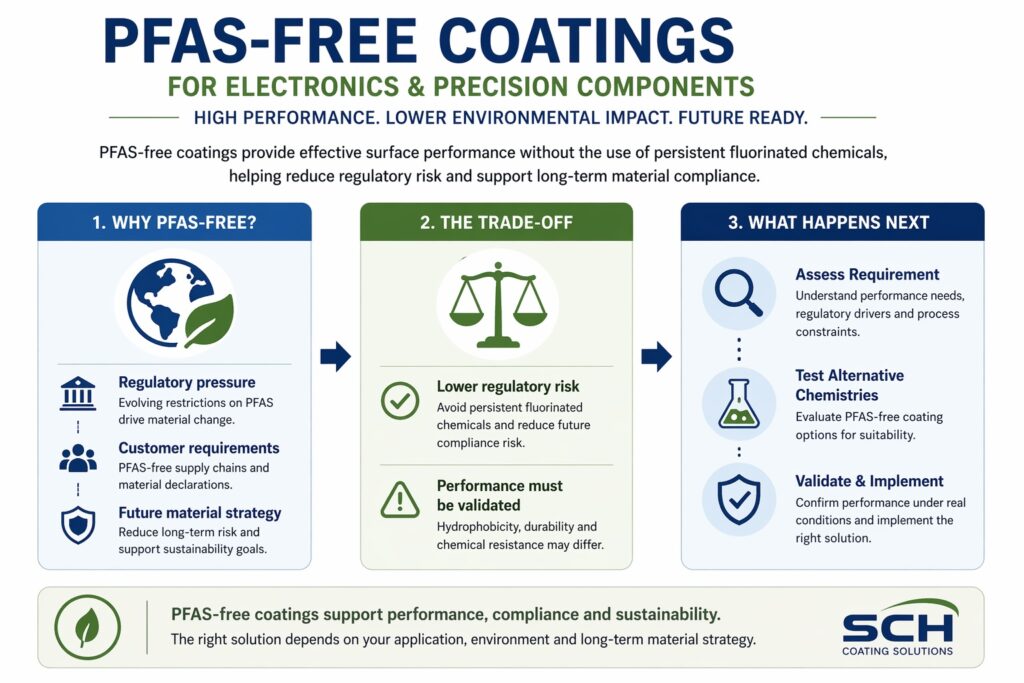
Decision framework showing how regulatory drivers, performance trade-offs and validation requirements interact when selecting PFAS-free coatings.
You Are in the Right Place If…
- Regulatory or compliance requirements are driving coating selection
- Customers require PFAS-free materials or supply chain declarations
- You need to reduce long-term material risk or dependency on fluorinated chemistry
- A coating system must be re-evaluated due to PFAS restrictions
- You are balancing coating performance against environmental or regulatory constraints
If performance is the only driver, fluorinated coatings may still offer advantages. PFAS-free coatings are selected when compliance, risk or long-term strategy must be considered alongside technical performance.
Why PFAS-Free Coatings Are Being Considered
PFAS-free coatings are being driven by a combination of regulatory pressure, environmental concerns and long-term material strategy. In many industries, reliance on fluorinated chemistries is becoming a risk factor rather than a default solution.
Historically, fluorinated coatings have been used to deliver low surface energy, hydrophobic behaviour and chemical resistance. However, evolving regulations and customer expectations are now pushing manufacturers to consider alternative chemistries.
The shift is not only technical but strategic. Coating selection is increasingly influenced by lifecycle risk, supply chain requirements and future compliance considerations.
The Real Challenge
PFAS-free coatings are not direct replacements for fluorinated systems. Performance, durability and process behaviour can differ significantly depending on the chemistry.
In many cases, the challenge is not replacing one coating with another, but redefining the overall coating strategy. This may involve moving between surface treatments, film-forming coatings or barrier systems depending on the application.
Where the distinction between surface behaviour and protection level matters, see our surface vs film vs barrier guide. For common mistakes around water repellency and protection, see why hydrophobic coatings don’t protect electronics.
PFAS-free is not a coating type
PFAS-free is a material constraint applied to an existing coating strategy, not a standalone coating route.
The correct approach is:
1. Define the required coating behaviour: surface, film or barrier
2. Select the appropriate coating route: hydrophobic, ultra-thin, conformal coating or Parylene
3. Assess whether a PFAS-free option is viable within that route
Where PFAS-Free Coatings Fit
PFAS-free coatings are selected when regulatory compliance, environmental impact or long-term material strategy are key drivers alongside technical performance.
In many cases, PFAS-free coatings are selected not because fluorinated materials have failed, but because long-term risk, compliance requirements or material strategy make continued use less desirable. If the primary driver is ultra-thin coating selection rather than compliance, review nano coating vs conformal coating.
When PFAS-Free Coatings Are the Right Solution
- Regulatory or compliance requirements are influencing material selection
- Customers require PFAS-free declarations or supply chain control
- Long-life products need to avoid dependency on fluorinated chemistry
- A controlled validation programme is acceptable
- A wider advanced functional coating strategy is being implemented
PFAS-free coatings are often the correct route when compliance and long-term risk must be balanced with achievable performance.
When PFAS-Free Coatings Are Not the Right Answer
PFAS-free selection must not compromise critical performance requirements. Any substitution from fluorinated systems requires validation against real operating conditions.
In these cases:
→ For proven PCB protection and corrosion resistance, use conformal coating solutions
→ For high-performance barrier protection and complex geometry coverage, use Parylene coating solutions
→ For surface behaviour or minimal coating build, use advanced functional coatings
→ For common boundary conditions, review limitations of hydrophobic coatings
What PFAS-Free Coatings Actually Do
PFAS-free coatings aim to deliver similar functional outcomes to fluorinated systems without relying on persistent fluorinated compounds. Depending on the chemistry, they may overlap with hydrophobic coatings, ultra-thin coatings or film-forming coatings.
Provide Alternative Surface Performance
Can deliver hydrophobic behaviour, cleanability or contamination resistance depending on chemistry.
Reduce Regulatory Risk
Removes reliance on PFAS materials, supporting compliance and future-proofing.
Support Sustainability Goals
Often selected to meet internal environmental targets or customer requirements.
Enable Long-Term Material Strategy
Helps reduce risk of future obsolescence or regulatory disruption.
Implementation Pathways
- Customer-Led Evaluation – In-house trials where coating capability exists
- SCH-Enabled Implementation – Support with material selection, process development and training
- SCH Coating Services – Outsourced coating under controlled production conditions
For customers looking to validate PFAS-free coatings without committing to full process setup, SCH provides advanced functional coating services for application, testing and production support.
In many cases, outsourcing is the fastest route to validating PFAS-free coatings without internal investment.
Key point: PFAS-free does not mean equivalent performance. Material substitution must always be validated against real application requirements.
Need Help Choosing the Correct Route?
SCH can assess your regulatory requirements, coating performance needs and application environment to recommend the correct PFAS-free strategy.
Why Choose SCH Services?
SCH supports PFAS-free coating projects from initial assessment through to implementation, ensuring regulatory requirements and technical performance are properly balanced.
📞 +44 (0)1226 249019 | ✉ sales@schservices.com | 💬 Discuss Your Application ›