Why electrostatic behaviour cannot be understood properly without considering the operating environment
Electrostatic behaviour is often discussed as though it is fixed and predictable. In reality, the operating environment has a major influence on how charge is generated, how it accumulates, and how it dissipates.
A surface that appears stable in one condition may behave very differently in another. Air movement, humidity, contamination, contact materials, and conductive surroundings can all change the way an electrostatic problem develops.
This is why electrostatic control should never be treated as a simple material property alone. It is a system-level behaviour shaped by where and how the material is used.
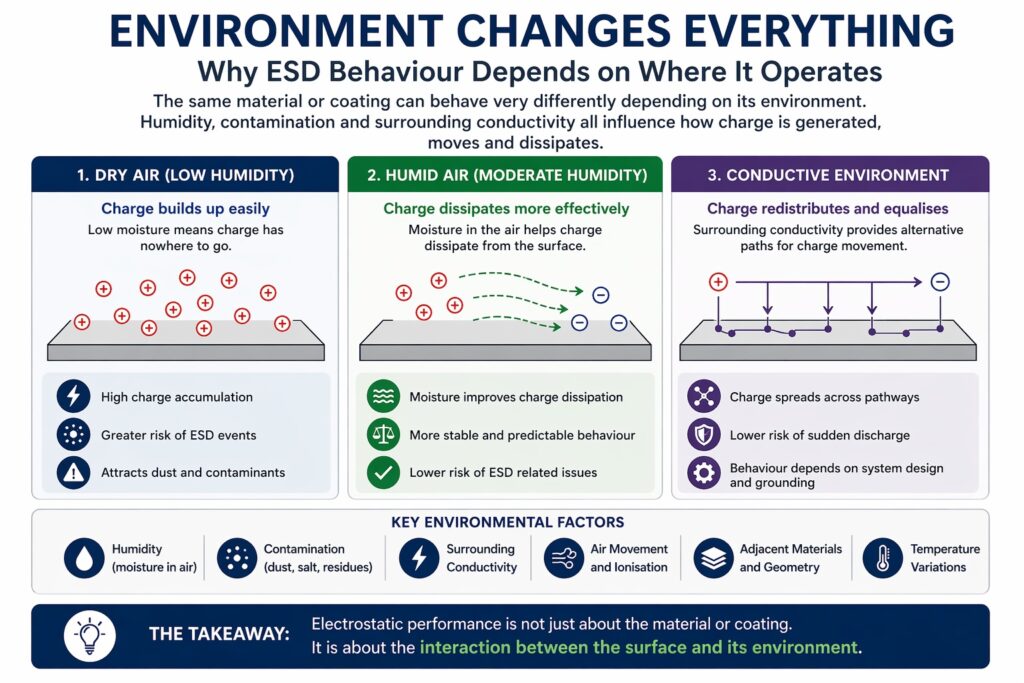
Electrostatic behaviour changes with environment. Humidity, contamination and surrounding conductivity all influence how charge is generated, moves and dissipates.
Why the Same Surface Can Behave Differently
Charge behaviour does not happen in isolation. It is affected by the full operating context around the surface, including nearby materials, motion, geometry, and environmental conductivity.
For example, a polymer surface may hold charge in dry air, behave more predictably in controlled indoor conditions, and respond very differently again in a humid, contaminated, or conductive environment. The surface itself has not changed, but the way charge moves through and around the system has.
This is where many electrostatic problems become misunderstood. Engineers may review the material, but not the wider environment that is shaping the outcome.
Electrostatic performance is not defined by the surface alone. It is defined by the interaction between the surface and its environment.
Why Conductive Environments Need Different Thinking
In conductive or electrochemically active environments, the behaviour of charge changes again. Instead of simply building on the surface, charge may redistribute, equalise, or interact with adjacent conductive paths.
This means the challenge is no longer just about preventing accumulation. It becomes a question of managing surface potential, controlling differential charging, and avoiding instability across the wider system.
In practical terms, this matters in environments involving moisture, conductive contamination, marine exposure, or systems where sensitive electronics operate close to moving polymer or coated surfaces.
What This Means for Coating Strategy
A coating that performs well in one environment may not be suitable in another. Electrostatic control must therefore be judged by application behaviour, not by a single headline value or marketing label.
Questions worth asking include:
- where is charge being generated in the process?
- what surrounding materials or media influence dissipation?
- is the environment dry, humid, contaminated, or conductive?
- are sensitive signal paths or electronics nearby?
- does the coating remain stable under real operating exposure?
In practice, this means considering both how charge is generated during operation and whether it is maintained within a controlled dissipative range, as both factors are influenced by the surrounding environment.
To understand how environmental factors interact with grounding, conductive and dissipative strategies, see the ESD control pyramid explanation.
A Better Way to Frame the Problem
Instead of asking whether a material is electrostatically safe, it is often better to ask whether the full system remains electrostatically stable in its real operating environment.
That distinction matters. It shifts the focus away from simplified material claims and towards practical engineering performance. It also helps explain why some electrostatic issues appear only after installation, scale-up, or field use.
The right solution is usually the one that performs consistently within the actual environment, not the one that looks strongest in isolation.
Related Reading
For further guidance on coating behaviour, inspection, and process-led engineering support, these pages may be useful:
Related insights:
Why Choose SCH Services?
SCH Services helps customers assess coating behaviour in the context of the real process and operating environment. Our approach is practical, process-led, and focused on helping engineering teams reduce instability, improve consistency, and make better coating decisions.
Disclaimer: This article is provided as general technical guidance only. Electrostatic behaviour depends on the interaction between materials, coatings, movement, contamination, humidity, and surrounding operating conditions. Final decisions should be validated through application-specific testing and engineering review.