Cleaning helps, but it does not guarantee adhesion
Delamination after cleaning is often a surface chemistry problem, not simply a cleaning failure. A PCB can appear clean, pass a basic visual check, and still show widespread coating lift if the surface energy is wrong, residues remain that are incompatible with the coating, or the assembly materials do not present a stable surface for adhesion.
This matters because many teams respond by repeating the same cleaning step, using more solvent, or extending wash time, when the real issue is often compatibility, wetting behaviour or surface condition rather than visible dirt.
Quick take. If conformal coating delaminates despite apparently good cleaning, the correct response is usually to review surface energy, residue type, assembly materials, process history and coating compatibility — not just to clean harder.
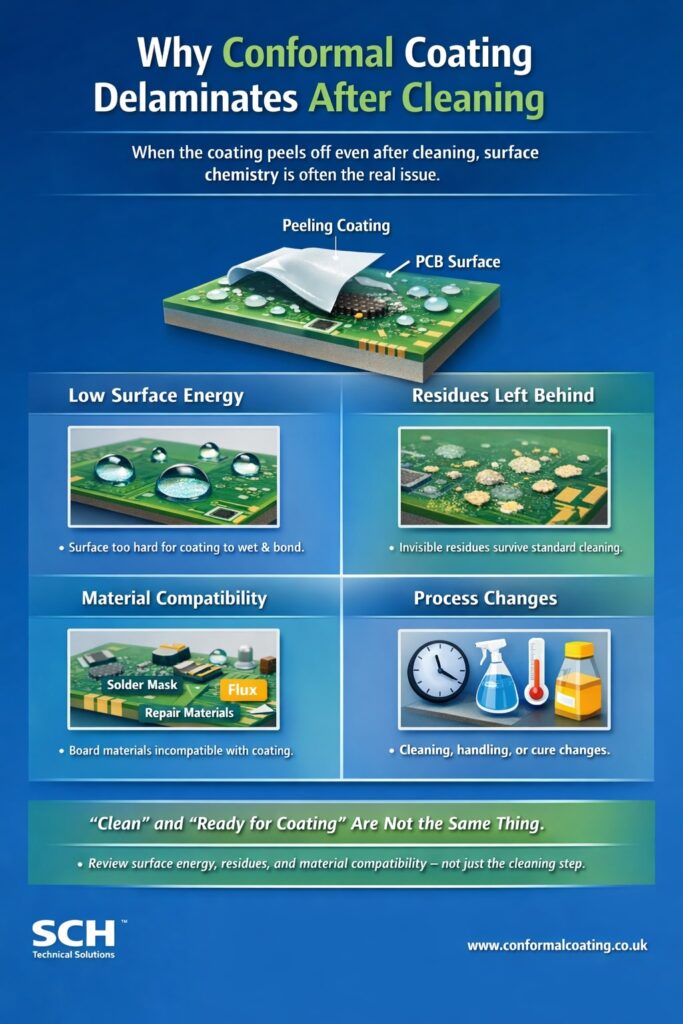
Most conformal coating delamination issues are caused by surface chemistry, residues, material compatibility and process changes — not simply poor cleaning.
Why this matters
When coating peels, lifts, or separates from a PCB after cleaning, the first assumption is often that the board was not cleaned properly. That is understandable because contamination is a common source of coating defects. However, this explanation is often too simple.
A board can be visibly clean and still be a poor surface for coating adhesion. Extremely thin residues, low surface energy materials, process changes, handling contamination, incompatible repair materials, or a mismatch between cleaning method and coating chemistry can all leave the surface looking acceptable while remaining technically unstable.
That is why “clean” and “ready for coating” are not always the same thing.
The pattern we see again and again
This type of failure often appears on one specific product or PCB design while other assemblies run through the same coating line without obvious issue. The film may lift across a broad area, recede from the surface, peel at edges, or fail during handling, de-masking or later environmental exposure.
That pattern matters because it usually points to a surface chemistry or compatibility issue linked to the board, the residues, the solder resist, the local materials, or the process history rather than a random contamination event.
- The board may look clean but still carry residues that interfere with wetting or adhesion.
- The cleaning method may remove loose contamination without changing the underlying surface energy.
- Different solder masks, finishes, labels, mould compounds and local repair materials may respond differently to the same cleaning route.
- The coating may be acceptable in general but still be a poor match for the surface condition on that assembly.
In those situations, repeated cleaning often delays the answer rather than solving the problem.
What is usually happening underneath the failure
There are several common mechanisms behind delamination despite cleaning.
Low surface energy
Some surfaces are difficult to wet and difficult for coatings to anchor to. In practical terms, the coating may bead, recede or sit on the surface instead of spreading and bonding properly.
Residues that survive routine cleaning
Not all residues behave the same way. Some are soluble in one cleaner but not another. Others smear or redistribute. A board can therefore pass through cleaning and still carry enough residue to disrupt adhesion.
Assembly-specific material effects
One board may include solder mask changes, component mould compounds, labels, sealants, repaired areas or process residues that make it behave very differently to another assembly that appears similar.
Coating compatibility issues
A coating may perform well on many products but still struggle on a specific surface condition. This is where process understanding becomes more important than assuming the chemistry will tolerate everything.
Practical warning sign. If the same product repeatedly shows adhesion failure while other boards in the same process look fine, the issue is often the interaction between that assembly and the coating process rather than a general cleaning problem.
A more useful way to think about adhesion problems
A weak coating process does not always fail because the line is dirty. It often fails because the surface is not technically prepared for that specific coating. The better engineering question is not simply, “Was it cleaned?” but, “Was the surface actually suitable for reliable adhesion?”
That means reviewing the full surface condition, including the residue type, the material set on the board, the handling route, the cleaning chemistry, the drying process and the coating selected.
This shift in thinking is often what stops teams from running in circles.
What to review before changing the whole process
Before changing the coating, reworking the line, or blaming the cleaner, it is worth stepping back and checking a few basics.
- Has the board design, solder mask, flux, cleaning chemistry or handling route changed?
- Is the failure limited to certain areas, materials or components?
- Does the coating show poor wetting before cure, or only fail later?
- Are there local repair materials, labels, sealants or other non-standard surfaces on the board?
- Is the cleaning method genuinely suitable for the contamination or residue type present?
These questions often reveal that the problem is not random and not simply caused by insufficient wash time.
What This Means in Practice
If coating delaminates despite apparently good cleaning, the next step is not automatically to increase cleaning intensity or change coating chemistry. It is to review the surface condition in a structured way and identify whether the issue is residue, low surface energy, material incompatibility or a process change that has altered the board surface.
For related defect mechanisms, see De-wetting in Conformal Coating, Corrosion and Ionic Contamination, and Why Masking Causes Most Conformal Coating Defects.
For broader inspection and process review context, see the Conformal Coating Inspection & Quality Hub and the Conformal Coating Processes Hub.
This is also where many teams benefit from operator training, structured troubleshooting and practical process review rather than repeated trial-and-error cleaning.
Where this insight fits in the wider coating system
Delamination does not usually sit in isolation. It links directly to masking practice, process sequencing, contamination control, inspection and defect interpretation. That is why this topic is best treated as part of a wider coating reliability system rather than as a standalone cleaning question.
In practical terms, teams often improve faster when they connect adhesion failures to the full process instead of viewing them as one-off surface preparation events.
Why Choose SCH Services?
SCH supports customers with practical conformal coating troubleshooting, training and production-facing engineering support. If your coatings appear to fail despite correct cleaning, we can help review the likely causes and identify a more stable route based on the full process rather than guesswork.
Useful next steps:
This is often where a structured review saves more time than repeating the same cleaning and recoating cycle.