
When plasma cleaning improves coating adhesion — and when it doesn’t
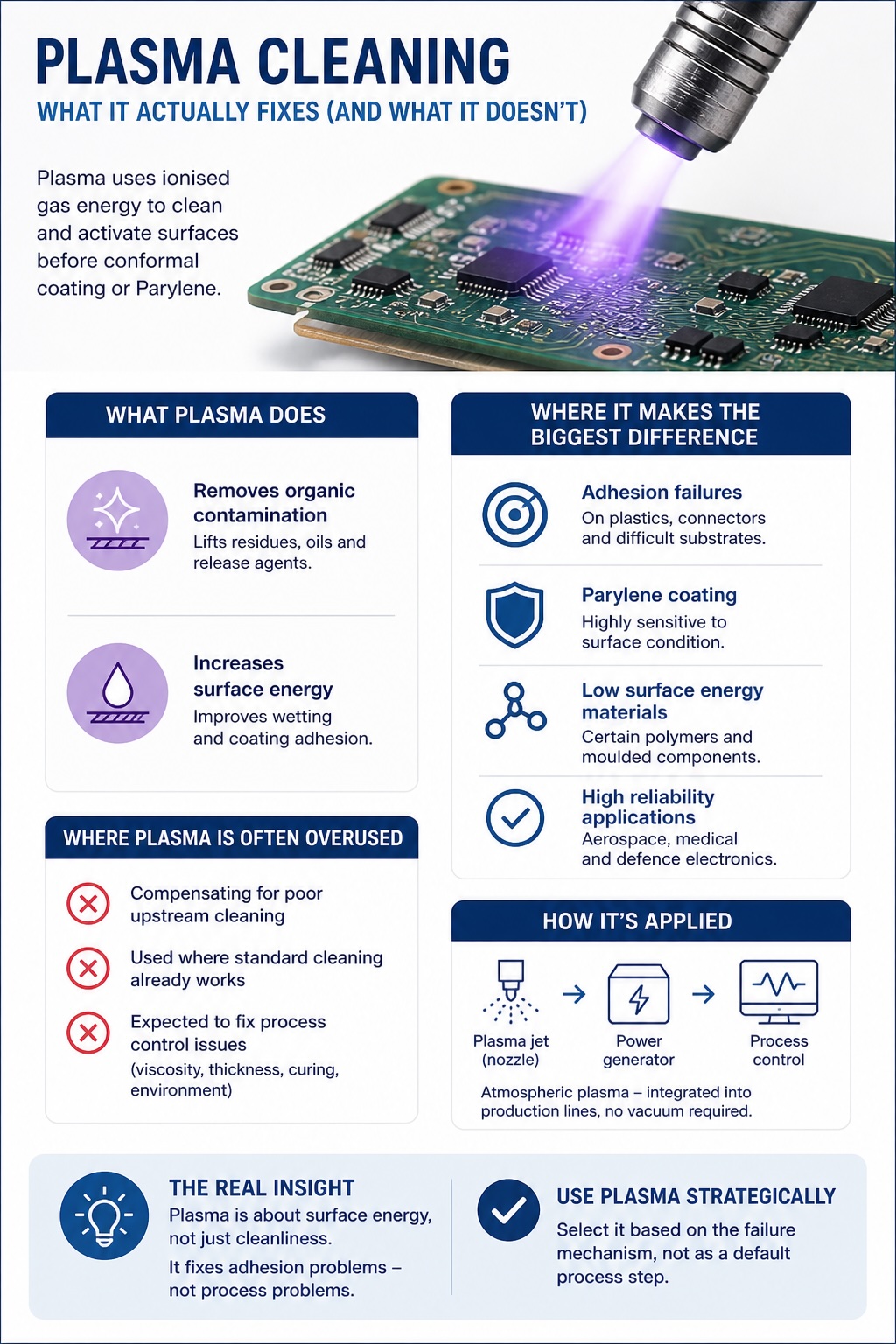
Quick Takeaway
- Plasma improves adhesion by increasing surface energy, not just cleaning
- It is most effective on low-energy materials and adhesion-critical applications
- It does not fix process instability (viscosity, thickness, curing)
- Use plasma based on failure mechanism — not as a default step
What Plasma Cleaning Actually Does
Plasma is an energy-rich ionised gas (often referred to as the fourth state of matter) created by applying electrical energy to a gas. When applied to a surface, it interacts at a molecular level. In conformal coating and Parylene processes, plasma does two key things:
- Removes organic contamination – including light residues, oils and some release agents that interfere with coating adhesion (see surface preparation and cleanliness)
- Increases surface energy – making the surface more “wettable”, allowing coatings to spread and bond more effectively
This second effect — surface activation — is often more important than the cleaning itself.
Different plasma gases can produce very different cleaning, activation and oxidation effects. Oxygen, argon, nitrogen and mixed-gas plasma processes do not behave the same way on PCB assemblies or polymer surfaces. For a deeper technical explanation, see How Plasma Gas Chemistry Changes PCB Surface Preparation Before Parylene.
Why Plasma Works When Solvent Cleaning Doesn’t
Traditional cleaning methods (IPA wipes, solvent washes) remove bulk contamination, but they do not fundamentally change the surface energy of a material. This is why coatings can still fail after “clean” processing:
- Low surface energy plastics resist wetting
- Thin contamination layers remain undetected
- Surface chemistry prevents proper bonding
Plasma addresses these limitations by modifying the surface at a molecular level, not just removing visible contamination.
Where Plasma Cleaning Makes the Biggest Difference
Plasma treatment is most valuable in specific, high-risk scenarios:
- Adhesion failures – particularly on plastics, connectors and difficult substrates
- Parylene coating – where adhesion is highly sensitive to surface condition
- Low surface energy materials – such as certain polymers and moulded components
- High-reliability applications – aerospace, medical and defence electronics
In these cases, plasma can significantly improve coating consistency and long-term reliability.
Where Plasma Cleaning Is Often Overused
Plasma is not a universal solution. In many cases, it is introduced without addressing the real root cause of coating issues. Common misapplications include:
- Using plasma to compensate for poor upstream cleaning
- Applying plasma where standard cleaning already provides sufficient adhesion
- Expecting plasma to fix process control issues (viscosity, thickness, curing, environment)
If the coating process itself is unstable, plasma will not fix it. Issues such as viscosity control, curing behaviour and thickness variation must be addressed at a process level (see process control fundamentals).
Atmospheric Plasma vs Vacuum Plasma
For conformal coating and Parylene pre-treatment, atmospheric plasma is commonly used because it can be integrated directly into production lines. Typical systems include:
- Plasma jets or nozzles (manual or robotic)
- Power generators controlling plasma energy
- Process control systems for repeatability
This allows targeted treatment of specific areas without the need for vacuum chambers. For further technical background on plasma physics and ionisation processes, see plasma (physics).
The effectiveness of both atmospheric and vacuum plasma systems also depends heavily on the selected gas chemistry and the interaction with the substrate materials being treated. Different gases can produce very different activation and oxidation behaviour during preparation.
The Real Insight: Plasma Is About Surface Energy, Not Just Cleanliness
The biggest misunderstanding in plasma cleaning is treating it as a “better cleaning method”. In reality, its primary role is surface activation — changing how a coating interacts with the substrate. This is why plasma can transform coating performance in some cases, while making little difference in others. If the failure mechanism is adhesion-related, plasma can be critical. If the failure mechanism is process-related, plasma is irrelevant.
Need Help Understanding Whether Plasma Is Required?
Plasma cleaning should be selected based on the failure mechanism, not added as a default process step. If you are seeing adhesion issues, de-wetting, or inconsistent coating behaviour, we can help determine whether plasma is the right solution — or whether the issue sits elsewhere in the process (see common coating failure causes). Contact us to discuss your application.
