
Plasma Cleaning for Conformal Coating and Parylene Adhesion
Why surface preparation controls coating performance, adhesion, and long-term reliability
Plasma cleaning is one of the most effective methods for preparing electronic assemblies prior to conformal coating and Parylene deposition. Different plasma gas chemistries can significantly change how surfaces are cleaned, activated and prepared before coating.
However, plasma is not a universal solution. Its performance depends on how it is integrated into the coating process, including cleaning, handling, and timing before coating application.
In most coating failures, the issue is not the coating itself but poor surface preparation. Plasma addresses this — but only when used within a controlled process.
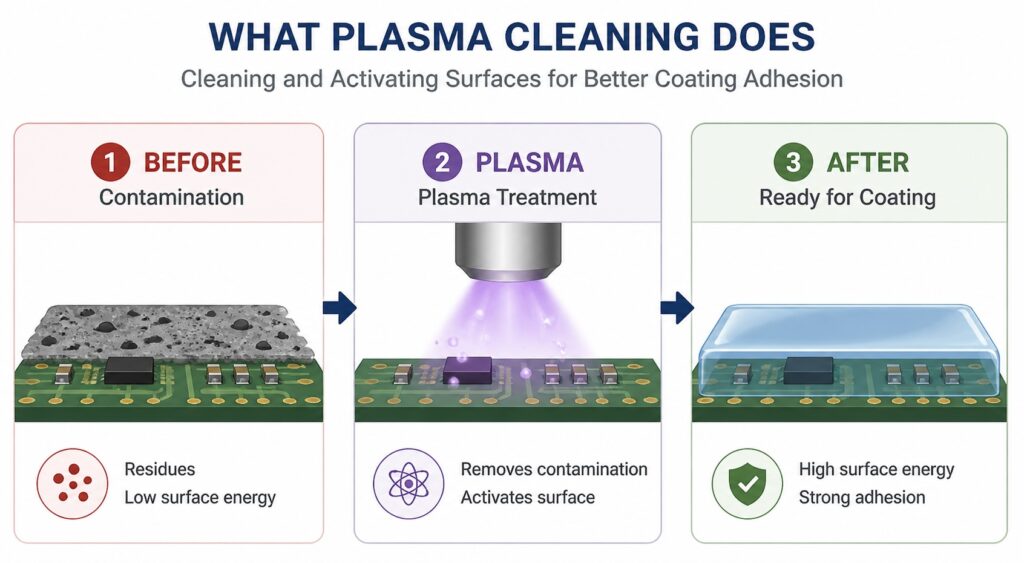
Plasma cleaning removes contamination and increases surface energy to improve coating adhesion
What Is Plasma Cleaning?
Plasma is an ionised gas containing reactive species such as ions, electrons, and radicals. It is often described as the fourth state of matter.
When applied to a surface, plasma interacts at a microscopic level without damaging the bulk material.
- Removes organic contamination such as oils and flux residues
- Breaks down weak boundary layers
- Increases surface energy for improved wetting
- Modifies surface chemistry without mechanical impact
The exact surface effect depends heavily on the plasma gas being used. Oxygen, argon, nitrogen and mixed-gas plasmas all interact differently with PCB materials, solder masks, metals and polymers.
This makes it particularly effective for electronic assemblies where contamination is often invisible but critical to performance. For a formal definition of plasma, see plasma (state of matter).
Key insight: If coating adhesion is inconsistent, the root cause is usually contamination or low surface energy — not the coating material.
Why Plasma Cleaning Matters for Coating Performance
Surface preparation directly controls coating adhesion and long-term reliability. The choice of plasma chemistry can affect contamination removal, oxidation behaviour, surface activation and long-term adhesion stability.
- Surface cleaning – removal of microscopic residues that prevent bonding
- Surface activation – increased surface energy for improved coating wetting
This is particularly important when working with low surface energy materials, dense PCB geometries, or high-reliability applications.
Without effective preparation, coatings may initially appear acceptable but fail over time due to poor adhesion.
Surface energy behaviour can be further understood through surface energy principles.
Plasma Cleaning vs Traditional Cleaning Methods
Plasma should be viewed as a complementary process rather than a direct replacement for all cleaning methods.
| Method | Strengths | Limitations |
|---|---|---|
| Solvent cleaning | Simple and low cost | Limited activation, possible residues |
| Aqueous cleaning | Effective bulk contamination removal | Requires drying and process control |
| Plasma cleaning | Molecular-level cleaning and activation | Requires controlled integration |
In most applications, plasma is used to enhance or stabilise an already defined cleaning process.
Atmospheric vs Vacuum Plasma
Atmospheric Plasma
Atmospheric systems operate at normal pressure and are typically applied using plasma jets or nozzles.
- Inline integration into production
- Selective treatment capability
- No vacuum chamber required
Vacuum (Low Pressure) Plasma
Vacuum systems operate in a controlled chamber and treat the entire assembly uniformly.
- Consistent batch processing
- Common in high-reliability applications
- Often used in Parylene processes
In both atmospheric and vacuum systems, gas selection remains critical because different plasma chemistries produce very different surface interactions.
Where Plasma Fits in the Coating Process
Plasma cleaning must be integrated into the overall coating workflow rather than treated as an isolated step.
- Cleaning → Plasma → Coating → Cure or Deposition → Inspection
Incorrect integration can lead to process instability.
- Recontamination after plasma treatment, including fingerprints, packaging contact, airborne contamination or absorbed moisture before coating. Even a plasma-treated assembly can lose its coating-ready surface condition if contamination or residual moisture is introduced before coating. See Moisture Trapped Before Conformal Coating for practical guidance.
- Surface energy decay before coating
- Inconsistent adhesion performance
Timing between plasma and coating is critical to maintaining surface activation.
Limitations of Plasma Cleaning
Plasma is highly effective but should not be considered a universal solution.
- Not effective for heavy contamination or particulate removal
- Requires stable and repeatable process control
- Surface activation can decay over time
- Equipment cost must be justified by application need
In practice, many coating wetting problems are incorrectly attributed to a lack of plasma treatment when the root cause is contamination, cleaning residues or surface-energy disruption. See the bulletin Common Causes of De-Wetting After Cleaning for practical production examples, and Boards Look Clean but Still Fail Conformal Coating for guidance on hidden contamination that may remain even when assemblies appear visually clean.
Plasma improves a controlled process. It does not replace one.
When Should Plasma Cleaning Be Used?
Plasma cleaning is most valuable when there is a defined technical need.
- Adhesion issues are present or suspected
- Low surface energy materials are used
- High reliability is required
- Complex geometries limit coating wetting
It is often unnecessary where standard cleaning processes already provide stable and repeatable adhesion.
Related Process Control Considerations
Why Choose SCH Services?
SCH Services supports customers in selecting, validating, and implementing the correct surface preparation and coating processes for their application.
We focus on process reliability — not just coating application.
Disclaimer: This article provides general technical guidance. Final process design and material selection should be validated through application-specific testing and qualification.
