Conformal Coating Masking Dots
Repeatable masking for vias, pads, grounding holes and small keep-out features
Masking dots are one of the fastest ways to protect repeat features during conformal coating.
They remove the need to cut tape by hand, helping operators protect grounding holes, vias, pads, test points and small keep-out areas with greater speed and consistency.
SCH masking dots are not selected from catalogue specifications alone. They are used and evaluated within our own conformal coating services operation, allowing us to recommend materials based on proven production behaviour rather than theoretical suitability.
This makes masking dots a practical option for prototype work, NPI, low-volume coating and production processes where repeatable masking control is required.
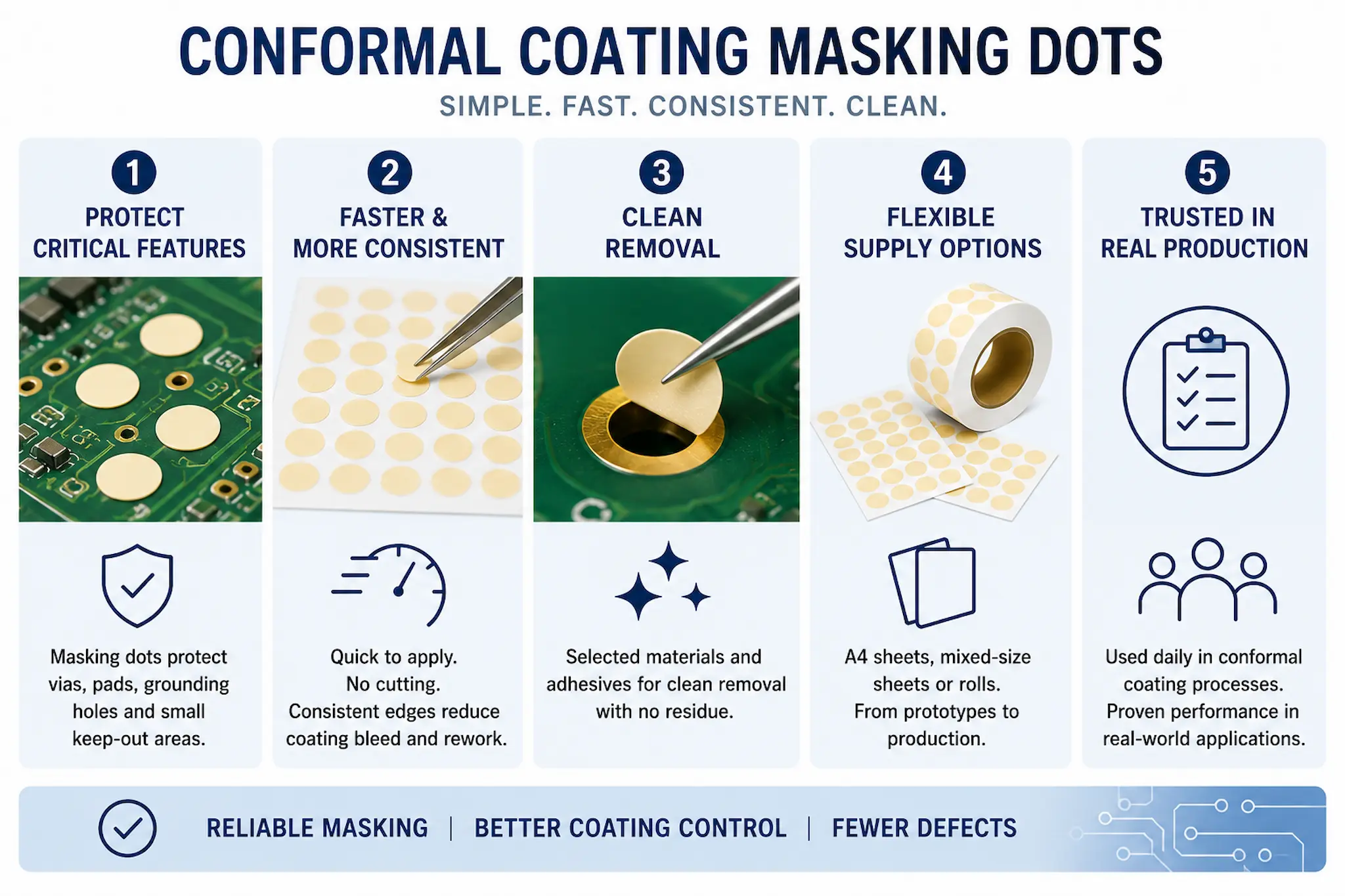
Conformal coating masking dots provide fast, repeatable masking for vias, pads and grounding holes, helping improve process consistency, reduce rework and prevent masking-related coating defects.
Production note: SCH supplies masking dots in flexible formats, including A4 sheets for lower-volume work, mixed-size options for evaluation, and rolls for higher-volume production. This allows customers to trial, validate and standardise before committing to large quantities.
Why Choose SCH Conformal Coating Masking Dots?
Masking dots are designed for repeatable protection of small, defined features where cutting individual pieces of tape would be slow, inconsistent or difficult to control.
- Fast masking for grounding holes, vias, pads and test points
- Consistent circular edges to reduce coating bleed and rework
- Clean removal when the correct material and adhesive system is selected
- Available as A4 sheets, mixed-size sheets or production rolls
- Useful for prototypes, NPI, low-volume work and production masking
- Material options selected according to coating chemistry, temperature and process sensitivity
Reality check: Not all masking dots are suitable for conformal coating. Poor-quality materials can cause de-wetting, halo effects, adhesive residue, coating ingress or tearing during removal.
Engineering bulletin: Even when the correct masking dot is selected, lifting can still occur if surface condition, application pressure, coating flow or handling are not controlled. See Masking Dots Lift During Conformal Coating.
Next step: View our full range of conformal coating masking materials, including masking dots, pre-cut shapes, tapes and reusable boots.
Flexible Supply Options for Development and Production
Many customers do not want to commit to large rolls before they know which size or material will work best. SCH can support both evaluation and production requirements.
- A4 sheets — suitable for prototypes, low-volume work, trials and controlled issue to operators
- Mixed-size sheets — useful when testing several dot diameters before standardising
- Production rolls — suitable for higher-volume repeat masking once the process is validated
- Custom sizes — available where standard diameters do not suit the assembly
This supports a practical workflow: evaluate, validate, then standardise. Customers can begin with sheets or sample packs before moving to production quantities.
Where Masking Dots Are Most Useful
Masking dots are best used where the feature is small, repeatable and clearly defined.
- Grounding holes and earthing points
- Vias and circular keep-out areas
- Test pads and contact pads
- Small connector-adjacent features
- Defined board areas where repeatable circular masking is required
They are particularly useful when multiple assemblies require the same masking position again and again, because they reduce operator variation compared with hand-cut tape.
Process note: For complex connectors, irregular shapes or high-volume repeat masking, dots may be combined with masking boots, tapes or liquid latex to create a more complete masking system.
Material Options for Masking Dots
Masking dots can be supplied in different material constructions depending on coating chemistry, process temperature, dwell time and removal requirements.
- Paper-based masking dots — commonly used for liquid conformal coating applications where clean removal and low contamination risk are important.
- Polyimide masking shapes and dots — suitable for higher-temperature processes and selected applications including soldering and Parylene deposition where dimensional stability is required.
Note on polyimide masking materials: Some masking tapes, dots and shapes are manufactured from polyimide film and are commonly used in applications where Kapton® tape is typically specified. Kapton® is a registered trademark of DuPont. SCH supplies high-performance polyimide masking materials selected for conformal coating, soldering and high-temperature processes, and does not claim supply, affiliation or endorsement by DuPont unless explicitly stated.
Process Compatibility
Masking dots can be selected to suit a range of electronics protection and manufacturing processes.
- Liquid conformal coating
- Parylene deposition
- Selective solder protection, where process conditions are suitable
- Prototype and NPI masking trials
- High-volume repeat masking once the dot specification is validated
By understanding your process conditions, SCH can recommend the correct masking dot material, size and adhesive system to minimise leakage, lifting, residue or coating defects.
Request a Masking Sample Pack
Many customers start with a masking sample pack containing tapes, dots, boots and shapes, then standardise on the most effective solution once the process has been validated.
Sample packs and A4 sheet formats are especially useful for testing dot sizes, checking removal behaviour and confirming compatibility with your coating and cure conditions before ordering production quantities.
Build a Complete Masking System
Masking dots form part of a wider masking strategy. Most production environments achieve the best results by combining different masking materials according to the feature being protected.
- Masking dots — vias, pads, grounding holes and circular keep-out features
- Masking tape — straight boundaries, PCB edges and larger keep-out zones
- Custom masking boots — connectors and high-value components
- Liquid latex — irregular features and complex masking transitions
Used together, these materials help manufacturers improve consistency, reduce labour time, reduce rework and prevent masking-related coating defects.
For deeper technical guidance, see the Conformal Coating Masking Hub.
Conformal Coating Masking Training
Masking is one of the most labour-intensive and risk-prone stages of conformal coating. SCH Services delivers hands-on training covering masking boots, shapes, tapes and dots.
Training can be delivered standalone or as part of a complete conformal coating programme, using real production examples and practical masking challenges.
Fast Links to Conformal Coating Masking Pages
Why Choose SCH Services?
SCH combines practical conformal coating production experience with masking materials, reusable masking solutions, training and process support.
- Masking dots used and evaluated within SCH coating services
- Flexible supply options including A4 sheets, mixed-size sheets and production rolls
- Support for dots, tapes, shapes, boots and hybrid masking approaches
- Practical guidance on reducing masking defects and rework
- Training and consultancy for coating and masking process control
Disclaimer: This page provides general technical and product guidance only. Masking dot selection, coating compatibility, cure exposure and removal behaviour should always be validated against the specific assembly, coating material, process conditions and customer requirements.