At higher production volumes, handling and masking can become more important than deposition time.
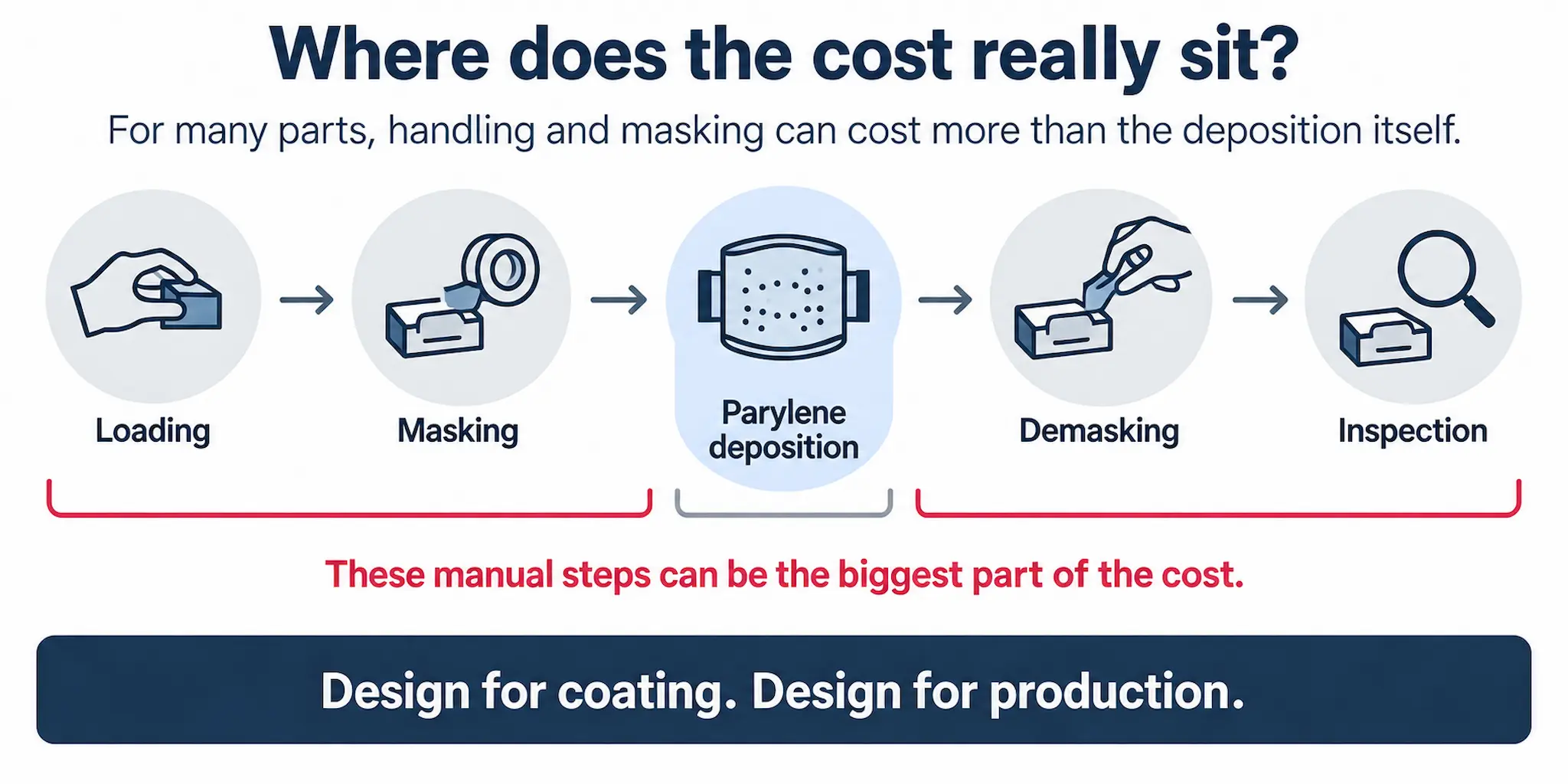
At production volumes, handling and masking can become a significant part of Parylene coating cost.
Small handling times become big production costs
A few minutes of manual handling may seem insignificant during development or when coating small batches. At production scale, it is very different. If every component requires individual positioning, masking, demasking and inspection, even a relatively short manual operation is multiplied across hundreds or thousands of components.
Masking should be considered as part of the production process
Masking is sometimes treated as a secondary operation that can be worked out once the coating process has been established. For higher-volume applications, it should be considered much earlier. If areas of a component must remain free from Parylene, the method used to achieve that can have a significant effect on labour, repeatability and throughput. Simple manual tapes or temporary masking methods may be perfectly sensible for prototypes and low-volume work. They may become much less attractive when the same operation has to be repeated thousands of times. For practical guidance on defining keep-outs and designing assemblies for repeatable masking, see Parylene Masking Design Requirements.
Fixtures can do more than hold the component
At higher volumes, one of the opportunities is to consider whether a reusable production fixture can perform several functions at the same time. A well-designed fixture may locate the component consistently, control its orientation within the chamber and may even provide some or all of the required masking. This can reduce repetitive manual operations while also improving process consistency.
Consider: Load into reusable fixture → Coat → Unload → Inspect
The exact solution depends on the component geometry and coating requirements, but the principle is important: fixture design can become part of the economics of Parylene coating.
Design for coating, not just for the component
This becomes particularly important when a product moves from development into volume manufacture. A component that is straightforward to coat ten times may not necessarily be economical to coat one thousand times per day. Where Parylene is expected to become a production process, coating requirements should therefore be considered alongside component design, masking strategy, fixture design, chamber loading and inspection. For organisations considering Parylene as a production capability rather than simply a subcontract process, see our Turnkey Parylene Implementation & Support pathway.
Think about the complete production process
Parylene deposition remains an important part of the cost equation, but it should not automatically be assumed to be the dominant one. At sufficient volume, the economics increasingly depend on what happens before and after the chamber. Early consideration of component design, masking and reusable fixturing can therefore be just as important as optimising the deposition cycle itself. That is often where the bigger production opportunity lies.
Planning a Parylene process for production?
SCH Services can support Parylene projects from initial feasibility and engineering trials through to production process development, including consideration of masking, fixturing, loading and inspection. For higher-volume applications, involving the coating process early can help identify opportunities to reduce manual handling before it becomes built into the production method. See our Parylene Coating Services or contact SCH to discuss your application.
Why Choose SCH Services
SCH Services operates Parylene coating equipment within its own coating facilities and works with customers on both coating services and production process development. This practical experience allows coating requirements to be considered as part of the complete manufacturing process rather than simply as an isolated deposition operation.