Why Conformal Coating Pulls Away from Component Edges
Practical guidance on edge thinning, surface tension, geometry, viscosity, drainage and application method
Conformal coating edge coverage can be significantly thinner than coating on flat PCB surfaces. A coating may appear to cover an assembly correctly while pulling away from sharp component edges, corners, leads and other changes in geometry.
This behaviour is often described as edge thinning or poor edge coverage. It can occur because a liquid coating naturally flows and redistributes before it cures, causing material to move away from some raised or sharply defined surfaces.
Understanding why conformal coating pulls away from component edges helps distinguish normal coating-flow behaviour from contamination, application problems and more serious process-control issues.
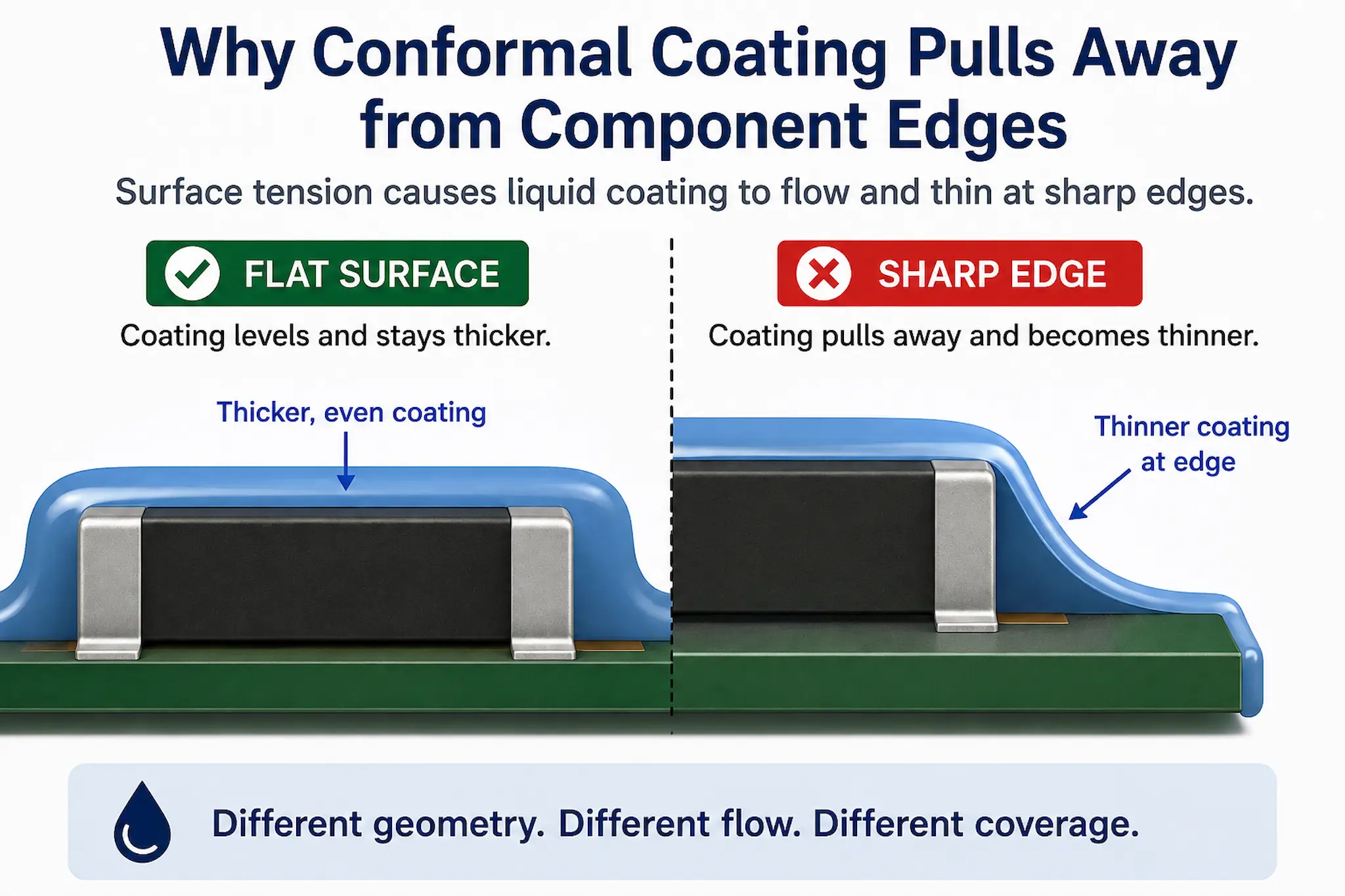
Conformal coating can become thinner around sharp component edges as surface tension and geometry influence how the liquid coating flows.
Engineering Observation
A PCB assembly may show apparently good coating coverage across flat areas while component corners, package edges, lead edges or other raised features have noticeably less coating.
This type of local thinning is different from general conformal coating thickness variation across large assemblies, although both can be influenced by geometry, flow and application technique.
In some cases the coating remains continuous but is simply thinner. In more severe cases, local areas may have insufficient coverage to provide the intended protection.
Why Conformal Coating Pulls Away from Edges
Surface Tension
Liquid conformal coatings naturally try to minimise their surface area. Surface tension therefore influences how the wet coating distributes itself across a component and around sharp changes in geometry.
On a sharp edge, the wet film may redistribute toward adjacent flatter surfaces before curing, leaving a thinner coating directly over the edge.
Where a coating appears visually complete but local protection is still questionable, it is also worth reviewing why coating thickness can pass while coverage still fails.
Component Geometry
Sharp corners, vertical faces, component leads, raised packages and other three-dimensional features are more difficult to coat uniformly than flat PCB surfaces.
The more severe the change in geometry, the greater the potential for local differences in wet-film build and final dry-film thickness.
Viscosity
Coating viscosity affects how readily material flows after application. A lower-viscosity coating may flow and drain more readily, while a higher-viscosity material may retain more wet film in some locations.
However, simply increasing viscosity is not automatically the solution. Excessive viscosity can introduce other application and coverage problems. The coating should be used within the material supplier’s recommended process window and validated for the application method.
Drainage and Gravity
Before curing, liquid coating can continue to move under gravity. Material may drain away from raised surfaces and accumulate around lower features, component bases or other areas where the coating naturally collects.
Board orientation and the time between application and cure can therefore influence the final coating distribution.
Application Method
Spraying, dipping, selective coating and manual application do not place material onto an assembly in exactly the same way.
Spray direction, atomisation, nozzle path, withdrawal behaviour, board orientation and local application technique can all affect how much wet coating initially reaches an edge and how the film subsequently flows.
Practical Findings
- Flat PCB areas are generally easier to coat consistently than sharp component edges and vertical surfaces.
- A coating can remain continuous across an edge while being significantly thinner than on adjacent flat areas.
- Overall coating thickness does not necessarily represent local edge coverage.
- Component geometry can influence coating distribution even when the coating process itself is stable.
- Viscosity, board orientation and drainage time can affect final film build.
- Application direction and method can determine how much material initially reaches difficult geometry.
- Repeated poor coverage in the same location may indicate a systematic geometry or application issue rather than random process variation.
If the coating is also pulling back or refusing to wet certain surfaces, review whether a separate conformal coating adhesion or surface-energy problem is present.
Process Note: Thickness and Coverage Are Not the Same
Coating thickness is normally measured at defined locations, but those measurements may not represent every surface on a complex PCB assembly.
A compliant thickness reading on a flat test location therefore does not prove that every component edge, lead or raised feature has the same coating build.
Actions When Edge Coverage Is Poor
- Identify whether the problem occurs repeatedly on the same component or feature.
- Check coating viscosity and material condition against the controlled process requirements.
- Review board orientation during application, flash-off and cure.
- Check whether coating is draining away from the affected feature before cure.
- Review spray direction, nozzle path or other application parameters relevant to the process.
- Consider whether the component geometry requires application from more than one direction.
- Compare edge coverage with adjacent flat-area coating thickness.
- Inspect representative assemblies rather than relying only on flat witness areas or single thickness readings.
Escalation Point
Some difference between coating build on flat surfaces and sharp edges can be a natural consequence of liquid coating behaviour and component geometry.
Further engineering review is appropriate where edge thinning creates exposed areas, repeatedly falls outside the required protection standard, occurs unpredictably or affects features considered critical to product reliability.
In these cases, review the actual component geometry, coating material, viscosity, board orientation, application method and cure sequence together rather than attempting to correct the problem by changing a single process setting.
Related Guidance
- Coating Thickness Passes but Coverage Still Fails — Practical guidance explaining why acceptable thickness measurements do not necessarily prove complete coating coverage.
- Why One Coating Thickness Reading Can Be Misleading — Guidance on why local geometry, drainage and process conditions can make a single thickness reading unrepresentative of the complete assembly.
- Conformal Coating Processes Hub — Deeper technical guidance covering conformal coating application and process control.
- Conformal Coating Bulletin Library — Practical operational guidance covering coating defects, coverage, masking, contamination, inspection and process control.
Need Help With Conformal Coating Coverage?
SCH Services can support coating trials, application-process review, coating thickness assessment and troubleshooting where component geometry, edge coverage or coating-flow behaviour is affecting production reliability.
Why Choose SCH Services?
SCH Services combines practical conformal coating production experience with process engineering, inspection, coating application and technical consultancy.
Our approach considers the complete coating process, including material behaviour, component geometry, application method, coating thickness and inspection requirements.
This helps identify whether poor edge coverage is caused by normal coating-flow behaviour, product geometry or a process condition that requires correction.
Technical Guidance Disclaimer
The information provided in this bulletin is general technical guidance only. Conformal coating materials, thickness requirements, application parameters and inspection criteria should always be validated against the specific assembly, coating material, application process, operating environment and reliability requirements.
SCH Services can provide application-specific engineering support where coating trials, testing, process review or validation is required.