Superhydrophobic coatings can reduce water retention on RF-exposed structures
Useful for antennas and radomes where surface wetting, ice, contamination and signal performance must be considered together
Antennas, radomes and RF-exposed housings often need surface protection without adding unnecessary thickness, changing dielectric behaviour or trapping water on the external surface.
Superhydrophobic and highly water-repellent coatings can help reduce water retention, surface wetting and contamination build-up, but they should not be treated as a direct replacement for structural protection, corrosion control or environmental sealing.
The key question is not simply whether water beads on the surface. The correct question is whether the coating supports the RF, environmental and mechanical requirements of the complete system.
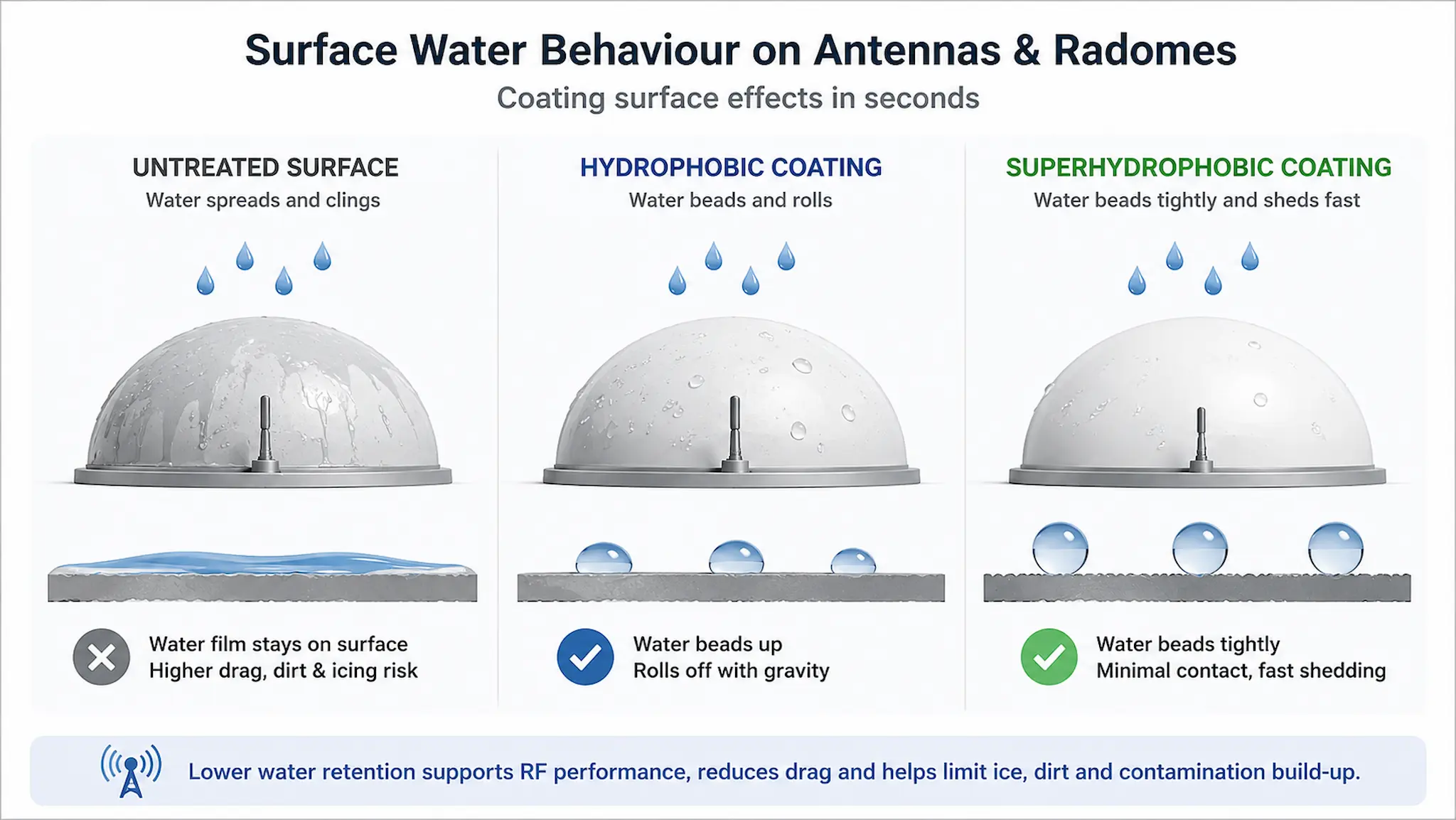
Comparison of untreated, hydrophobic and superhydrophobic surface behaviour on antennas and radomes showing differences in water retention and shedding.
Why antennas and radomes are different from standard electronics coating applications
Many electronics coatings are selected primarily for insulation, corrosion resistance or environmental barrier performance. Antennas and radomes introduce an additional constraint: the coating must not interfere with the electromagnetic function of the structure.
Thickness, dielectric properties, uniformity, moisture behaviour and surface roughness can all matter. A coating that works well on a general PCB may not be suitable for an RF-transparent component or tuned antenna structure.
For RF applications, surface water behaviour is only one part of the decision. Coating thickness, dielectric effect and real exposure conditions must also be assessed.
This is why antenna and radome coating decisions should be treated as functional coating decisions, not just surface protection decisions.
What superhydrophobic coatings can help with
Superhydrophobic coatings are designed to reduce surface wetting and encourage water to bead or shed from the surface. In suitable applications, this can reduce the time that liquid water remains on exposed surfaces.
- Water shedding: helping rain or spray leave the surface more quickly.
- Reduced surface wetting: limiting the formation of continuous water films.
- Contamination management: reducing adhesion of some water-borne dirt or residues.
- Ice and frost support: potentially reducing water retention before freezing, depending on operating conditions.
- Optical or RF surface cleanliness: helping exposed surfaces remain clearer in some environments.
These benefits depend heavily on surface design, coating durability, exposure angle, airflow, contamination type, abrasion and maintenance regime.
For an overview of available superhydrophobic coating routes and their practical use, see Superhydrophobic Coatings.
What they should not be assumed to provide
Water beading is not proof of complete environmental protection. A surface may look highly water-repellent while still allowing moisture access at edges, fasteners, interfaces, scratches or uncoated regions.
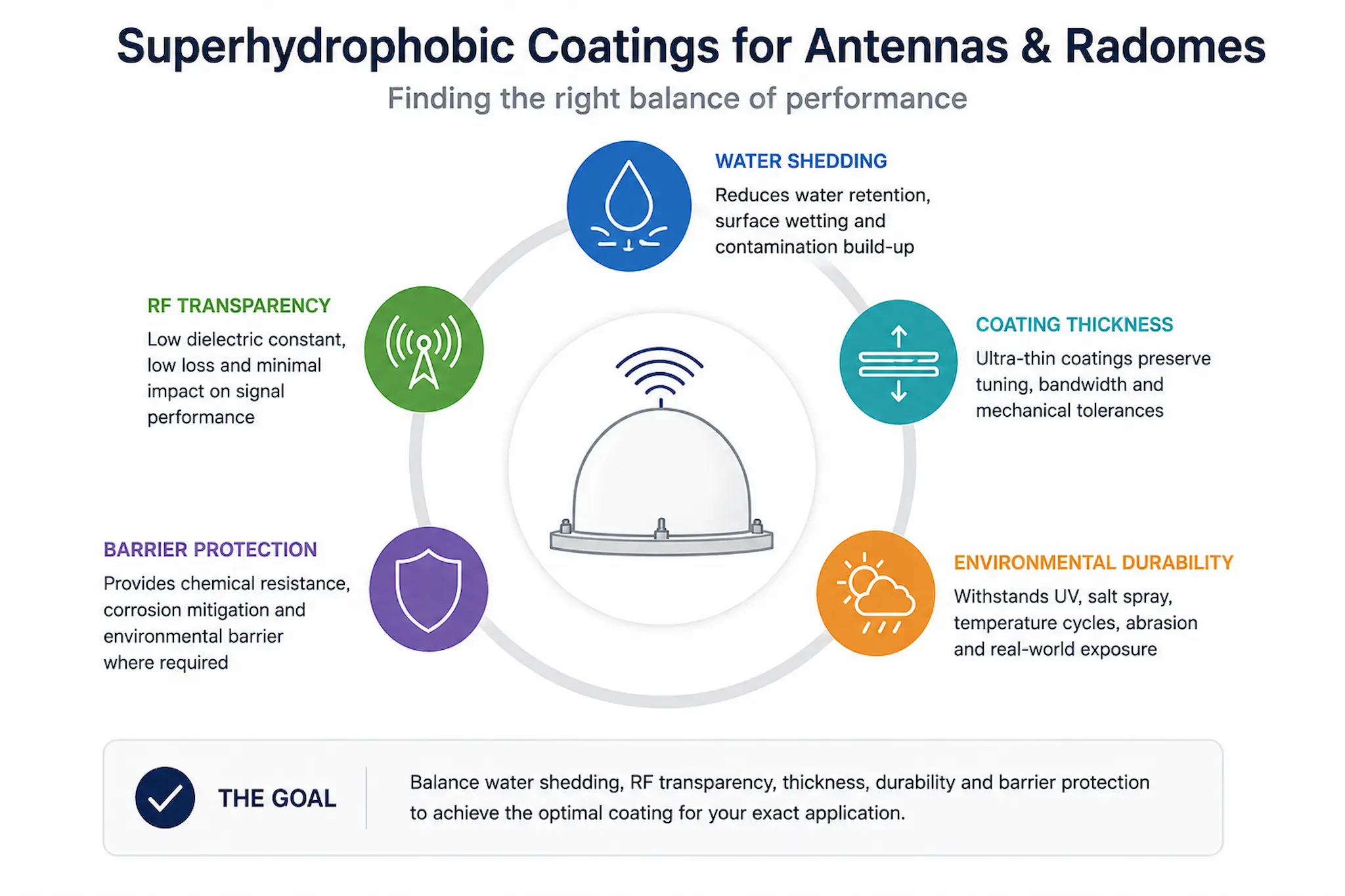
Engineering trade-off diagram showing how water shedding, RF transparency, coating thickness, durability and barrier protection must be balanced for antenna and radome coating selection.
Superhydrophobic coatings should not automatically be assumed to provide:
- Long-term corrosion protection for metallic structures.
- Protection against ionic contamination or electrochemical activity.
- Mechanical durability under repeated abrasion or cleaning.
- Complete sealing of joints, seams or interfaces.
- Equivalent protection to Parylene or conventional conformal coating systems.
For this reason, superhydrophobic coatings should be specified around measured functional performance, not appearance alone.
Key design questions before specifying a coating
The coating decision should begin with the operating requirement rather than the coating name. Antenna and radome applications need a controlled review of both surface behaviour and RF performance.
RF behaviour
Will the coating thickness, dielectric properties or surface uniformity affect signal transmission, tuning or loss?
Exposure environment
Is the surface exposed to rain, salt spray, UV, ice, dust, cleaning chemicals, abrasion or temperature cycling?
Surface durability
Will the water-repellent surface survive handling, wiping, erosion, installation and service maintenance?
System protection
Is the coating only required to manage surface wetting, or must it also contribute to barrier protection?
How this connects to ultra-thin and RF-transparent coating selection
Superhydrophobic coatings for antennas and radomes sit within a wider group of surface-function coatings. These coatings are often selected because they change surface behaviour without adding the build associated with conventional conformal coatings.
For related decision-making, see Surface Function vs Barrier Function Coatings, RF Transparent Coatings for Electronics & Antennas and What Is an Ultra-Thin Functional Coating?.
These pages help separate surface wetting, RF performance, barrier protection and coating thickness into clearer engineering decisions.
Where SCH Services can help
SCH Services supports coating selection where standard conformal coating assumptions may not be suitable, including ultra-thin coatings, hydrophobic coatings, RF-sensitive assemblies and functional surface treatments.
If your application involves antennas, radomes, optical electronics, sensors or exposed housings, SCH can help assess whether the requirement is best treated as a surface-function coating, barrier coating or hybrid protection problem.
Why Choose SCH Services?
- Practical coating experience: SCH works across conformal coatings, Parylene, nano coatings and advanced functional coatings.
- Process-led support: Recommendations are based on application conditions, production method, inspection and validation requirements.
- Independent selection thinking: SCH helps compare coating routes rather than forcing every application into one material type.
- Engineering and production capability: Support can include coating trials, process development, masking strategy, inspection planning and subcontract coating.
For coating selection support, review our Advanced Functional Coatings, Superhydrophobic Coatings, CytoThane Superhydrophobic Coating Selection Guide, Hydrophobic Coatings and Ultra-Thin Coatings pages.
This article provides general technical guidance only. Final coating selection, RF performance, environmental durability and reliability decisions must be validated against the relevant application requirements, test standards and qualification procedures.