Press-Fit Connector Coating Problems: Why They Cause Failures
Why press-fit connectors cause conformal coating and Parylene failures
Press-fit connectors are one of the most difficult features to manage in coating processes.
These press-fit connector coating problems are one of the most common causes of conformal coating failure in complex PCB assemblies.
They combine tight mechanical tolerances, exposed conductive interfaces and complex geometry, creating conditions where liquid coatings and vapour-deposited films behave in ways that are hard to control and often unacceptable.
This is why connector-related coating failures are rarely solved by changing material alone. They are usually a process architecture problem involving capillary action, boundary control, masking reliability and interface sensitivity.
1) The fundamental conflict: protection vs function
In conformal coating of connectors, coatings are designed to insulate, protect and separate the PCB from its environment.
Press-fit connectors are designed to do the opposite at the contact interface:
- Maintain clean metal-to-metal electrical contact
- Rely on mechanical interference and intimate surface contact
- Remain free from insulating films in functional areas
This creates an unavoidable engineering conflict. The same coating that protects the board can interfere with the connector if it reaches the wrong place.
Connector-sensitive boards often force a wider protection decision, not just a local masking decision. In these cases, comparing conformal coating, nano coating and Parylene helps define which route is safest overall.
2) Capillary action is the hidden failure mechanism
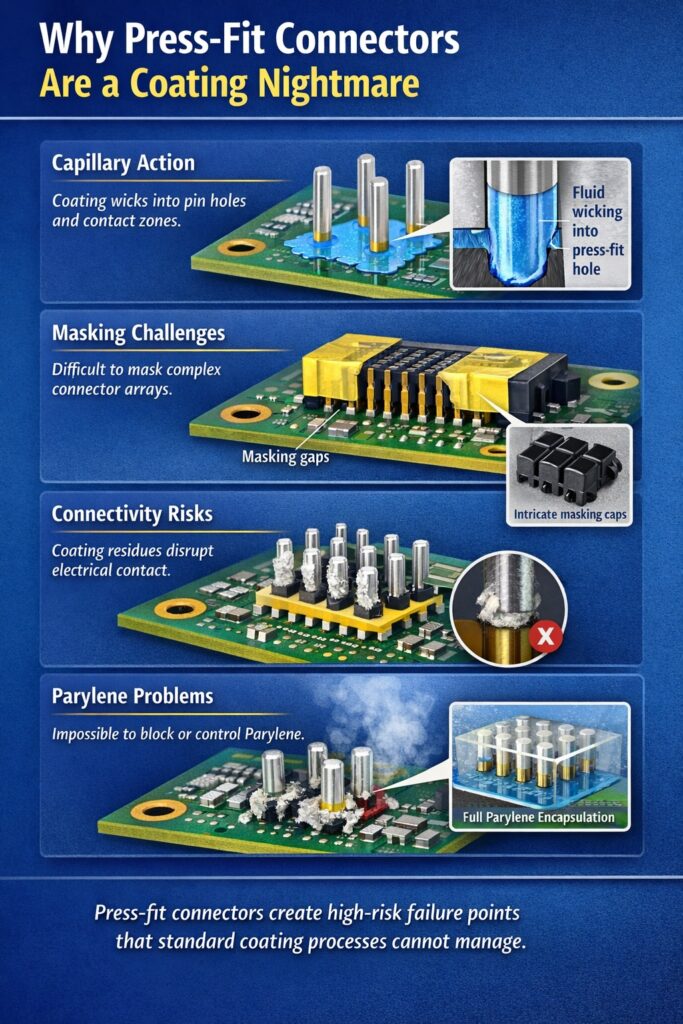
Press-fit connectors create micro-scale gaps, plated holes and interfacial paths that pull liquid coatings into areas they were never meant to reach.
- Liquid moves into narrow gaps through capillary action
- Coating can travel beyond the visible boundary
- Critical interfaces may be contaminated even when the outer area looks acceptable
This is one of the main reasons connector failures are often discovered late. The visible coating line can appear controlled while the real failure sits inside the interface.
This behaviour is a core part of coating failure mechanisms, particularly in complex assemblies where fluid control becomes dominant. See why conformal coating fails in complex PCB assemblies.
3) Geometry makes boundary control difficult
Press-fit connectors are not simple flat features. They introduce:
- Vertical pins and cavities
- Mixed surfaces and material transitions
- Sharp edges, blind features and narrow access zones
- Closely spaced coated and uncoated regions
This changes how coatings wet, flow and settle.
Even accurate dispense placement does not guarantee a safe final boundary once the coating starts to level, spread and wick.
4) Selective coating improves placement — not final behaviour
Selective coating is often assumed to solve connector problems because it gives the appearance of precision.
In reality, it controls where material is dispensed, but not fully where the coating finishes after fluid behaviour takes over.
- Wetting still changes the boundary
- Capillary action still pulls material into gaps
- Edge control is always limited by geometry and liquid behaviour
This is why selective coating can reduce risk, but cannot eliminate it around press-fit connectors. Where coating reaches the interface, even thin films can affect contact behaviour — see how conformal coating and Parylene interfere with press-fit electrical contacts.
Important:
If a connector cannot tolerate coating ingress, the solution cannot rely on machine path accuracy alone. The process must be designed around exclusion, control and realistic boundary behaviour.
5) Masking is often necessary — and often unstable
Masking is the usual defence when connectors must remain completely free from coating. However, connectors are also one of the hardest areas to mask reliably.
- Complex shapes are hard to seal consistently
- Application depends heavily on operator technique
- Removal can disturb nearby coating edges
- Masking materials themselves can introduce contamination or transfer risks
This means the process may be technically possible, but commercially unstable if masking becomes too labour-intensive or too variable.
6) Parylene makes connector planning even more critical
Parylene does not behave like a liquid coating. It is deposited from vapour and is highly conformal, which means it can penetrate extremely small gaps and internal features.
- Connector interfaces will be coated unless they are effectively masked
- There is no simple selective “keep-away” zone once vapour reaches the feature
- Post-deposition removal is possible, but adds time, risk and rework cost
With Parylene, connector planning must happen before coating, not after.
7) Why connector failures are often blamed on the wrong thing
When connector-related coating failures appear, the first assumption is often that the coating was wrong, the operator made an error, or the machine drifted.
These connector coating failures are often incorrectly attributed to materials or operators, when they are actually driven by process limitations.
In practice, the underlying problem is often simpler:
- The keep-out requirement was unrealistic
- The interface was too sensitive for the chosen process
- The masking strategy was unstable
- The process allowed fluid behaviour to dictate the result
That is why these failures should be treated as process design failures, not just coating defects.
8) What actually works in practice
Successful coating strategies around connectors do not rely on one perfect material or one perfect machine. They usually depend on a more structured approach:
- Define connector exclusion zones before coating selection
- Accept realistic limits of flow and spread
- Reduce dependence on masking where possible
- Separate protection functions where one coating cannot safely do everything
This is where hybrid strategies become powerful, because they allow protection to be separated by function rather than forced into one unstable process route. See Hybrid Coating Strategy: Combining Conformal and Nano Coatings for Complex PCBAs.
If connector protection cannot be controlled reliably with standard conformal coating or Parylene routes, it is worth reviewing alternative coating technologies and process routes before locking the coating strategy.
9) Why this problem is growing, not shrinking
Modern assemblies are becoming denser, more functionally complex and less tolerant of boundary variation.
- Connector density is increasing
- Spacing is tightening
- Reliability expectations are rising
- Environmental and contamination requirements are becoming more severe
As a result, connector-related coating failures are becoming a bigger process issue, not a smaller one.
10) Summary
Press-fit connectors are a coating nightmare because they combine electrical sensitivity, complex geometry and strong capillary-driven failure risk.
The core issue is not coating chemistry alone. It is the mismatch between:
- what the connector must do
- how coatings behave around it
- what the process can realistically control
Once that is understood, the problem becomes clearer: this is a process design problem, not just a materials problem.
Related process articles:
Why Choose SCH Services?
SCH Services supports customers with process-led coating strategy where connectors, keep-outs and complex geometry make standard coating routes unstable. We focus on practical boundary control, masking strategy, validation and technology selection for real manufacturing conditions.
- 🛠️ Process-Led Support – We solve connector coating problems through process design, not guesswork.
- 📈 Scalable Solutions – From feasibility and trials through to stable production routes.
- 🌍 Global Support – Technical support across the UK, Europe, Asia and North America.
- ✅ Practical Reliability Focus – Built around what real assemblies and real processes can actually achieve.
📞 Call: +44 (0)1226 249019 | ✉ Email: sales@schservices.com | 💬 Contact Us ›
Note: This article provides general technical guidance only. Final coating design, connector compatibility, masking strategy and validation decisions must be verified by the product manufacturer and confirmed against applicable standards and product-specific requirements.