
Most coating defects are driven by process issues — not the material itself
Most conformal coating defects are not caused by the coating. They are caused by what happens before the coating is applied — contamination, poor cleaning, compressed air quality, humidity control and material handling.
If you are troubleshooting recurring coating issues, you can explore the Conformal Coating Defects Hub for detailed root causes and the Conformal Coating Processes Hub for guidance on building stable, repeatable coating systems.
In many cases, risk is also introduced outside the coating process itself — through packaging, storage, handling and wider working environments. This broader system effect is explored in Why ESD Protection Fails in Data Centres, where infrastructure and handling are shown to directly influence reliability outcomes.
This insight highlights a common mistake: when coating results look inconsistent, teams often change materials first, instead of identifying where the process is introducing risk.
Quick take. Most conformal coating problems are caused by contamination, poor cleaning, airborne particles, compressed air quality, humidity variation and incorrect material handling — not the coating chemistry itself.
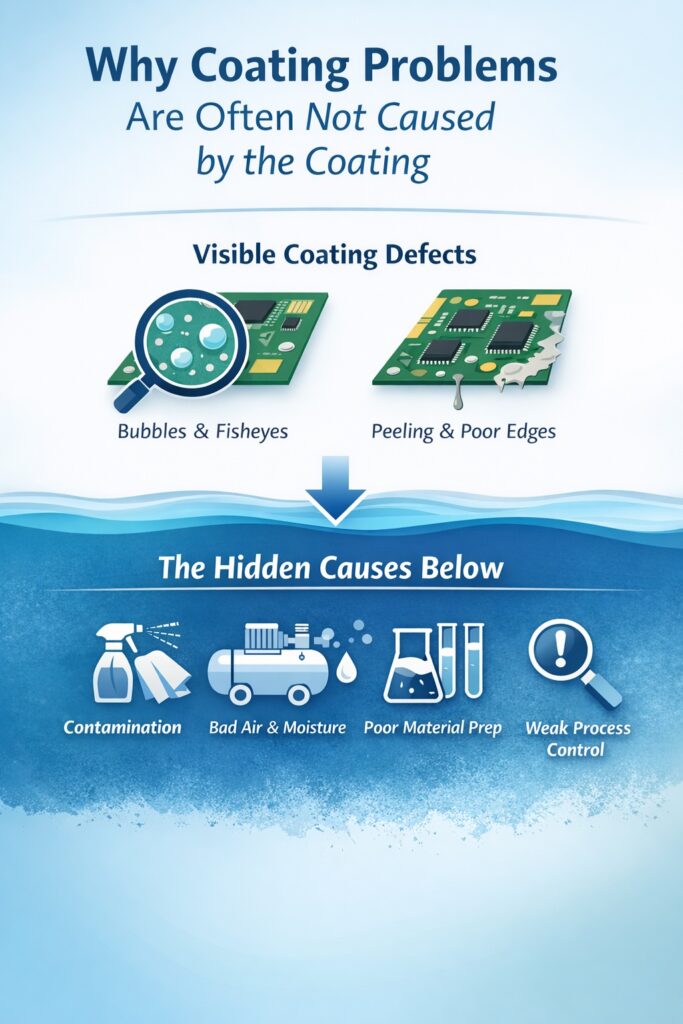
Most conformal coating defects originate from process issues such as contamination, cleaning, compressed air quality and material handling — not the coating itself.
Why this matters
When an engineering team starts seeing particles trapped in coating, poor edge coverage, bubbles, fisheyes, patchy wetting, or inconsistent finish, the immediate reaction is often to question the coating chemistry. That is understandable because the coating is the visible final layer.
In reality, the coating is often only exposing problems that already existed in the assembly, the environment, or the application method. A conformal coating process only works when the board is genuinely clean, the coating area is controlled, the compressed air is dry and clean, the material is handled correctly, the application method is stable, and inspection is strong enough to catch defects early.
If one of those areas is weak, the whole process can look unreliable even when the coating itself is perfectly suitable.
In many cases, failure is not caused by the coating itself, but by how products are handled, stored, or moved through different environments. This wider-system risk is explored in Why ESD Protection Fails in Data Centres, where packaging, infrastructure and handling are shown to directly influence reliability outcomes.
The pattern we see again and again
Small engineering environments often build a coating process around sensible-looking equipment: a spray gun, a booth, compressed air, some masking, and a curing method. That can be a reasonable starting point, but the hidden weakness is usually not the visible hardware — it is the surrounding discipline.
- Boards may look clean but still carry ionic residues, oils, fingerprints, or solvent traces.
- Spray areas may look tidy but still feed fibres and dust into the wet film.
- Compressed air may appear stable while carrying moisture, oil, or particulates.
- Material handling may drift through poor mixing, pot life overruns, or uncontrolled thinning.
- Inspection may only confirm that the board was coated, not that the coating is actually acceptable.
That combination creates a process that feels unpredictable, even though the real cause is usually poor control rather than poor chemistry.
A more useful way to think about conformal coating
Commercial coating teams often ask, “Can we coat this assembly?” High-reliability teams ask a different question: “Can we prove this coating process is controlled, repeatable, and acceptable?”
That shift in mindset is where better results usually begin.
What This Means in Practice
If this sounds familiar, the next step is not to trial another coating — it is to understand where your process is introducing risk.
If you want a deeper breakdown of how these issues appear in real environments, see Why Conformal Coating Processes Fail in Small Engineering Environments.
For a higher-reliability perspective, including how controlled coating processes are approached in aerospace-style environments, see What NASA Gets Right About Conformal Coating.
This is where many teams benefit from stepping back and reviewing the full coating process rather than changing materials repeatedly.
