Anti-Static Coating for Plastic
Convert standard plastic surfaces into controlled static-dissipative materials
Anti-static coating for plastic provides a practical way to upgrade insulating plastic surfaces without redesigning the base part. Standard plastics are widely used in housings, covers, ducts, trays, fixtures, packaging and industrial equipment, but most are electrical insulators.
During handling, airflow, friction or normal operation, static charge can accumulate on plastic surfaces. This can lead to dust attraction, contamination, nuisance discharge, poor process control and increased ESD risk in sensitive environments.
The ProShieldESD coating platform uses filler-free conductive polymer technology to convert plastic surfaces into controlled static-dissipative or conductive surfaces while retaining the original material, shape and mechanical function.
This diagram shows how anti-static coating for plastic converts insulating polymer surfaces into controlled static-dissipative materials.
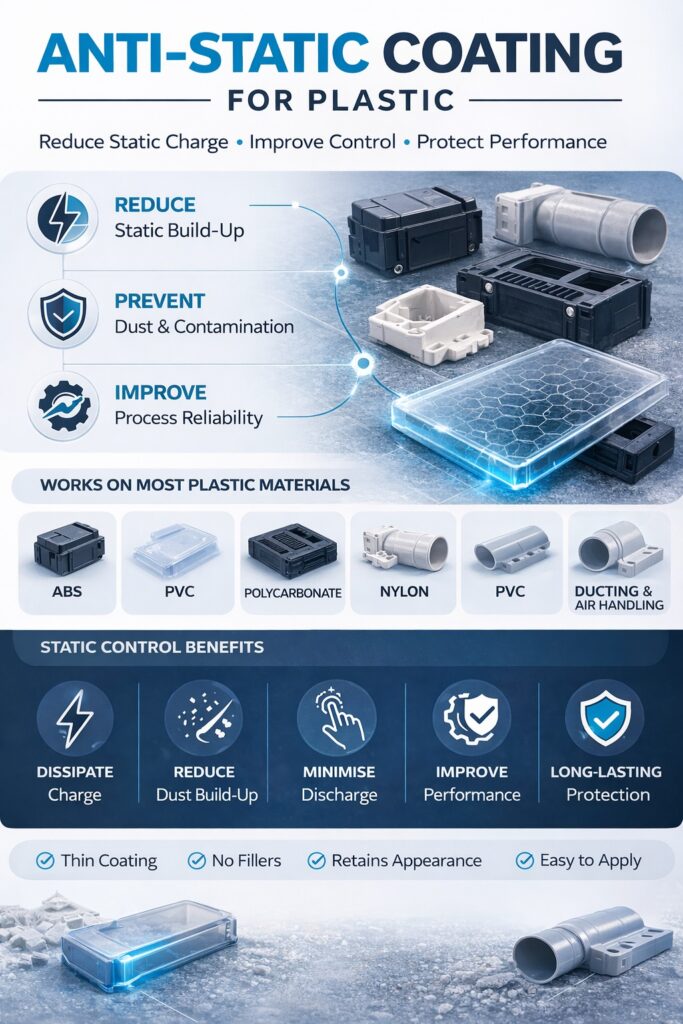
Anti-static coating for plastic converts insulating polymer surfaces into controlled static-dissipative materials using conductive polymer technology.
Why Plastic Surfaces Generate Static
Most plastics commonly used in engineering and manufacturing are highly insulating. Because they do not naturally dissipate charge, electrostatic energy can build up on the surface during normal use.
- Handling and contact between parts
- Airflow across covers, ducts and housings
- Friction during transport, assembly or cleaning
- Movement through conveyors and packaging lines
- Dry operating conditions that reduce natural charge dissipation
This is why anti-static coating for plastic is often considered where the plastic part is mechanically suitable but electrically unsuitable for the process.
Where Anti-Static Coating for Plastic Is Used
Anti-static coatings can be applied where plastic is the preferred material for weight, cost, shape, toughness, transparency or manufacturability, but surface static control is still required.
- Plastic housings and instrument enclosures
- Machine covers, guards and access panels
- Ventilation ducts and fan assemblies
- Conveyor parts and handling equipment
- Packaging inserts, trays and protective structures
- Automation panels, robotics covers and production fixtures
For wider application examples, see Applications of the ProShieldESD Coating Platform. For equipment-level applications, see Static Control for Industrial Equipment. Where plastic is part of benches, racks, shelves or local working areas, see Static Control for Work Surfaces & Facilities.
Why Not Just Use Conductive Plastics?
Conductive plastics can solve some static control problems, but they are not always the most practical, available or economical route. Many applications only require controlled surface dissipation rather than a fully conductive bulk material.
- Conductive plastics are often more expensive than standard grades
- Specialist materials may affect appearance, weight or mechanical behaviour
- Changing material may require redesign, tooling or validation work
- Installed equipment cannot usually be upgraded by changing the bulk plastic
- Surface performance is often the real requirement, not full part conductivity
In practice, carbon-filled coatings and moulded anti-static plastics can show variability, wear-related drift and contamination risk over time, particularly in high-use environments. For a practical breakdown, see why carbon-filled ESD paints and moulded anti-static plastics can fail.
For a deeper engineering comparison, see Conductive Coatings vs Conductive Plastics.
How Anti-Static Coating for Plastic Works
Anti-static coating for plastic works by modifying the electrical behaviour of the surface rather than changing the material itself. A conductive polymer layer is applied to create a controlled pathway for charge dissipation while the underlying plastic retains its mechanical properties.
This approach allows standard insulating plastics to function as static-dissipative surfaces without redesigning the part or replacing the base material. In most ESD applications, the objective is not high conductivity, but stable and controlled dissipation of charge.
ProShieldESD uses filler-free ESD coating technology to achieve this without relying on carbon-loaded paints or unstable filler networks, helping maintain more consistent behaviour across real operating conditions.
For measured performance across different materials, see live ProShieldESD testing results, or for a deeper explanation of long-term behaviour, see what lifetime dissipation really means.
Key point: Anti-static coating for plastic is most useful where the plastic part is already mechanically right, but the surface needs controlled static dissipation.
Typical Surface Resistivity Range
Anti-static coating for plastic is commonly designed to produce a static-dissipative surface rather than a highly conductive one. Typical target surface resistivity values may sit in the range of 106 to 109 Ω/sq, depending on the application and ESD control strategy.
This range allows electrostatic charge to dissipate in a controlled way while avoiding the rapid discharge associated with highly conductive materials. Final resistance targets should always be agreed against the process, product and applicable ESD requirements.
Benefits of Anti-Static Coating for Plastic
- Retain standard plastics where the base material already meets the design need
- Avoid unnecessary redesign, tooling or material change
- Reduce dust attraction and contamination risk on exposed plastic surfaces
- Support controlled charge dissipation in ESD-sensitive environments
- Upgrade installed plastic parts, covers and structures
- Use one coating platform across multiple plastic applications
These advantages make anti-static coating for plastic attractive where conductivity is needed at the surface but a full material change would be excessive.
Engineering Considerations
As with any functional coating system, suitability depends on both the plastic substrate and the operating environment. Before selecting an anti-static coating for plastic, engineers should consider the following.
- Plastic type and surface energy
- Surface preparation and adhesion compatibility
- Required resistance range for the ESD control strategy
- Mechanical wear, handling, abrasion and cleaning exposure
- Chemical exposure during use
- Whether grounding paths are required at equipment level
- Coating chemistry selection for substrate and durability requirements
The most suitable format can be selected from the wider ProShieldESD chemistries depending on the substrate, environment and performance requirement.
Plastic Surfaces in Wider Static Control Systems
Plastic parts are often part of larger equipment, packaging, work surface, facility or hazardous environment systems. Where plastic surfaces interact with other materials, the coating approach should be considered as part of the whole static control strategy.
- Plastic guards, housings and panels used on industrial equipment
- Plastic trays, bins and inserts used in packaging and logistics systems
- Plastic components used near powders, solvents or hazardous processes
- Plastic covers, benches, racks and surfaces used in work areas or facility infrastructure
Related solution pages include Static Control for Industrial Equipment, Static Control for Work Surfaces & Facilities, Static Control for Packaging & Logistics and Static Control in Hazardous Environments.
How SCH Services Supports Plastic ESD Coating Projects
SCH Services can support anti-static coating for plastic from early feasibility through to repeat coating work. The process starts with the plastic part, operating environment and required ESD performance.
- Review of the plastic substrate and application requirement
- Assessment of surface preparation and adhesion route
- Selection of suitable ProShieldESD chemistry
- Trial coating and resistance testing
- Practical review of handling, wear, cleaning and appearance
- Support through ProShieldESD subcontract coating services
Choosing the Right Static Control Route
Plastic components are one of the most common sources of static build-up, but they are only part of the wider system. The correct approach depends on how charge is generated, how parts are used, and whether the issue extends into equipment, packaging, work surfaces, facility areas or higher-risk environments.
For a structured route across all application types, see How to Choose the Right Static Control Approach.
ProShieldESD Solutions
Other ProShieldESD solutions support related static control requirements across equipment, packaging, hazardous areas and working environments.
Why Choose SCH Services?
SCH Services combines coating process experience, ESD application knowledge and practical production support to help customers evaluate and apply ProShieldESD correctly.
- Technical support for plastic substrate assessment and coating selection
- Trial coating and process evaluation before wider adoption
- Support for repair, upgrade and retrofit strategies
- Experience with coatings used in industrial, electronics and safety-critical environments
- Practical guidance for inspection, maintenance and verification
Disclaimer: This page provides general technical guidance only. Anti-static coating suitability depends on plastic type, surface preparation, coating chemistry, operating environment, resistance range, cleaning regime, wear conditions and verification testing. Final suitability must be confirmed through appropriate trials, risk assessment and qualification checks before use.