Why We Don’t Automatically Use ESD Masking Tape for Conformal Coating
Why controlling the complete manufacturing risk can be more important than specifying an ESD-labelled masking material
At first sight, the choice seems obvious. If an electronic assembly is ESD-sensitive, why not simply use an ESD masking tape?
In practice, masking is a production process and not just a material specification. At SCH Services, the masking material has to protect the assembly reliably, remain where it is placed, seal the required coating boundary and be practical for operators to apply repeatedly. We have evaluated ESD masking materials, but the products we have assessed have not provided the same combination of handling and masking performance as the specialist tapes we use in production.
The engineering question is therefore not simply whether a tape is ESD-labelled. It is which combination of material and process controls creates the lowest overall manufacturing risk.
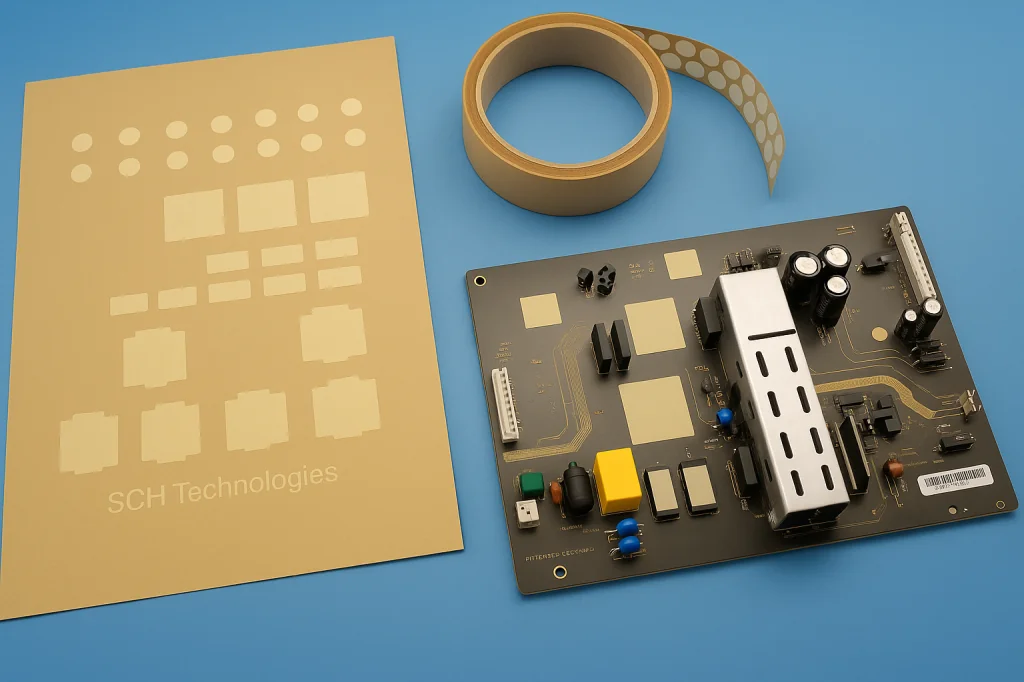
Specialist conformal coating masking materials in tapes, dots, pre-cut shapes and sheet formats for accurate, repeatable PCB masking.
Two Different Risks Have to Be Controlled
A conventional masking tape can be an electrically insulating material and handling or removing adhesive tapes can generate electrostatic charge. That risk needs to be recognised and controlled when ESD-sensitive assemblies are being processed.
However, changing to an ESD masking tape can introduce another risk if the alternative material is more difficult for the operator to apply accurately or does not provide equivalent conformability, adhesion or sealing performance.
Electrostatic Risk
Insulating masking materials may accumulate electrostatic charge during handling, application or removal. This needs to be managed within the ESD-controlled process.
Masking Failure Risk
A tape that is difficult to handle, position or seal can increase the possibility of edge lift, movement, coating ingress, inconsistent keep-outs and subsequent rework or rejection.
Why Masking Performance Matters
Masking has one fundamental purpose: to prevent coating reaching areas that must remain uncoated. This can include connectors, contacts, test points, component interfaces and other defined keep-out areas.
For a masking tape to work successfully in a production environment it must therefore do considerably more than satisfy an electrical material classification. Operators need to be able to position it accurately, manipulate it around real PCB geometries, create reliable boundaries and trust that it will remain in position throughout the coating process.
In our production experience, this is where the ESD masking tapes we have evaluated have been less satisfactory than our established masking materials. A theoretically preferable electrical characteristic does not compensate for a material that makes the physical masking operation less reliable.
Production reality: improving one process characteristic is not an improvement if it increases the probability of another, more frequent manufacturing defect.
So What About the Static Charge?
Recognising that conventional masking materials can generate or retain electrostatic charge does not mean that the material has to be removed from the process. Electrically insulating materials are common in electronics manufacturing and cannot necessarily be made safe simply by connecting them to ground.
Where process-essential insulating materials are required, ionisation is an established method of reducing accumulated electrostatic charge. SCH therefore uses ionisation at appropriate masking workstations as part of the ESD-control strategy.
Air ionisers provide positive and negative ions within the controlled work area, allowing charge on insulating surfaces to be neutralised. This means the electrostatic behaviour of the masking material is addressed through an engineered process control rather than relying solely on the electrical classification of the tape.
Important: ionisation should be considered part of the overall ESD-control programme. It does not replace appropriate workstation controls, procedures, verification, grounding of conductive items or other ESD precautions required for the assembly being processed.
The Complete Process Matters More Than One Material
It is easy to evaluate an individual process material in isolation. Manufacturing reliability requires a wider view.
Choose masking materials for reliable sealing, handling and process compatibility.
Use controlled operator techniques to create repeatable coating boundaries.
Use the appropriate ESD workstation controls and ionisation for process-essential insulators.
Inspect masking integrity and maintain the required ESD-control process.
The objective is not to optimise one item on a material specification sheet. It is to create a repeatable manufacturing process in which both masking reliability and electrostatic risk are controlled.
Would We Use an ESD Masking Tape?
Absolutely, if it provided equivalent production performance.
There is no fundamental reason to avoid an ESD masking material. If a tape offers the required ESD characteristics while also providing the handling, conformability, adhesion, clean removal and masking reliability required by the coating process, it can be an excellent solution.
The reason we do not automatically specify ESD tape is simply that the products we have evaluated have involved a production compromise that we do not believe is justified. In those circumstances, we prefer to use masking materials proven within our coating process and manage electrostatic charge through the wider ESD-controlled workstation.
If a future ESD masking material gives us both properties, we would be very happy to use it.
The Engineering Insight
The material with the best individual specification is not necessarily the material that creates the lowest-risk manufacturing process.
Masking tape selection is a good example. Specifying an ESD tape may appear to remove one concern, but if its physical behaviour increases masking failures, the process may actually become less reliable.
A better approach is to identify each significant risk and control it appropriately: use a masking material that masks reliably, and use engineered ESD controls to manage electrostatic charge.
Related Guidance
For the wider engineering principles behind masking material choice and operator application, see the SCH masking guidance below.
Conformal Coating Masking HubMasking Material SelectionMasking Application Best Practices
Need Help With a Masking Process?
Masking problems are rarely solved by looking at the tape alone. PCB geometry, coating chemistry, application method, operator technique, ESD requirements and inspection all influence the final result.
SCH Services can help evaluate masking strategies as part of the complete conformal coating process, including material selection, masking methods, operator controls and production defect reduction.
Why Choose SCH Services?
SCH combines practical conformal coating production with masking development, process optimisation and operator training. The masking methods we recommend are informed by the same production issues we manage when coating customer assemblies ourselves.
This allows masking materials to be evaluated as part of the complete manufacturing process rather than as an isolated consumable specification.
Disclaimer
This information is provided as general engineering guidance. ESD requirements, masking materials and process controls should be evaluated and validated for the specific assembly, component sensitivity, production environment and applicable customer or industry requirements. The suitability of any masking or ESD-control strategy remains dependent on the complete manufacturing process and its verification.