ProShieldESD Coating Platform Chemistries
How chemistry selection enables practical, scalable static control
ProShieldESD coating platform chemistries are selected based on application, not fixed products. Traditional ESD solutions often limit performance by forcing a choice between materials. The ProShieldESD platform takes a different approach by delivering consistent static control across multiple chemistry formats.
Each chemistry is built on the same filler-free conductive polymer backbone. This means conductivity does not rely on carbon or metal particles that can drift, wear or vary during use. Instead, performance remains stable across substrates, environments and processes.
Current formats include polyurethane, epoxy, water-based and solvent-based systems. These are not limits. The platform can extend to new chemistries as application requirements evolve without changing electrical performance.
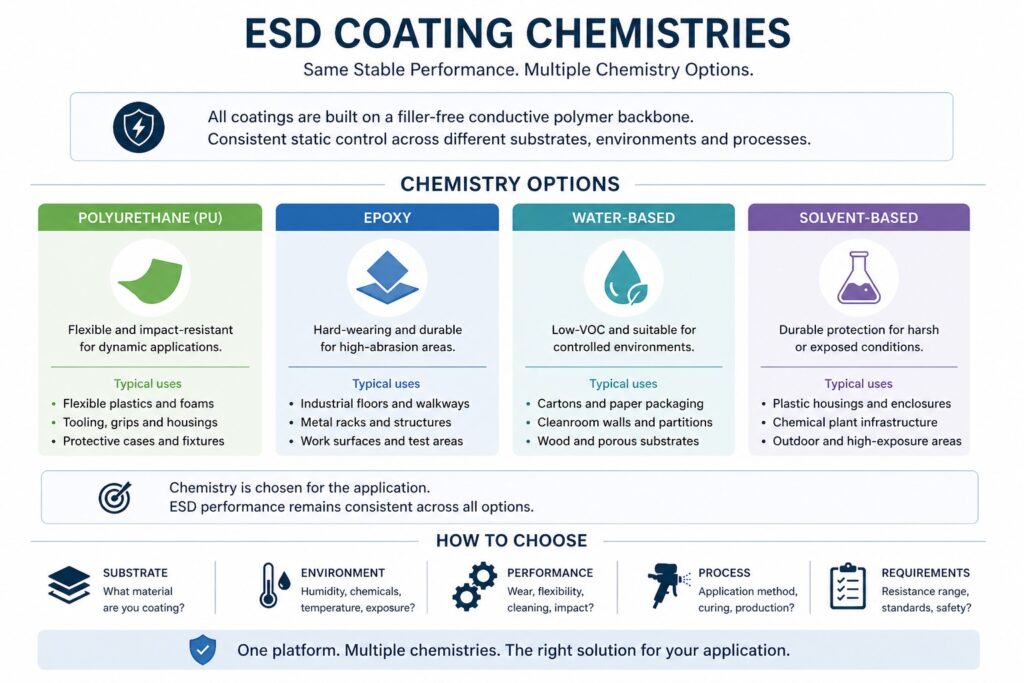
Simple overview of ESD coating chemistries showing how different coating types are selected based on application while maintaining consistent static control performance.
Why Chemistry Selection Matters
Different applications require different coating behaviours, but ESD performance must remain consistent. Traditional systems often force a compromise between chemistry, substrate compatibility and conductivity.
With ProShieldESD, chemistry is selected to match the substrate, environment and process. Electrical performance remains stable regardless of the chosen format.
Available Chemistries and Typical Use Cases
Polyurethane (PU)
Flexible and impact-resistant coatings for dynamic or soft materials.
- Flexible plastics and foams
- Tooling, grips and housings
- Protective cases and lightweight fixtures
Epoxy
Hard-wearing coatings for high-abrasion environments.
- Industrial floors and walkways
- Metal racks, frames and structures
- Heavy-duty work surfaces and test areas
Water-Based
Low-VOC coatings for controlled or sensitive environments.
- Packaging materials such as cartons and paper
- Cleanroom walls and partitions
- Wood and porous substrates
Solvent-Based
Durable coatings for harsh or exposed conditions.
- Plastic housings and enclosures
- Chemical plant infrastructure
- Outdoor or high-exposure environments
Key point: Chemistry selection is about application fit. ESD performance remains consistent across all ProShieldESD formats.
Where These Chemistries Are Used
ProShieldESD chemistries are applied across a wide range of industries and environments where static control must remain stable during real operation.
- Electronics and semiconductor manufacturing
- Aerospace, defence and ruggedised systems
- Pharmaceutical and cleanroom environments
- Automotive and battery production
- Chemical and solvent handling areas
- Work surfaces and facility areas
- Packaging and logistics systems
- Explosive and ATEX environments
For the broad industry view, see Applications of the ProShieldESD Coating Platform. For practical application routes by material or environment, see ProShieldESD Solutions.
Chemistry Selection by Solution Route
The most suitable chemistry depends on the substrate, use environment, wear exposure, cleaning regime and required resistance range.
- Anti-Static Coating for Plastic often depends on plastic type, surface energy, adhesion route and handling exposure.
- Static Control for Industrial Equipment often requires wear resistance, repairability and compatibility with machinery surfaces.
- Static Control for Work Surfaces & Facilities often depends on wear, cleaning, operator contact, substrate type and local repair requirements.
- Static Control for Packaging & Logistics may favour flexible, low-VOC or material-compatible coating routes.
- Static Control in Hazardous Environments requires selection around process conditions, cleaning and safety context.
- Explosive & ATEX Environments require site-specific assessment, verification and a complete static control strategy.
How to Choose the Right Chemistry
| Requirement | Likely Chemistry Route |
|---|---|
| Flexible or soft materials | Polyurethane |
| High wear or abrasion | Epoxy |
| Low VOC or cleanroom-sensitive environments | Water-based |
| Harsh, exposed or chemically demanding environments | Solvent-based |
All options are designed to deliver controlled ESD performance. Selection depends on application conditions, not simply conductivity.
How SCH Services Supports Chemistry Selection
Choosing the correct chemistry starts with the application, not the coating. SCH Services supports evaluation, testing and implementation across different substrates and environments.
Assessment of substrate, environment and performance requirements
Selection of suitable chemistry and application method
Trial coating and validation
Support through ProShieldESD subcontract coating services
Related ProShieldESD Pages
Why Choose SCH Services?
SCH Services supports practical implementation of ProShieldESD across multiple chemistries, substrates and industries.
Technical support for chemistry selection and application
Trial coating and validation
Support for retrofit and upgrade projects
Experience across industrial and safety-critical environments
Disclaimer: This page provides general technical guidance only. Final chemistry selection and performance must be validated against application requirements, operating conditions and relevant standards.