Parylene Basics: Dimer Grades, Properties & Uses
Parylene grades, material properties, and application uses
← Back to the Parylene Basics Hub
Parylene basics covers what the coating is, how it’s deposited, the main Dimer grades (N, C, D, F), and when to use it. This page summarises core properties, typical thickness ranges, and design/inspection tips so you can choose and specify Parylene with confidence.
For a broader technology comparison, see Parylene vs Conformal Coating: How to Choose the Right Protection for Electronics.
Quick Links
What Is Parylene?
Parylene is a family of vapor-deposited, ultra-conformal polymer coatings applied via room-temperature CVD. The film grows molecule by molecule on all exposed surfaces, creating a pinhole-free barrier with outstanding dielectric and moisture performance—ideal for complex 3D assemblies.
Learn more: Parylene overview (Wikipedia).
Parylene Dimer Grades (N, C, D, F)
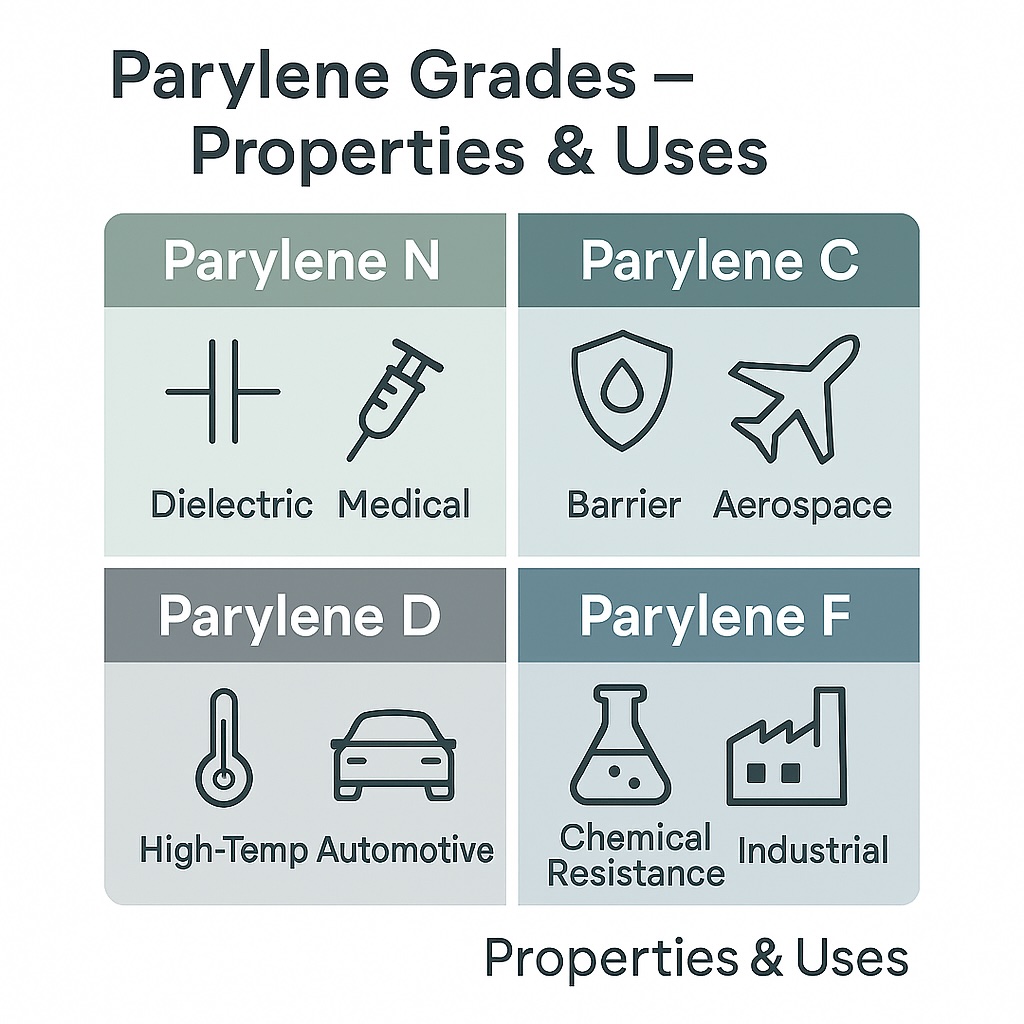
- Parylene N: Highest dielectric strength per thickness; excellent crevice penetration; good humidity barrier.
- Parylene C: Most widely used; strong moisture/ionic barrier; good chemical resistance; balanced cost/performance.
- Parylene D: Better high-temperature performance than C; slightly lower barrier than C.
- Parylene F (AF-4/HT types): Fluorinated grades offering improved high-temp and chemical resistance; premium cost.
Typical selection: C for general reliability, N for ultra-thin dielectric layers, D/F for higher-temperature or aggressive environments.
Grade choice also affects surface preparation strategy and long-term bond reliability. For a deeper look at coating bond performance and substrate compatibility, see Parylene Adhesion: Causes of Failure & Solutions.
Key Properties
- Dielectric performance: High dielectric strength at thin builds; stable over a wide frequency range.
- Barrier protection: Excellent moisture and corrosion resistance; low permeability.
- True conformality: Uniform coating on edges, vias, cavities, and under leads.
- Low thermal mass cure: Deposited at room temperature—gentle on heat-sensitive parts.
- Biocompatibility (grade dependent):strong> Options suitable for medical devices (verify to application standards).
- Mechanical: Tough, pinhole-free films with good abrasion resistance; flexible at typical thicknesses.
These property advantages are one reason Parylene is often selected over traditional liquid-applied coatings in critical applications. For a side-by-side engineering comparison, see Parylene vs Conformal Coating.
Parylene Basics: Deposition & Thickness
Parylene is deposited via CVD from a solid dimer. The dimer is vaporised, pyrolysed to a monomer, and then polymerised on the substrate surface at room temperature in a vacuum chamber.
- Typical thickness: 5–20 µm for light protection; 10–25 µm for most electronics; 25–50 µm for harsh environments.
- Uniformity: Film builds uniformly on all exposed surfaces including internal voids reachable by line-of-sight + diffusion paths.
- Verification: Measure with optical thickness meters or eddy-current gauges; manage plans via AQL, coupons & SPC.
Thickness selection often determines the real-world durability margin. For practical thickness bands and environmental guidance, see our Parylene thickness article.
When moving from general thickness awareness to a formal engineering requirement, use the Parylene Thickness Specification Guide.
Typical Uses
- Aerospace & defence electronics needing long-term moisture and corrosion resistance.
- Medical devices and sensors (verify biocompatibility for the specific grade/application).
- Automotive/EV control units exposed to condensation, salt, and thermal cycling.
- Industrial, IoT and instrumentation with tight keep-outs and complex geometries.
In many of these sectors, the key question is not whether to coat, but whether Parylene or a traditional liquid conformal coating is the better fit. See Parylene vs Conformal Coating for a practical selection guide.
See our Parylene coating services and training & consultancy for application support.
Design & Inspection Tips
- Define keep-outs and masking features early; consider reusable masking boots, tapes & dots.
- Specify thickness targets and acceptance criteria (link to inspection standards).
- Verify coverage under UV inspection; record edges and keep-outs.
- Plan thickness verification with AQL/coupons/SPC.
Good design and inspection also rely on stable adhesion to the underlying materials. Where plastics, metals or solder masks are involved, see Parylene Adhesion: Causes of Failure & Solutions.
Limitations & Removal
- UV sensitivity without over-coat; consider testing if long UV exposure is expected.
- Rework is harder than liquid coatings—solvents are ineffective; use precision micro-abrasion (see Parylene removal guide).
- Material and cycle costs are higher than liquid coatings; evaluate lifetime cost vs risk.
That trade-off is one of the main reasons engineers compare Parylene carefully against spray, dip and selective liquid coating processes. See Parylene vs Conformal Coating.
Why Choose SCH Services?
Partnering with SCH means gaining a complete, integrated platform for Conformal Coating, Parylene & ProShieldESD with equipment, materials, and training, backed by decades of expertise.
- ✈️ 25+ Years – trusted worldwide
- 🛠️ End-to-End Support – coating, masking, application, inspection
- 📈 Scalable Solutions – prototypes to high-volume
- 🌍 Global Reach – support in EU, NA, Asia
- ✅ Proven Reliability – consistent quality & service
📞 Call: +44 (0)1226 249019
✉ Email: sales@schservices.com