How to Select a Conformal Coating Material
Choose the right chemistry for environment, process, rework and compliance
Knowing how to select a conformal coating material is critical to protecting PCB assemblies against moisture, chemicals, electrical leakage and long-term reliability risks.
This guide compares the main coating chemistries used in electronics, including acrylic, urethane, silicone, epoxy and Parylene. It also explains why material selection should not be treated as a datasheet-only decision.
Before selecting a specific chemistry, it is worth stepping back and comparing conformal coating vs nano coating vs Parylene, because the right protection strategy is often determined first by geometry, connector sensitivity, rework needs and process control limits.
Where static control is required on housings, fixtures, packaging or handling surfaces, ProShieldESD may sit alongside environmental protection as a separate ESD control layer rather than as a direct conformal coating substitute.
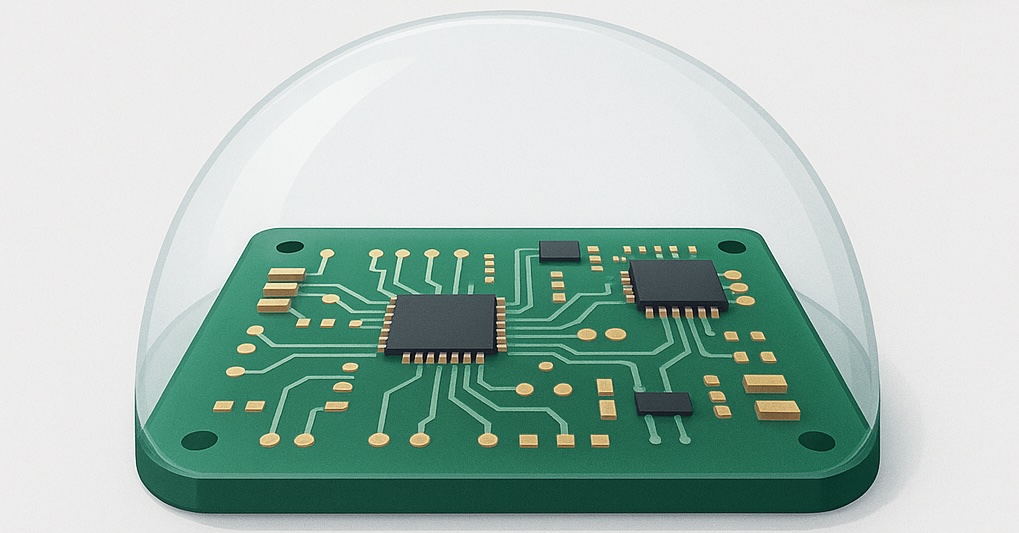
Selecting coating chemistry depends on environment, process capability, rework requirements and reliability targets, not just material type.
Article Quicklinks
| Topic | Jump |
|---|---|
| Why material selection is not the starting point | 🔗 |
| Key selection factors | 🔗 |
| Comparison table | 🔗 |
| Selection steps | 🔗 |
| Conclusion | 🔗 |
Material Selection Is Often the Wrong Starting Point
Many coating problems are not caused by choosing the wrong chemistry. They are caused by applying a suitable material through an unstable process, or onto an assembly that is difficult to coat reliably.
Before selecting a material, assess the real coating challenge:
- PCB geometry and component density
- Connector sensitivity and masking complexity
- Cleanliness and contamination risk
- Application process capability and repeatability
- Inspection, repair and rework expectations
This is why coating selection should be treated as part of a wider protection strategy, not as an isolated material choice.
For a broader comparison of protection approaches, see Conformal Coating vs Nano Coating vs Parylene. Where coating challenges persist despite changing materials, it may be necessary to consider alternative coating strategies better suited to the assembly geometry, process limits and boundary control requirements.
For the practical reasons coatings still fail on dense, connector-heavy boards, see Why Conformal Coating Fails in Complex PCB Assemblies.
Reality check: Changing coating chemistry rarely fixes recurring coating failures on its own. In most cases, geometry, masking, contamination or process control are the real causes.
If coating problems are already appearing in production, it is also worth reviewing the Conformal Coating Defects Hub and the Conformal Coating Processes Hub before changing material.
Key Factors in How to Select a Conformal Coating Material
1) Application Environment
- Moisture and humidity: Acrylics and silicones are often chosen where moisture protection is the main priority.
- Chemicals, fuels and oils: Urethanes and epoxies typically offer stronger chemical resistance.
- High temperature and thermal cycling: Silicones are widely used where flexibility and temperature tolerance matter.
- Ultra-high barrier requirements: Parylene provides thin, highly conformal coverage with strong moisture and gas barrier performance.
2) Electrical Requirements
- Dielectric strength and leakage control: Select chemistry and thickness to support the electrical design, not just the coating datasheet, and verify the result through practical thickness measurement.
- SIR and insulation stability: Confirm both material qualification and actual process performance on your assemblies.
- ESD mitigation: Where static control is required alongside environmental protection, ProShieldESD can be applied to housings, packaging, fixtures or handling surfaces.
3) Application Process
- Spray, dip and selective coating: Acrylics and urethanes are common where manual or automated liquid coating lines are used, but the final choice must reflect realistic selective conformal coating accuracy where keep-out control is critical.
- UV-curable systems: Useful for high throughput, but shadowing and lamp access must be considered carefully, alongside the wider curing and drying behaviour of the process.
- Parylene deposition: Vacuum CVD gives highly conformal coverage on complex geometries and fine-pitch assemblies, but it also creates different masking, validation and rework requirements.
Chemistry selection only works when it matches the process route you can actually control, which is why it also helps to understand the main conformal coating application processes used in production.
4) Rework and Repair
- Easiest to remove: Acrylics are generally the most rework-friendly.
- Moderate difficulty: Urethanes and silicones often require more specialist removal methods.
- Most challenging: Parylene normally needs methods such as laser ablation, plasma etch or controlled micro-abrasion.
5) Standards and Compliance
- IPC-CC-830: Common baseline for conformal coating qualification.
- UL 746E and UL94: Relevant where electrical safety and flammability are part of the design requirement.
- IEC 60664: Important context for pollution degree, creepage and clearance considerations.
- Sector-specific requirements: Parylene is often selected in medical and aerospace applications where reliability, thin films or biocompatibility may be important.
Related reading: Material selection is only one part of a successful high-reliability coating process. For a broader explanation of the workmanship and process-control principles used in aerospace-style environments, see What NASA Gets Right About Conformal Coating.
For practical guidance on building stable coating processes, see the Conformal Coating Processes Hub.
Comparison Table: How to Select a Conformal Coating Material
Each chemistry brings a different balance of protection, process practicality and rework difficulty. The right choice depends on the whole application, not just one performance property.
| Coating Type | Strengths | Limitations | Typical Uses |
|---|---|---|---|
| Acrylic (AR) | Easy to apply and remove; good moisture protection; clear | Lower chemical resistance; moderate temperature range | General electronics, rapid prototyping, rework-heavy builds |
| Urethane (UR) | Excellent chemical and solvent resistance; tough films | Harder to rework; longer cure; potential yellowing | Automotive, industrial and chemically exposed assemblies |
| Silicone (SR) | Wide temperature range; flexible; good humidity performance | Lower abrasion resistance; removal can be more difficult | Aerospace, power electronics and thermal cycling environments |
| Epoxy (ER) | High chemical and abrasion resistance; durable films | Can be brittle; difficult to rework; may stress components | Harsh industrial and chemical environments |
| Parylene (XY) | Strong barrier performance; thin and highly conformal vapour-deposited coverage | Vacuum process; higher cost; more challenging rework; masking must be controlled | Medical, aerospace and fine-pitch high-reliability electronics |
| ProShieldESD | Conductive polymer for static control on surfaces, cases and packaging | Not a moisture barrier; used alongside environmental protection systems where needed | ESD-sensitive assemblies, workspaces, packaging and handling surfaces |
Making the Right Choice: How to Select a Conformal Coating Material
A practical material selection process should start with the real service conditions and the process you can actually control in production.
- Define the environment: humidity, splash or immersion risk, chemicals, temperature profile and contamination exposure.
- Set electrical targets: insulation stability, dielectric requirements, creepage and clearance context, and any ESD control requirements.
- Choose the process route: spray, dip, selective coating or Parylene CVD, based on geometry, masking complexity and throughput. On mixed-function assemblies, a hybrid coating strategy may be safer than forcing one chemistry across the whole board.
- Plan rework and repair: make sure the coating can be serviced using acceptable removal methods.
- Verify compliance: align material and process with IPC-CC-830, UL expectations and customer sector requirements.
Tip: Use coated test coupons alongside assemblies to verify thickness and behaviour, rather than relying only on direct measurement on populated boards.
Where masking and process practicality are major decision factors, see our masking section for further guidance.
Conclusion
When deciding how to select a conformal coating material, there is no single chemistry that fits every application. Acrylics are versatile and reworkable, urethanes and epoxies offer stronger chemical robustness, silicones handle heat and cycling well, and Parylene delivers strong barrier performance at thin film thicknesses.
The best result comes from matching chemistry to the real environment, process capability, masking difficulty and repair expectations, rather than selecting material in isolation.
Where coating issues are driven by geometry, connector sensitivity or masking limits, the next step may be to reassess the overall protection route using conformal coating vs nano coating vs Parylene, or consider whether a hybrid coating strategy is more realistic.
Where static control is needed alongside moisture or environmental protection, ProShieldESD can be integrated as part of the wider protection strategy.
Choosing a Conformal Coating Material Is Only Part of the Answer
Material selection is only one part of a successful coating process. The real outcome depends on how the coating behaves on your assembly, how it is applied, and whether the process can be controlled in production.
🔍 Still deciding between coating types?
Before choosing a chemistry, compare the full protection strategies — including conformal coating, nano coating and Parylene.
⚠️ Struggling with coating failures or edge control?
If coating is failing in practice, the issue is usually process, geometry or masking — not the material itself.
🛠️ Need a coating process that works in production?
SCH supports coating selection, process development and production implementation across conformal coating, nano coatings and Parylene systems.
SCH Services helps customers move beyond material selection — defining coating strategies that work reliably in real assemblies and real production environments.
📞 Call: +44 (0)1226 249019 | ✉ Email: sales@schservices.com