
CytoThane Superhydrophobic Coating Selection Guide
Compare CytoThane MW, WX2100, TS, R04 and MX by water repellency, durability, chemistry and application method
The CytoThane coating family provides several routes for controlling water interaction on antennas, radomes, telecommunications equipment and other exposed surfaces. The correct material should not be selected from water contact angle alone.
Different CytoThane systems provide different combinations of superhydrophobic performance, abrasion resistance, fluorine content, application method, colour and field practicality. Some are simple single-part systems. Others are designed to provide increased durability or a fluorine-free route.
The purpose of this guide is to help narrow the selection before trials begin. Final material selection should always be confirmed against the actual substrate, environment, application process and required service life.
If you first need to understand whether extreme water repellency is appropriate for your application, review Superhydrophobic Coatings. For the wider coating family, return to Advanced Functional Coatings.
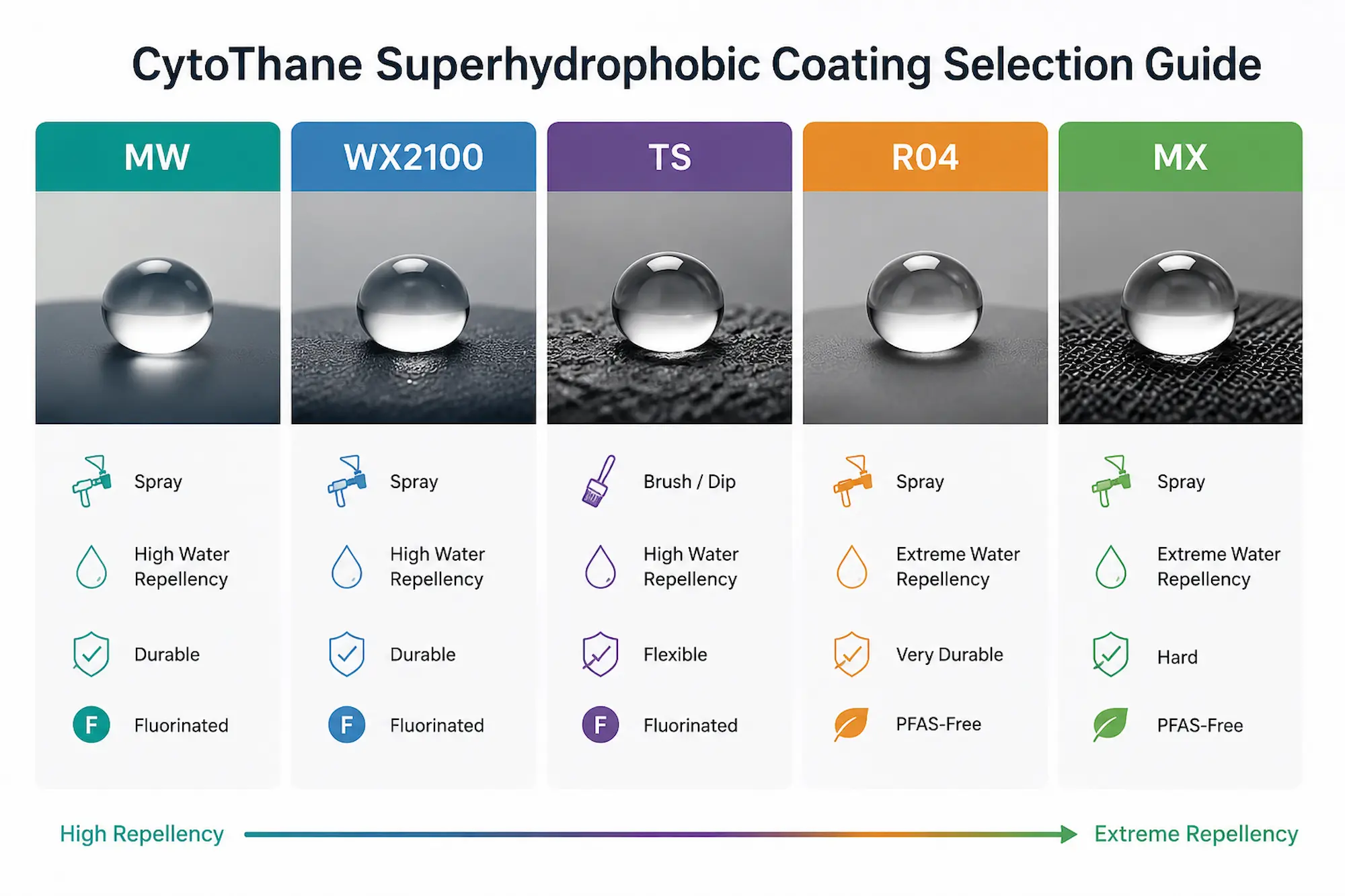
CytoThane coating selection guide comparing superhydrophobic coating options for different application and performance requirements.
Start With the Requirement
Do not begin by asking which CytoThane has the highest contact angle. Begin with the problem the coating must solve.
| If the main requirement is… | Initial route to evaluate |
|---|---|
| Established single-part coating for antennas and radomes | CytoThane MW |
| Convenient aerosol application for smaller areas or field work | WX2100 |
| Higher durability combined with a fluorine-free route | CytoThane TS |
| Single-part fluorine-free superhydrophobic coating | CytoThane R04 |
| Harder water-repellent surface with a wider range of standard colours | CytoThane MX |
This is a starting point, not a specification. Substrate compatibility, required roll-off behaviour, weathering, abrasion, handling, RF performance, application conditions and maintenance requirements may change the preferred material.
CytoThane Coating Comparison
The table below provides a practical first comparison of the main CytoThane routes.
| Property | MW / WX2100 | TS | R04 | MX |
|---|---|---|---|---|
| System | Single-part | Two-part / two-stage | Single-part | Single-part |
| Application | Roll or spray; WX2100 aerosol option | Roll or spray | Roll or spray | Roll or spray |
| Typical water contact angle | Approximately 140° | Approximately 140°* | Approximately 140° | Approximately 130° |
| Hardness | HB pencil hardness | 2H pencil hardness | HB pencil hardness | 2H pencil hardness |
| Fluorine position | Fluorinated | Fluorine-free | Fluorine-free | Fluorinated |
| General position | Established general-purpose superhydrophobic route | Higher-durability fluorine-free route | Single-part fluorine-free route | Harder highly water-repellent route with broader colour availability |
*Cytonix documentation supplied for the TS system contains different contact-angle figures depending on the document and test context. Current technical data should therefore be confirmed when specifying the coating rather than using a single published figure as the selection criterion.
CytoThane MW
CytoThane MW is the established single-part CytoThane route for antennas, radomes and telecommunications surfaces.
It is an air-cured coating designed to create very high water repellency so that rain forms beads and sheds from the surface rather than remaining as a persistent water film.
CytoThane MW can be applied using controlled spray or roll processes. Spray application is particularly suitable for consistent factory coating over larger surfaces, while roll application can provide greater control in some field environments where overspray needs to be limited.
Consider MW when:
- an established superhydrophobic system is required;
- the application involves antennas, radomes or exposed telecommunications equipment;
- a single-part application process is preferred;
- spray or roll application is practical; and
- fluorinated chemistry is acceptable for the application.
WX2100 Aerosol
WX2100 is the pressurised aerosol version of the CytoThane MW technology.
It provides a convenient application route where coating equipment is unavailable or where relatively small areas need to be treated. This can make it useful for evaluation, field application, maintenance or selected local coating operations.
Its convenience does not remove the need for process control. Surface cleanliness, spray distance, overlap, coating quantity, drying conditions and post-application handling still influence the finished superhydrophobic surface.
Consider WX2100 when:
- an aerosol application route is useful;
- the area is relatively small;
- field application or maintenance is required;
- bulk spray equipment is impractical; or
- the MW coating technology is otherwise suitable for the application.
CytoThane TS
CytoThane TS is positioned as the higher-durability fluorine-free route within the CytoThane family.
Compared with the standard MW/WX2100 route, TS provides increased surface hardness and has been developed to improve resistance to abrasion and rain exposure while maintaining very high water repellency.
The trade-off is process complexity. TS uses a two-part / two-stage coating approach rather than the simpler single-part process used by MW and R04.
Consider TS when:
- fluorine-free chemistry is required or preferred;
- higher abrasion or rain durability is important;
- a harder coating surface is beneficial;
- a two-stage application process can be controlled; and
- long-term superhydrophobic behaviour is more important than minimum process complexity.
CytoThane R04
CytoThane R04 provides a single-part fluorine-free route.
This makes R04 particularly interesting where customers want to move away from fluorinated chemistry but would prefer to avoid the additional process stages associated with a two-stage system.
R04 should not automatically be treated as equivalent to TS simply because both are fluorine-free. Durability, surface hardness, roll-off behaviour, application requirements and environmental exposure should still be compared against the real requirement.
Consider R04 when:
- a fluorine-free superhydrophobic coating is required;
- a single-part application route is preferred;
- spray or roll application is suitable; and
- the application does not automatically require the higher-durability TS route.
CytoThane MX
CytoThane MX occupies a different position within the family. It provides strong water repellency together with increased surface hardness and a broader range of colour options.
Its reported contact angle is lower than the more strongly superhydrophobic MW, TS and R04 routes, so MX should not be selected simply because it belongs to the CytoThane family. It may instead be useful where appearance, colour or hardness is an important part of the requirement alongside water repellency.
Consider MX when:
- high water repellency is required but maximum contact angle is not the only priority;
- greater surface hardness is useful;
- colour options are important; and
- fluorinated chemistry is acceptable.
Contact Angle vs Roll-Off Behaviour
A high water contact angle is useful, but it does not by itself prove that water will readily leave the surface.
For many antenna and radome applications, droplet mobility is as important as droplet shape. A highly rounded water bead that remains pinned to the surface may provide less practical benefit than a droplet that rapidly moves away at a very low surface inclination.
Cytonix rain-exposure data shows differences in roll-off behaviour between the CytoThane systems. This is one reason that selection should consider both initial contact angle and how the surface behaves after weathering.
Selection principle: Do not ask only “what contact angle does the coating produce?” Also ask “how easily does water leave the surface, and does that behaviour remain after real environmental exposure?”
Durability Can Change the Best Choice
Superhydrophobic surfaces can be sensitive to mechanical contact because their extreme repellency depends partly on the condition of the finished surface.
CytoThane systems have been evaluated under rain, UV exposure and temperature cycling, but the service environment still needs to be considered carefully. A coating installed on a radome that is rarely touched has a very different durability requirement from a surface that is regularly cleaned, rubbed, walked on or mechanically contacted.
The supplied Cytonix selection data positions TS as having approximately twice the abrasion and rain resistance of WX2100. This makes durability an important reason to consider TS where the additional coating process is acceptable.
Handling is part of the specification. If the coating will be touched, cleaned, rubbed or exposed to repeated mechanical contact, include this in the material evaluation rather than treating it as a maintenance issue after installation.
Fluorinated vs Fluorine-Free Selection
The CytoThane family allows water-repellent performance to be considered separately from the decision to use fluorinated or fluorine-free chemistry.
| Chemistry route | CytoThane options |
|---|---|
| Fluorinated | MW, WX2100 and MX |
| Fluorine-free | TS and R04 |
Fluorine-free should not automatically be interpreted as the technically superior route. The complete requirement — including durability, application method, surface hardness, water shedding and service environment — still needs to be considered.
Factory Application vs Field Application
Application location can materially influence coating choice and process design.
Factory Application
Controlled spray application can provide consistent coverage over larger components and allows surface preparation, coating quantity, overlap and cure conditions to be managed more closely.
Field Application
Roll application or an aerosol route such as WX2100 may be easier to manage where overspray, access, equipment availability or surrounding infrastructure make conventional spray processing impractical.
The most convenient application method is not automatically the best-performing method. Trials should establish whether the required water behaviour can be reproduced consistently using the intended production or field process.
Selection Summary
| Material | Think of it as… |
|---|---|
| CytoThane MW | The established single-part superhydrophobic starting point for antennas, radomes and telecommunications surfaces. |
| WX2100 | The convenient aerosol version of the MW technology for smaller or field-applied areas. |
| CytoThane TS | The higher-durability fluorine-free route where additional process complexity is acceptable. |
| CytoThane R04 | The simpler single-part fluorine-free superhydrophobic route. |
| CytoThane MX | The harder, colour-flexible water-repellent option where maximum superhydrophobic performance is not the only selection criterion. |
Validate Before Standardising
The final coating should be selected through practical evaluation rather than a datasheet comparison alone.
A useful evaluation may include:
- substrate compatibility and adhesion;
- surface preparation requirements;
- application consistency;
- water contact angle;
- water roll-off or shedding behaviour;
- rain exposure;
- UV and outdoor weathering;
- temperature cycling;
- salt and humidity exposure where relevant;
- abrasion and handling;
- colour and appearance;
- RF, microwave or sensor performance where applicable; and
- repair, cleaning and reapplication requirements.
The practical route is shortlist → trial → validate → standardise.
Need Help Selecting a CytoThane Coating?
SCH can help review the application and determine which CytoThane route should be evaluated first. The starting point is normally the substrate, operating environment, required water behaviour, expected handling and preferred application process.
Where required, SCH can also support practical coating trials, process development, validation and production application through our advanced functional coating services.
Related Guidance
Superhydrophobic Coatings
Advanced Functional Coatings
Application Services
Why Choose SCH Services?
SCH approaches CytoThane selection as an application and process decision rather than simply supplying the product with the highest published contact angle.
- Application-led selection – define the water-management problem before selecting the material.
- Cytonix technology knowledge – compare the different CytoThane routes rather than treating them as interchangeable.
- Process understanding – consider preparation, application, cure and handling as part of coating performance.
- Fluorinated and fluorine-free options – support selection according to both technical and material-strategy requirements.
- Practical validation – evaluate coating behaviour on the real substrate and under representative conditions.
- Implementation support – move from initial material selection through trials, validation and controlled coating production where required.
📞 +44 (0)1226 249019 | ✉ sales@schservices.com
Technical Disclaimer
This selection guide is provided as general engineering guidance and is based on Cytonix technical information available to SCH. Product properties, formulations and published performance data may change. Actual coating performance depends on the substrate, surface preparation, application method, coating condition, cure, handling and service environment. Contact angle or supplier test data should not be treated as proof of suitability for a particular application. Customers should confirm current technical documentation and validate the selected coating under representative operating conditions before production implementation.
