ProShieldESD Solutions
Practical static control across materials, equipment and operating environments
ProShieldESD solutions focus on solving real electrostatic problems across materials, equipment and environments. Rather than relying on a single product or fixed material choice, the platform allows static control to be engineered directly into surfaces using conductive polymer coating technology.
These solutions are used where insulating materials create unwanted charge build-up, contamination, handling instability or safety concerns. The goal is controlled static dissipation in real operating conditions, not just theoretical compliance.
Insight: Traditional filler-based ESD coatings can become unstable over time as particle networks degrade. See why this happens in real applications.
Each page below focuses on a specific application route, helping you identify where coating-based static control is most appropriate.
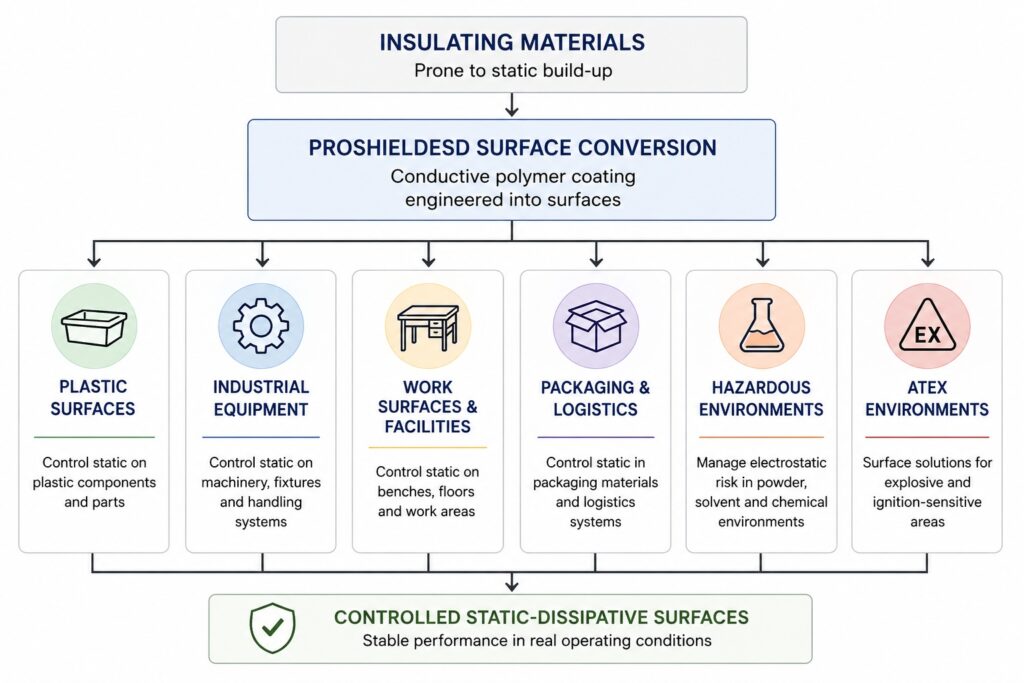
Overview of how insulating materials across multiple applications are converted into controlled static-dissipative surfaces
Solution Areas
Anti-Static Coating for Plastic
Convert insulating plastic components, housings, covers, trays and polymer parts into controlled static-dissipative surfaces without redesigning the base material.
View anti-static coating for plastic
Static Control for Industrial Equipment
Upgrade machinery, fixtures, guards, handling systems and production surfaces where static charge affects cleanliness, handling or process control.
View static control for industrial equipment
Static Control for Work Surfaces & Facilities
Upgrade benches, floors, trolleys, racks, shelves and facility surfaces where static charge affects cleanliness, handling or ESD control.
View static control for work surfaces and facilities
Static Control in Hazardous Environments
Control electrostatic risk in powder, solvent, chemical and higher-risk industrial environments where surface charge may affect safety or process stability.
View static control in hazardous environments
Explosive & ATEX Environments
Review the specialist high-risk application page for explosive, ATEX-related and ignition-sensitive environments where visible, repairable ESD control is critical.
View explosive and ATEX environments
Static Control for Packaging & Logistics
Convert cartons, foams, trays, totes, containers and handling systems into static-dissipative surfaces for transport, storage and production logistics.
Key point: Static control is rarely about changing the whole material. It is usually about engineering surface behaviour to match real operating conditions.
Where to Start
If you are unsure which route is most appropriate, start with the material, component, work surface, equipment or environment creating the issue. From there, the correct coating chemistry and application route can be selected based on substrate, wear conditions, cleaning exposure and required ESD performance.
For the wider technology overview, see the ProShieldESD coating platform. For material and process selection, review ProShieldESD chemistries. If you want SCH to coat parts or trial samples directly, see ProShieldESD subcontract coating services.
Why Choose SCH Services?
SCH Services supports practical ProShieldESD implementation across materials, components, equipment, work areas and operating environments.
- Technical support for application review and coating selection
- Trial coating and validation before wider adoption
- Support for retrofit, repair and upgrade strategies
- Experience across industrial, electronics and safety-critical environments
- Practical guidance for inspection, maintenance and verification
Disclaimer: This page provides general technical guidance only. Solution suitability depends on substrate, environment, resistance range, grounding strategy, cleaning regime, wear conditions and verification testing. Final performance must be confirmed through appropriate trials and qualification checks before use.