Why thickness variation is usually a process problem long before it becomes a measurement problem
Inconsistent coating thickness is rarely caused by one bad reading or one poor application pass.
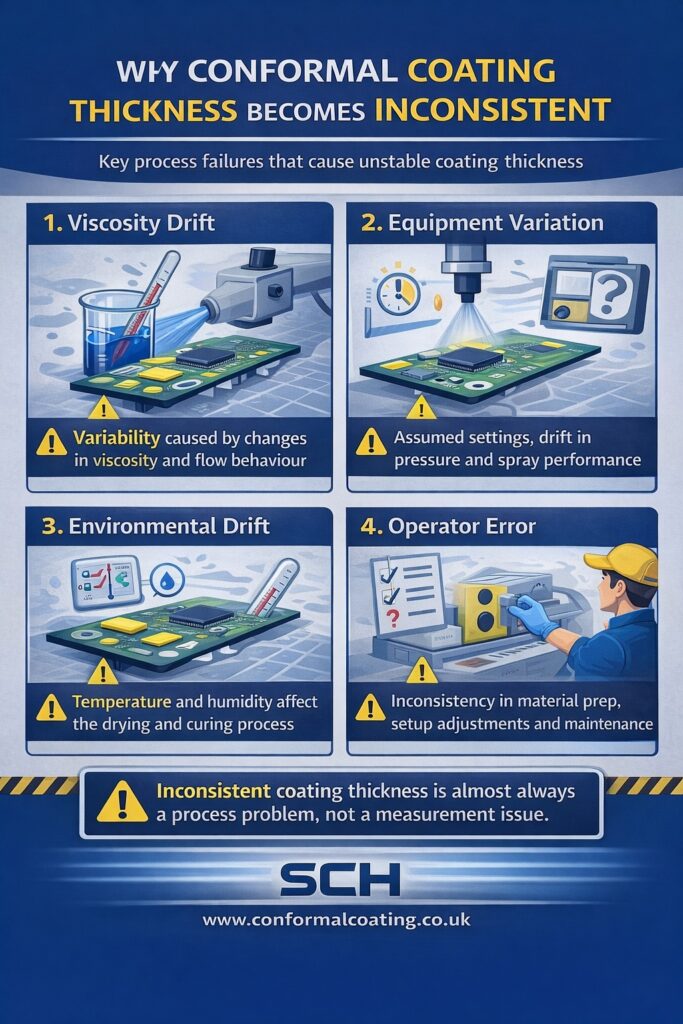
In most cases, variation is built into the process itself. Changes in viscosity, equipment condition, operator setup and environmental conditions all affect how coating behaves before any measurement is taken.
This is why many coating operations look acceptable on paper but still produce unstable results in production. To understand why thickness measurement itself is so difficult on real assemblies, see Why Measuring Conformal Coating Thickness is Difficult.
1) Thickness variation starts before inspection
A common mistake is to treat thickness inconsistency as an inspection issue.
By the time thickness is measured, the variation has usually already been created by the coating process itself. Inspection may reveal the problem, but it does not explain why the process produced it.
This matters because many corrective actions focus on checking more parts rather than stabilising the underlying process.
Key insight: If thickness is unstable, the process is usually unstable first. Measurement only exposes it.
2) Viscosity drift is one of the biggest hidden causes
Coating viscosity changes during normal use. Solvent loss, temperature variation and pot life all alter how material flows and levels on the board.
That means two assemblies coated with the same material can still show different thickness profiles if the process conditions have changed between runs.
- Higher viscosity can increase local build
- Lower viscosity can reduce edge coverage
- Flow behaviour changes across different geometries
Unless viscosity is monitored and controlled properly, thickness consistency becomes largely reactive rather than predictable.
3) Equipment settings are often assumed, not controlled
Spray pressure, atomisation quality, dispense rate, traverse speed and nozzle condition all influence final film build.
The problem is that many processes are treated as “set and forget” once a line appears to be running acceptably.
- Nozzle wear changes spray characteristics
- Pressure variation alters deposition behaviour
- Application speed changes local coating build
- Maintenance intervals affect repeatability
A process can look stable while slowly drifting out of control.
4) Operator consistency is still a major variable
Even where automated equipment is used, operator decisions still shape the process. Material preparation, setup checks, loading orientation, masking quality and acceptance decisions all affect outcome.
In manual or semi-automatic processes, the variation can be even greater.
This is why process control must be built around defined methods and repeatable conditions, not individual skill alone.
Reality check: A process that depends on operator judgement for consistency is not fully under control.
5) Environment changes coating behaviour more than many teams expect
Temperature and humidity do not just affect drying. They affect coating flow, solvent evaporation and how material spreads across surfaces.
This means the same setup can produce different results on different days, or even across different shifts.
- Temperature affects viscosity and atomisation
- Humidity can affect surface behaviour and cure response
- Local environmental drift reduces repeatability
If these variables are not controlled or at least understood, thickness variation becomes inevitable.
6) Why more measurement does not fix poor control
When inconsistency appears, the instinct is often to increase inspection. More readings may give more data, but they do not make the process more stable.
This is where many operations get trapped: they measure variation repeatedly instead of reducing the conditions that create it.
For a deeper look at the limitations of measurement methods themselves, see Conformal Coating Thickness Measurement and the related hub article on why measuring conformal coating thickness is difficult.
7) What good process control looks like
A controlled coating process is not defined by occasional acceptable results. It is defined by repeatability.
In practice, that usually means:
- Defined viscosity control and material handling
- Routine verification of equipment condition
- Consistent setup methods
- Controlled environmental conditions
- Measurement used to support process understanding, not replace it
This is why the broader Conformal Coating Processes Hub matters: thickness consistency is only one output of process control, not a standalone issue.
8) Summary
Inconsistent coating thickness is usually not a mystery. It is a sign that the process contains more variation than the measurement system can sensibly manage.
The important question is not “how many microns did we measure?” but “what changed in the process that produced this result?”
- Thickness variation is process-driven
- Measurement alone does not create control
- Stable results come from repeatable conditions
When coating thickness is inconsistent, the right place to look first is the process itself.
Related process content:
Why Choose SCH Services?
SCH Services helps customers improve coating consistency by focusing on the real causes of variation, from process design and material control to practical production support.
- 🛠️ Process-led coating strategy
- 📈 Scalable from trials to production
- 🌍 Global technical support
- ✅ Focus on real-world reliability
📞 +44 (0)1226 249019 | ✉ sales@schservices.com | 💬 Contact Us
Note: This article provides general technical guidance only. Final process settings, material controls and validation requirements should be confirmed against the specific coating, assembly and production environment.