Data Centres | ESD Protection & Surface Reliability
Reducing hidden electrostatic risk across infrastructure, packaging and handling environments
Data centres depend on uptime, reliability and controlled handling of sensitive electronics. Yet electrostatic discharge risk is often treated as a narrow compliance issue rather than a wider environmental and infrastructure problem.
At SCH, we help customers take a more practical view of ESD protection across racks, cabinets, storage areas, packaging, work surfaces and maintenance zones. Instead of relying only on temporary controls, isolated safe areas or human compliance, we support a broader strategy based on surface behaviour, implementation reality and long-term operational consistency.
For background on industry guidance, see the Electrostatic Discharge Association and IPC.
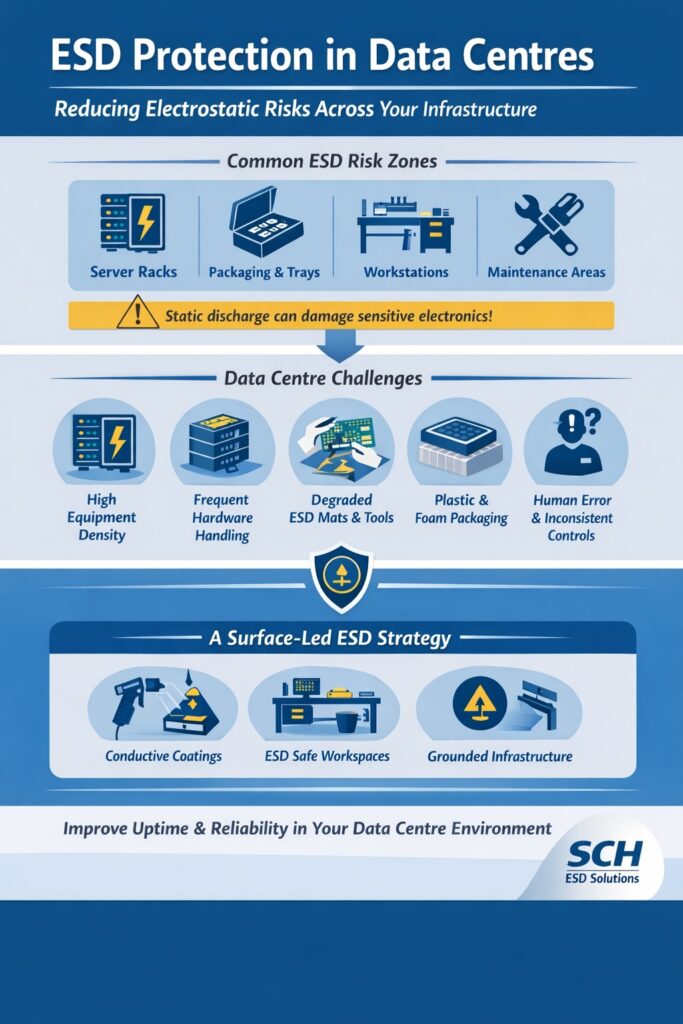
Infographic showing where ESD risk occurs in data centres and how a surface-led strategy can improve reliability across infrastructure, packaging and handling environments.
Jump Links
Data Centre ESD Protection Challenges
 Static can be generated across racks, plastics, packaging, foams and work surfaces
- High equipment density increases the consequence of small handling failures
- Maintenance activity introduces repeated contact events, tool movement and hardware swaps
- Temporary controls can degrade, wear out or be applied inconsistently over time
- Human-dependent systems are only effective when procedures are followed correctly every time
For example, many environments rely heavily on operator grounding, but as discussed in why wrist straps do not protect data centres, this does not address wider infrastructure risk.
Data Centre ESD Protection Solutions
Infrastructure & Surface Strategy
For data centres, ESD control should extend beyond wrist straps and isolated benches. A stronger approach looks at the wider environment and identifies where surfaces, storage and handling routes may introduce avoidable risk.
- Assess server racks, cabinets, shelving and support surfaces
- Review maintenance zones, staging areas and swap-out locations
- Prioritise the highest-risk surfaces first for practical implementation
Explore: Consultancy support
Packaging, Storage & Handling Protection
Sensitive electronics often spend significant time being moved, unpacked, staged, stored and serviced. This means packaging and handling materials can be as important as the live operating environment.
- Review trays, foams, totes, cardboard and protective inserts
- Reduce hidden static risk during storage, transport and commissioning
- Improve consistency across mixed-material logistics environments
In practice, hidden risks often begin earlier in the process. As outlined in packaging-related ESD risk in data centres, static exposure can occur before equipment even reaches controlled environments.
Explore: Talk to SCH
Surface Technologies Including ProShieldESD
Where appropriate, conductive polymer technologies such as ProShieldESD can form part of a wider ESD implementation strategy. The focus for SCH is on where these approaches make practical sense in real operating environments.
- Consider more durable surface protection for infrastructure and handling zones
- Reduce dependence on temporary sprays and selective safe areas
- Support broader ANSI/ESD programme thinking
Where ESD coatings are being considered for more demanding or non-static applications, it is also worth reviewing how performance changes on moving parts. See our related insight on anti-static coating on rotating fan blades.
Explore: ProShieldESD
Services & Support for Data Centre Projects
SCH supports data centre and electronics customers with practical implementation thinking, coating experience and wider reliability engineering support.
- Application review and identification of high-risk surfaces
- Support for phased retrofit or targeted implementation
- Consultancy, training and broader coating solutions support
Contact: SCH Services
Learn more about our ProShieldESD platform overview, consultancy support and training services.
Standards & Guidance (IPC / ANSI / ESD)
 ESD Association guidance and ANSI/ESD control frameworks
- IPC guidance relevant to electronics handling and assembly environments
- Internal customer specifications and reliability requirements for operational electronics infrastructure
SCH Approach to Data Centre ESD Strategy
- Review the Environment: identify where electronics move, pause, get stored and are serviced
- Map the Risk Surfaces: racks, trays, cabinets, foams, packaging and handling stations
- Select the Right Approach: decide where temporary controls, process changes or more durable surface strategies are suitable
- Implement in Phases: prioritise the most exposed or highest-value areas first
- Support Operators: align deployment with training, handling practice and site reality
- Review Long-Term Performance: monitor consistency and integrate ESD thinking into wider reliability planning
Benefits of a Surface-Led ESD Strategy
- Reduce hidden static risk across mixed-material environments
- Improve consistency beyond isolated mats, straps and temporary treatments
- Strengthen handling reliability during storage, transport and maintenance
- Support more practical long-term ESD thinking at infrastructure level
- Reduce repeated dependence on consumable or short-life control measures
Example Application
 Objective: reduce hidden ESD exposure across data centre storage, staging and maintenance environments
 Approach: review infrastructure, handling surfaces, packaging materials and potential use of durable conductive surface technologies
- Result: stronger system-level understanding of where ESD controls may need extending beyond isolated safe areas
Talk to an Expert
Next step: share your current handling environment, infrastructure challenges or ESD concerns and we can help review where a more practical, surface-led strategy may add value.
📞 +44 (0)1226 249019 | ✉ sales@schservices.com | 💬 Contact us
Related solutions: ProShieldESD · Consultancy · Training
FAQs
Is ESD risk in data centres limited to the server room?
No. Risk can also sit in storage areas, packaging, staging zones, maintenance benches and transport materials where sensitive electronics are handled before and after installation.
Can ESD protection be improved without replacing all infrastructure?
In some cases, yes. A phased review can identify where targeted changes or more durable surface strategies may improve protection without full infrastructure replacement.
Where does SCH fit compared with the ProShieldESD website?
ProShieldESD focuses on the technology platform. SCH focuses on application, implementation, consultancy and how these approaches may be used in real operating environments.
To understand how these issues combine, see our full breakdown: Why ESD Protection Fails in Data Centres.
Why Choose SCH Services?
Partnering with SCH Services means more than simply discussing products — you gain a practical implementation partner for ESD protection, surface reliability and wider coating solutions, backed by decades of hands-on industrial experience.
- ⚙️ Application-Led Thinking – We focus on how ESD risks appear in real environments, not just how products are described on paper.
- 🛠️ Implementation Support – Guidance on priorities, surface strategy, packaging risk, handling areas and phased deployment.
- 🧪 Coating & Surface Expertise – Broader experience across conformal coatings, Parylene, functional coatings and reliability-driven surface solutions.
- 🎓 Consultancy & Training – Support for customers who need practical guidance rather than product-only supply.
- 🌍 Global Support Model – Technical reach across the UK, Europe, North America and Asia through the wider SCH ecosystem.
📞 Call: +44 (0)1226 249019
✉ Email: sales@schservices.com
💬 Contact Us ›
Disclaimer: This page provides general technical guidance only. Suitability, compliance and final implementation decisions must be validated against the specific equipment, materials, operating environment, ESD control requirements and applicable standards relevant to the end use.