Parylene Adhesion: Causes of Failure & Solutions
Understanding adhesion mechanisms and how to prevent coating delamination
← Back to the Parylene Basics Hub
Parylene coatings provide excellent environmental protection for electronic assemblies, sensors and precision components. However, like all thin-film coatings, long-term performance depends heavily on adhesion to the underlying substrate.Adhesion failures can lead to coating delamination, blistering or peeling, compromising protection and potentially allowing moisture or contaminants to reach sensitive components.
Understanding the root causes of adhesion failure helps engineers design reliable coating processes and select appropriate cleaning, surface preparation and adhesion promotion methods.
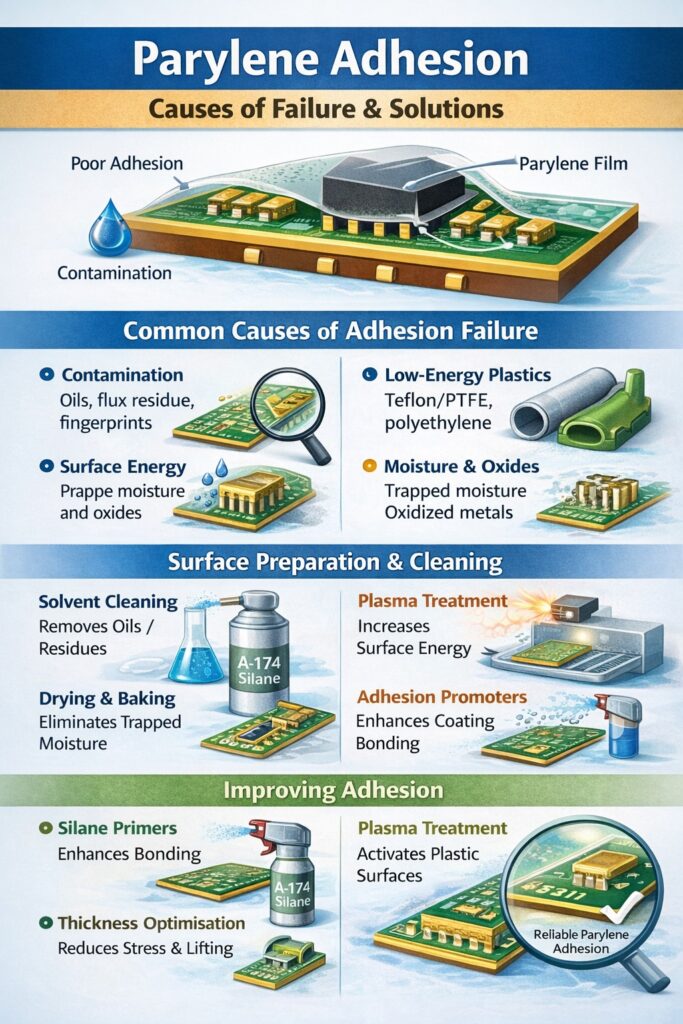
Engineering infographic illustrating common causes of parylene coating adhesion failure and practical solutions including cleaning, plasma treatment and A-174 silane adhesion promoters for electronics and PCB assemblies.
How Parylene Adhesion Works
Unlike liquid coatings, Parylene does not chemically bond strongly to most materials by default. Instead, adhesion relies on a combination of:
- Mechanical interlocking with the microscopic surface structure
- Surface energy compatibility between the substrate and polymer film
- Adhesion promoters such as silane coupling agents
- Clean, contaminant-free surfaces
The vapour deposition process itself is explained in more detail in the Parylene Deposition Process Parameters guide.
Because the film is extremely thin, even small surface contamination can prevent proper adhesion.
Common Causes of Parylene Adhesion Failure
Most adhesion problems originate from surface preparation or substrate compatibility.Typical causes include:
- Surface contamination such as oils, flux residues or fingerprints
- Low surface energy plastics including PTFE, polyethylene and polypropylene
- Moisture trapped in assemblies prior to coating
- Improper adhesion promoter application
- Oxidised metal surfaces
- Incompatible substrate finishes
Adhesion failures are often first visible as:
- blisters or bubbles
- lifting around edges
- coating separation under components
- film peeling after environmental exposure
Surface Preparation for Reliable Adhesion
Effective surface preparation is the most important step in preventing adhesion failure.Typical preparation steps include:
- Solvent or aqueous cleaning to remove oils and residues
- Controlled bake cycles to remove absorbed moisture
- Plasma treatment to activate low-energy surfaces
- Adhesion promoter application using silane coupling agents
Plasma treatment should not be treated as a generic preparation step. Oxygen, argon, nitrogen and mixed-gas plasma processes can produce different cleaning, activation, oxidation and surface modification effects. For a deeper explanation, see How Plasma Gas Chemistry Changes PCB Surface Preparation Before Parylene.
These steps are particularly important for complex electronic assemblies such as Parylene-coated PCBs where contamination may be trapped beneath components.
Adhesion Promoters for Parylene Coatings
The most commonly used adhesion promoter for Parylene coatings is A-174 silane.This coupling agent forms a molecular bridge between the substrate surface and the Parylene polymer film.
Benefits include:
- improved bonding to metals and ceramics
- better adhesion to glass and PCB solder masks
- reduced risk of environmental delamination
Correct application is critical and usually involves:
- vapour phase deposition
- spray application
- controlled hydrolysis and drying
Material Compatibility Considerations
Some materials are naturally easier for Parylene to adhere to than others.Good adhesion is typically achieved on:
- metals
- ceramics
- glass
- most PCB solder masks
More challenging materials include:
- PTFE and fluoropolymers
- polypropylene
- polyethylene
- silicone elastomers
These substrates often require plasma activation or specialised primers before coating.
Environmental Factors Affecting Adhesion
Even when initial adhesion appears good, environmental stress can expose weaknesses.Common environmental stress factors include:
- thermal cycling
- humidity exposure
- salt fog environments
- chemical exposure
Correct thickness selection can also improve long-term reliability. Guidance is provided in the Parylene Thickness Specification Guide.
Testing and Verifying Adhesion
Adhesion performance can be verified using several methods:
- cross-hatch adhesion testing
- environmental stress testing
- thermal cycling
- humidity exposure tests
Thickness verification is also important when validating coating quality. See the Conformal Coating Thickness Verification guide.
Frequently Asked Questions
Why does Parylene sometimes peel from surfaces?
Parylene adhesion problems are usually caused by surface contamination, poor cleaning, trapped moisture or incompatible substrate materials. Proper surface preparation and adhesion promoters significantly reduce these risks.
Do Parylene coatings require primers?
Many applications benefit from adhesion promoters such as A-174 silane. These improve bonding between the Parylene polymer film and the underlying substrate.
Can plasma treatment improve adhesion?
Yes. Plasma treatment increases surface energy and removes contamination, making it particularly useful for low-energy plastics.
Does coating thickness affect adhesion?
Yes. Very thick coatings can introduce mechanical stress during thermal cycling. Selecting an appropriate thickness improves long-term reliability.
Which materials are most difficult for Parylene adhesion?
Fluoropolymers, polyethylene and silicone surfaces are among the most difficult substrates and often require specialised preparation.
Why Choose SCH Services?
Partnering with SCH means gaining a complete, integrated platform for Parylene and conformal coating—services, equipment, materials and training—built around process control and repeatability.
- ✈️ 25+ Years – trusted worldwide
- 🛠️ End-to-End Support – coating, masking, validation and inspection
- 📈 Scalable Solutions – prototypes to steady production
- 🌍 Global Reach – support across Europe, North America and Asia
- ✅ Process Control – traceability, coupons and inspection discipline
📞 Call: +44 (0)1226 249019 | ✉ Email: sales@schservices.com | 💬 Contact Us ›
Fast links: Parylene Coating Services | Parylene Training & Support | Parylene Equipment