Static Control Coatings for Hazardous Environments
Reducing Static Charge Risks on Equipment Surfaces in Sensitive Industrial Areas
Static electricity can present a serious risk in environments where flammable gases, vapours or combustible powders may be present. In these situations, electrostatic discharge events can potentially act as an ignition source if charge accumulates on insulating surfaces.
Static control coatings provide a practical engineering method to reduce charge accumulation on equipment surfaces. By applying conductive polymer coatings to insulating materials such as plastics, composites or painted metal surfaces, equipment can be upgraded with controlled static-dissipative behaviour while retaining the original design and structure.
In most ESD control applications the aim is a stable static-dissipative surface rather than a highly conductive finish. Where ATEX-related considerations apply, ProShieldESD should be viewed as a surface-engineering tool that may support static control performance and qualification work, not as a standalone certification claim.
Learn more about the ProShieldESD coating platform, the underlying filler-free ESD coating technology, our comparison page on conductive coatings vs conductive plastics, the broader page on anti-static coating for plastic and our overview of ESD coating.
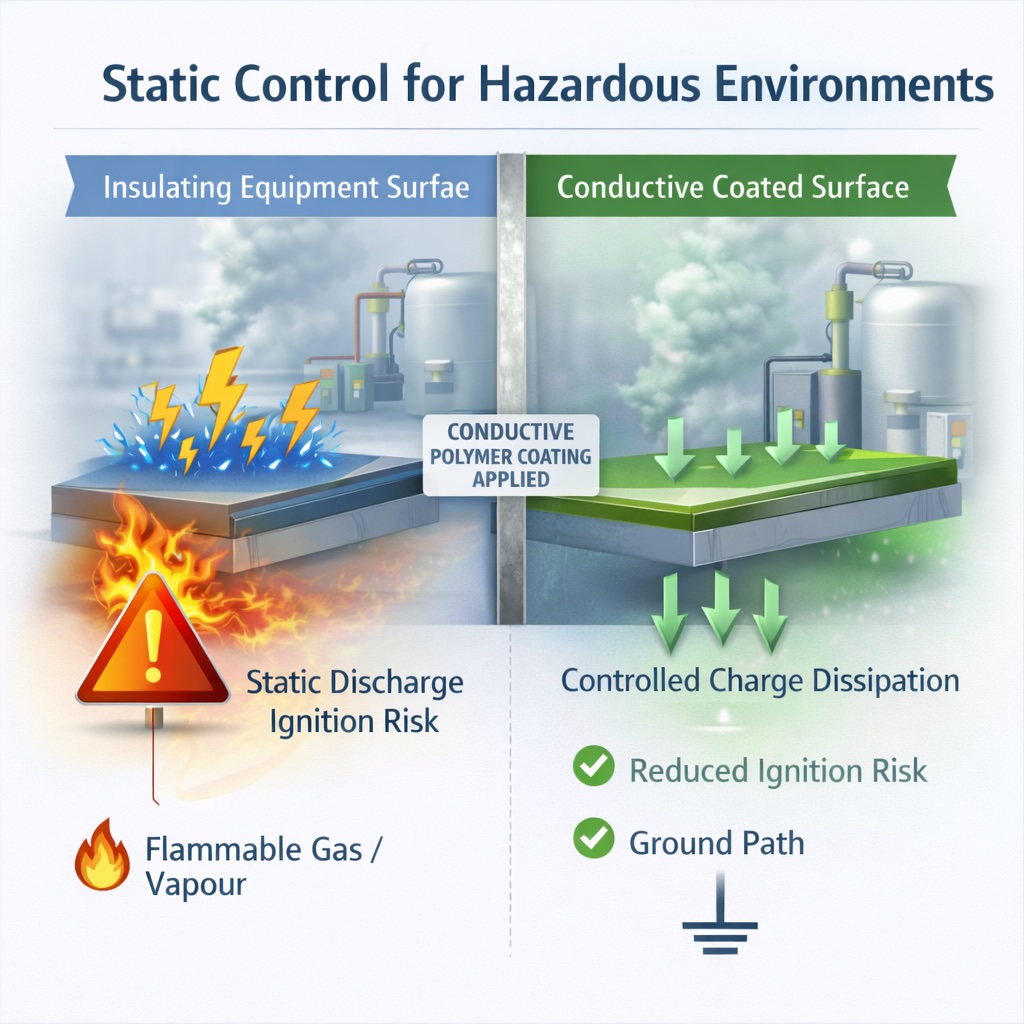
Infographic showing how conductive polymer coatings help reduce electrostatic discharge risks on equipment surfaces used in hazardous environments.
Where Static Risks Can Occur
Electrostatic charge can accumulate on insulating materials during normal industrial operation through airflow, material handling, friction and process movement.
- Ventilation and air handling systems
- Powder processing and transport equipment
- Chemical processing machinery
- Polymer ducting and filtration housings
- Plastic equipment covers and insulated machine surfaces
- Conveyors and material handling equipment
Where insulating materials are used in these environments, static charge can accumulate if there is no controlled pathway for dissipation.
Why Static Control Is Important in Sensitive Environments
In facilities where combustible materials or vapours may be present, uncontrolled electrostatic discharge can potentially introduce ignition risks. For this reason, controlling charge accumulation on surfaces is an important design consideration in many industrial systems.
- Static charge may accumulate on insulating surfaces.
- Discharge events can occur if charge levels become high enough.
- Insulating materials may prevent natural dissipation.
- Equipment surfaces can become static hotspots.
Engineering strategies for static control often involve grounding, material selection and surface conductivity management. In ATEX-related or other hazardous environments, coatings should be assessed as part of the full equipment design, grounding strategy and application-specific qualification route.
Using Conductive Polymer Coatings for Static Control
Static control coatings provide a way to introduce controlled surface conductivity to insulating materials used in industrial equipment. Instead of redesigning equipment using specialist conductive plastics, a conductive polymer coating can be applied to appropriate surfaces to create a controlled dissipative pathway.
ProShieldESD uses conductive polymer technology to produce stable surface conductivity without relying on conventional filler-loaded coatings. In many hazardous-area-related applications, this means creating a controlled static-dissipative surface rather than a highly conductive coating.
To understand the underlying technology, see the ProShield conductive polymer technology platform, learn more about filler-free ESD coating technology, compare the options in our guide to conductive coatings vs conductive plastics, explore the broader surface-upgrade route in our page on anti-static coating for plastic and read the main overview of ESD coating.
Typical Surface Resistivity Range
Static control coatings used in industrial environments are typically designed to produce static-dissipative surfaces rather than highly conductive ones. Typical target resistivity values are in the range of 106 – 109 Ω/sq. This resistivity range allows charge to dissipate in a controlled manner while avoiding rapid discharge behaviour associated with highly conductive materials.
Example Applications
- Air handling systems and ventilation fans
- Powder transport equipment and ducting
- Filtration housings and process enclosures
- Polymer covers and insulated machine surfaces
- Conveyors and material handling systems
In these applications, coatings can help reduce static build-up on insulating equipment surfaces. Related applications can also be found in our pages on ESD coating, anti-static coating for plastic and static control for industrial equipment.
Engineering Considerations
- Surface preparation and adhesion must suit the substrate.
- Resistivity should align with the overall static control strategy.
- Grounding arrangements should be evaluated where relevant.
- Environmental exposure and durability should be assessed.
- Coating chemistry must match operational conditions.
- Application suitability should be reviewed as part of overall equipment qualification where ATEX-related considerations apply.
Proper engineering evaluation helps ensure stable static control performance in demanding environments.
Need Static Control for Sensitive Environments?
If your equipment operates in environments where static charge could present a risk, conductive polymer coatings may provide a practical way to introduce controlled surface conductivity.
Our engineering team can review your equipment materials, operating environment and process conditions to determine whether static control coatings are appropriate and how they may support wider performance and qualification work.
Improve static control without redesigning equipment.
Related Static Control Applications
Useful Links
- ProShieldESD Overview
- What Is an ESD Coating?
- Introduction to ProShieldESD
- Anti-Static Coating for Plastic
- Conductive Coatings vs Conductive Plastics
- Static Control for Industrial Equipment
- Where ProShieldESD Can Be Used
- Chemistries & Available Formats
- Outsourced Coating Services
- FAQs – Learn More About ProShieldESD
Why Use ProShieldESD for Static Control?
- ✅ Stable conductivity through conductive polymer technology.
- ✅ Surface upgrade approach rather than full equipment redesign.
- ✅ Flexible application across plastics, composites and coated metals.
- ✅ Suitable for complex equipment surfaces where conductive plastics are impractical.
- ✅ Engineering-led evaluation for real industrial conditions.
Static control coatings can help improve electrostatic management across equipment used in sensitive industrial environments. In many cases that improvement is delivered as a controlled static-dissipative surface created using conductive polymer technology, rather than as a highly conductive finish. Where hazardous-area qualification matters, the coating should be considered as one part of the broader engineering and assessment process rather than as a standalone certification claim.